30 Earth Day captions to celebrate the planet we love.
Purposeful, playful, and ready to pair with your best Earth Day designs.
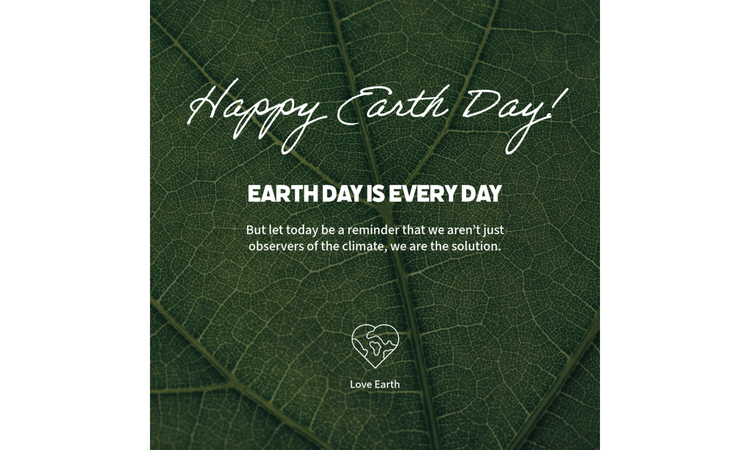




Make your Earth Day captions count.
The right caption turns a nice Earth Day post into something that doesn’t just stop the scroll. It makes your audience think and encourages meaningful conversations about our planet. Whether you’re designing a community poster or putting together a compelling social media graphic for April 22, the words you choose set the tone for everything else. Follow along as we explore 30 Earth Day captions and how you can bring them to life with Adobe Express.
Simple and direct Earth Day captions that stick.
The most effective and thought-provoking Earth Day captions usually aren’t the most complex or poetic. They’re pretty candid and easy to digest. They’re also easier to remember and tend to have better engagement rates. They remove friction, so there’s no need for people to decode anything or overthink things.
Note that this depends on what your goal is. For example, if you want to grab attention from the get-go, short captions with strong hooks work, while longer captions are perfect for telling your story — so keep that in mind when designing Earth Day captions.
These Earth Day captions offer clear ideas that immediately connect with your readers, making them especially useful for posters, awareness campaigns, and social posts in both digital and printed forms.
Try this: You can turn these Earth Day captions into high-visibility designs using the flyer maker or combine multiple ideas to craft a stunning visual story using the photo collage maker. You could also explore remixable social media templates that you can personalize by adding your own imagery and favorite Earth Day caption until you get a result that matches your style or brand.
Other creative projects you can try to pair with these Earth Day captions include announcement posters for Earth Day lectures and motivational posters you can frame and display at home. These captions can also work on donation flyers for Earth Day donation drives. For businesses, you can add these to banners advertising special offers for Earth Day.
recipe
Light and cute Earth Day captions that don’t lose their meaning.
Cute Earth Day captions are often dismissed as less impactful because of their playful and upbeat tone, but they can be surprisingly effective when used intentionally. Their strength lies in approachability because that same playful tone lowers resistance, making your message feel more like a friendly reminder instead of a stern lecture.
The challenge now is how to keep these cute Earth Day captions from feeling shallow. One way to do that is by pairing these captions with imagery that gives them weight and makes them unforgettable. They’re also the perfect accompaniment to bright and expressive visuals.
The free and beginner-friendly tools from Adobe Express, such as the flyer maker and photo collage maker, offer templates with bold palettes that suit the energy of these cute Earth Day captions versus muted, minimalist aesthetics.
Try this: These captions are also ideal for creative projects that feel personal or interactive, such as cards, letters, or banners. Pair them with visuals that reinforce a message to take your captions further. A clean layout works well for these captions because they let your words and design take center stage. When it comes to colors, leverage color psychology to make your design more impactful. The free color palette generator lets you build custom palettes you can use for all your Earth Day-related creative projects.
If you think infographics are boring, try incorporating these cute Earth Day captions as your tagline. Paired with charming graphics, they’ll make for showstopping designs that’ll pique your audience’s curiosity and make them want to check out your infographic. The free infographic maker from Adobe Express is a beginner-friendly tool that lets you design beautiful infographics in minutes. Explore professionally designed infographic templates or start your design from scratch.
recipe
Celebratory happy Earth Day captions to bring people into the message.
April 22 deserves to be celebrated, and these happy Earth Day captions capture that positivity and feelings of hope for our planet. These captions are often used for announcements or campaigns. They’re basically ideal for informative events that also encourage participation. Done well and paired with intentional design, these happy Earth Day captions can set the tone for how people engage with the day.
Having attention-grabbing visuals is important when designing posters or banners featuring happy Earth Day captions, but don’t forget about the caption and a compelling call to action. You can use your own photos or illustrations and experiment with colors to make your design come alive.
Try this: What makes these captions effective is their ability to create a sense of collective action. According to the World Economic Forum, collective action that brings together different perspectives and expertise, especially among leaders, can be an important factor in “building climate resilience.”
They work best when they’re tied to something specific, such as an event or initiative. Create a sense of urgency and make your Earth Day captions more impactful by including a time-based action and reinforcing it with consistent visuals.
If you’re printing your designs, this is a great opportunity to practice what you preach. This means printing on eco-friendly paper and choosing sustainable inks like water-based or soy-based inks. The Forest Stewardship Council highlights seven types of eco-friendly paper, including bamboo paper and seed paper, which are worth looking into. Go local and work with local printers to minimize transportation pollution.
recipe
How to turn one caption into multiple pieces of content.
Most people tend to write multiple Earth Day captions when they could be getting more value from one strong idea. This guide shows you how you can reuse your favorite or strongest captions without sounding like you’re repeating yourself.
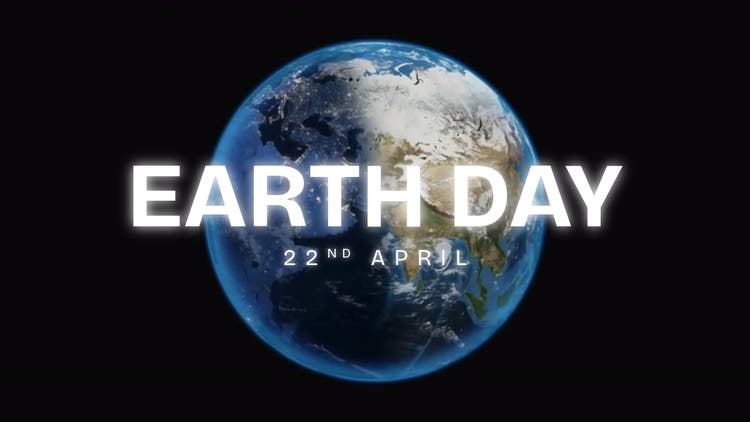
The beauty of this is that you don’t need to come up with a new caption every time. You can change the tone to create variations in your message.
For example, if you want something casual, stick to the original “Small actions, big impact.” For something more direct, try something like “Small actions, big impact. Start today.” For a caption with a more encouraging tone, this could work: “Small actions, big impact. You don’t need to do everything all at once today. You just need to start small.”
Common mistakes that weaken your Earth Day captions (and how to fix them).
Most Earth Day captions don’t fail because they’re wrong but because they’re generic and performative. They sound familiar, look like everything else in the feed, and don’t give people a reason to pause, reflect, or act. If your goal is to create something that sticks, you need to understand where captions lose their impact.
1. Writing for approval instead of clarity.
A lot of captions are written to sound “right” rather than to say something meaningful. Phrases like “save the planet” or “protect our earth” are safe, but they don’t give the reader anything to hold onto.
Why this matters:
When a caption feels generic, your audience might classify it as background noise. It doesn’t trigger attention or memory.
How to enhance it:
Anchor your caption in something specific or observable.
- Before: “Protect the earth.”
- After: “Protect the earth by being more intentional with how you shop.”
That slight shift turns a broad idea into something more realistic and actionable, and makes your audience think “Hey, I can actually do this” instead of “So what?”
2. Treating captions as an afterthought.
People often design the visual first and then quickly add a caption at the end. That disconnect shows. The words and the design don’t reinforce each other.
Why this matters:
Strong communication happens when text and visuals work together. If they feel separate, the message loses clarity. Then there’s the Picture-Superiority Effect, which suggests that people tend to remember visuals better than words. Designing imagery, particularly literal images versus abstract ones, that complements your Earth Day captions can strengthen your message’s memorability and help with comprehension, reported the Nielsen Norman Group.
How to enhance it:
Start with the caption, then build the design around it. For example, you can use a bold, minimal layout for short captions, or choose layered text or spacing for longer ones.
Tools like the beginner-friendly poster maker work best when the caption is treated as the centerpiece instead of filler.
3. Over-explaining the message.
There’s a tendency to add too much context in an attempt to sound meaningful. While it’s not wrong, this can weaken the impact of your caption.
Why this matters:
Captions work best when they leave a small gap for the reader to fill in. Over-explaining removes that engagement.
How to enhance it:
Trim your caption until only the strongest idea remains.
- Before: “We should all take better care of the environment because it affects future generations.”
- After: “Love your planet, it’s the only one we’ve got.”
4. Ignoring the format the caption lives in.
A caption that works on Instagram may not work on a poster or a flyer.
Why this matters:
Each format has a different reading behavior. For instance, social posts are better for quick scanning, while posters are great for maintaining readability even at a distance. Flyers are perfect for sharing layered information.
How to enhance it:
Adapt the caption to the format, not the other way around.
- Short, bold lines for posters
- Slightly longer phrasing for captions under images
- Structured text for flyers using the easy-to-use flyer maker.
5. Not giving the reader a next step.
Many Earth Day captions stop at awareness. They don’t guide the reader toward action. This matters because awareness without direction rarely leads to behavior change.
How to enhance it:
Add a subtle, easy-to-follow next step:
- “Use less plastic today.”
- “Start with one small change.”
Even a minimal call-to-action increases the usefulness and actionability of your Earth Day caption.
Creative ways to use Earth Day captions beyond social media.
Go beyond posting online and turn your Earth Day captions into real-world touchpoints.
If you’re only using these captions for social posts, then you’re limiting their reach and lifespan. The strongest content works across environments, whether it’s digital or physical. The ideas below can help you turn a single caption into something people can see and want to interact with.
1. Turn captions into micro-campaign posters.
Instead of creating one-off designs, build a small series of posters using different captions. To start, choose 3–5 captions with a similar theme and use consistent colors and typography. Display them together in a space or across multiple posts. You can design this using the free poster maker from Adobe Express. This works because repetition with variation builds recognition. People start associating the message with a visual identity.
2. Use captions as conversation starters in cards.
Earth Day cards don’t have to be formal. You can use them as prompts to encourage your audience to come up with their own unique solutions or start meaningful conversations with them. Open the online card maker and place your Earth Day caption on the front. Add a question inside, such as “What’s one thing you’ll change this week?” or “Which steps are you already taking for the planet?” This works because it turns a passive message into an active reflection without sounding too preachy.
3. Build educational collages for storytelling.
Instead of featuring one caption per image, try combining multiple Earth Day captions into a narrative. Using the Adobe Express photo collage maker, pair each caption with a related image. Then, arrange them in a sequence, such as problem to action to outcome. This is an effective technique because it creates context. The captions feel connected rather than isolated.
4. Turn captions into event-driven flyers.
Use captions as headlines for real initiatives like community cleanups or recycling drives. Open the flyer maker and use an Earth Day caption as the design’s top line. Add event details below, while keeping the layout clean and readable. This works because it bridges awareness and action in a single format, instead of having multiple, separate collaterals for all your Earth Day-related activities.
5. Create digital banners for ongoing campaigns.
Use one strong caption as a repeating visual anchor. With the banner maker, use the same caption across multiple banners, editing your main design slightly to create variations that are still anchored by a familiar, uniting design element. This works because consistency builds familiarity, which increases recall.
Earth Day captions made meaningful with Adobe Express.
Earth Day captions are relatively easy to write but harder to make meaningful. The difference comes from how you design them and where you place them with intention. When you treat each caption as a flexible idea rather than a one-time post, it becomes something more durable. By combining clear messaging with thoughtful design using Adobe Express, you can turn simple captions into tools that engage and stay relevant beyond a single moment.
Discover more you might like.
You might also like...