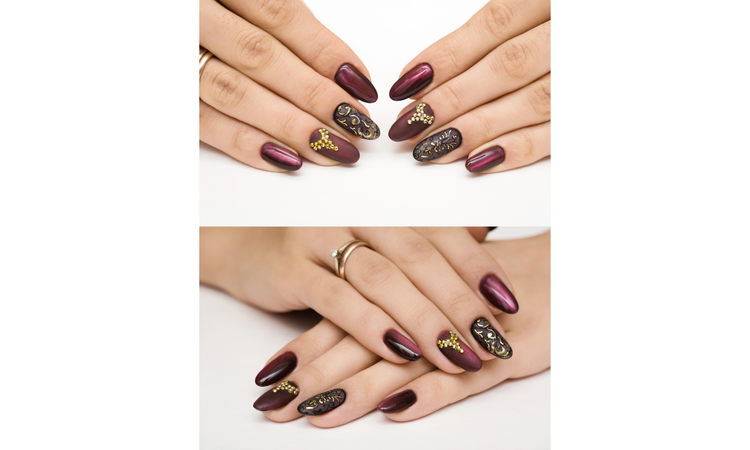
There are two things you can expect from a French set: a clean base and a defined tip. It’s straightforward, which is part of why it works. If plain white feels too expected, swap it for soft pink or muted sage. It keeps the structure, but shifts the mood.
Ombré is good to play with if you’re into colors. A nude to milky fade keeps things sophisticated. Coral to hot pink shade leans more playful. Choose a tone that sits close enough together to have a clean blend. For the right color pairing, use a
poster maker and arrange them by shade family. Grouping the colors shows if you prefer warm or cool tones.
Having a floral design on every nail can be overstimulating. Floral accents are better, like a single bloom near the cuticle or a detailed vine on another. Skip dense floral patterns, especially on shorter nails, where details crowd quickly. Pick one main color and let the others sit quieter so the design doesn’t fight itself.
Glazed acrylic nails catch light when you’re close, adding more dimension to the design. Milky white glaze feels clean and chic, while chrome glaze adds edge without committing to full metallic.
Straight lines, angled color blocks, and negative space designs require precision. Geometric acrylic designs look sharper on longer nails since there’s space for the pattern. To keep the palette tight, go for two or three colors max.
Uneven vein is the key to a great marble acrylic nail set. Marbles aren’t symmetrical, so your nails shouldn’t be either. For a classic look, choose white and gray. For a richer variation, try chocolate brown, navy, or deep green. Since marble already has a lot going on, use it on two or three nails and leave the rest solid.
A thin gold French tip or a narrow silver stripe across the center is usually enough to give the set a bit of shine. These make the set dressier without switching to a fully reflective finish.
This is where you can be as bold and as “extra” as you want. Think of swirls, layered color patches, and brushstroke effects. You can incorporate different trends in a single set. To avoid overloading the nails, sketch rough placements of your design, use an
image editor, and modify the elements with a layout tool.
Minimalist acrylics focus on restraint. Do a single thin line, tiny dot clusters, or a matte topcoat over nude acrylic. These intentional designs often age better over the two-week wear window because they don’t rely on heavy details.
This is the elevated version of a standard nail set design. It can be as simple as adding glitter on the ring finger or a muted geometric detail on the thumb. To choose which finger should carry the design, test placements digitally. Duplicate your base design and add the accent to different positions.
If you’ve locked in two to three acrylic nails ideas, remove the background from those saved images for easier comparison. This enables you to isolate just the design. Place those clean versions into the same layout so you can assess the details without the light or angle differences influencing your choice.
Some would think short nails are a limitation, but they’d be wrong. Short acrylic nails ideas just mean you have to be more intentional with the proportion and contrast of your design.
Beige or muted taupe on short nails feels considered. They’re not plain or basic, just steady. To pick the right neutral, drop the screenshots into a
photo collage maker and look at them side by side in one frame. It’s easier to notice the undertones when they’re sitting next to each other.
A thin French tip does the job without taking over the whole nail. On shorter lengths, thick tips can crowd the nail bed fast. If your shape leans rounded or squoval, the softer curve keeps the line from looking too sharp or boxed in.
Short nails painted in lavender, powder blue, or muted peach make sense, especially in spring. If you’re stuck between a few options, scroll through soft-toned
card templates to give you color pair ideas that feel seasonal without being overly sweet.
Glossy nude on short acrylics grows out better – and cleaner – than darker polish. To still have a definition, pick a shade deeper or lighter than your skin tone.
This design can give you an illusion of longer nails without the hassle of having them. Thin vertical lines can subtly elongate the nail. For a sharper look, add an off-center stroke in one to two nails.
Again, off-center is the key here. The slight shift keeps the flower from looking stamped on. Even one tiny bloom off to the edge can change the whole feel of the set.
The operational word here is subtle. Too much glitter will make short nails look dense. A light fade at the tip or a thin glitter outline looks better.
Shorter nail lengths benefit from a darker polish, like black, burgundy, or navy. The darker tone creates a polished, dramatic look.
Keep the fade soft. If there’s a clear line across the middle, the nails will look chopped in half. Choose colors that blend more naturally than a pale shade fading into something very dark.
One narrow stripe near the edge or a small, angled block closer to the cuticle usually works better than centering it. Placement matters more than size on short nails. One narrow stripe or a small angled block feels structured. If the shape sits too wide across the middle, the nail can start to look stubbier than it is.