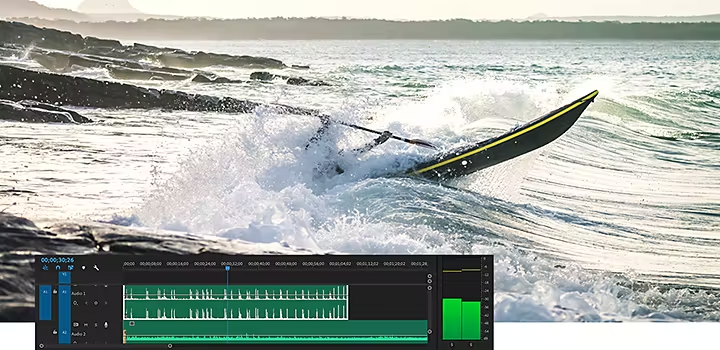
Sound effects are an often overlooked yet essential part of any video.
Find sound effects for free on Adobe Stock or create your own.
Add multiple layers of sounds to any video using Premiere.
layout
1 | 2
style
Two up, xl-spacing
What are sound effects?
Most people know that sound effects (sometimes shortened to “SFX”) are any audio a viewer hears that doesn’t come from the video recording itself. But what many might not realise is that, while on-set microphones pick up things like dialogue, filmmakers add all other audio in post-production. Films, TV and video games would be quite unsettling without these externally created sounds.
Sound effects can be anything from the ambient sounds of the wilderness to the loud whoosh of an aeroplane. Whether they’re almost deafening or nearly imperceptible, they’re always the result of careful creative work.
Here’s a brief rundown of the different types of sound effects and how to add accurate and convincing audio effects to your video in Adobe Premiere.
Types of sound effects.
When it comes to professional sound design and editing, audio and sounds are grouped into four major categories.
1. Isolated sounds are normal, everyday noises that you hear in daily life. Car beeps, barking dogs and jackhammers in a busy city are all isolated sounds. Isolated sound effects are usually easy to find in sound effect libraries and if you want something basic, like the sound of a door closing, royalty-free collections of audio clips will almost certainly have what you’re looking for.
2. Speciality effects are new sounds created especially for a production. Speciality effects are especially popular for fantasy and sci-fi. A dragon’s roar or the low hum of a lightsaber are not sounds that exist in the real world, so they have to be created.
3. Foley sounds, like speciality effects, are created specifically for a production. Often, Foley artists will time their sounds to whatever is happening on screen. If a character is walking through gravel, a Foley artist will record themselves doing the same, timing their steps with the character on screen. Foley effects are named after Jack Foley, an early sound effects designer who worked during the first years of sound filmmaking.
4. Ambience is the background sound of a given environment. The background noise of a city street is different from the background noise of a forest, which is different from the background noise of an office building. Every scene requires background ambience, otherwise it risks sounding unnatural. Sometimes you’ll have to remove background noise from an existing recording before adding background noise of your own.
Create everything from social clips to feature films.
Other styles of sound effects.
These are some common categories of both isolated and speciality sound effects.
Glitch sound effects emulate malfunctioning technology, like scratchy analogue tape, skipping records or CDs, radio static or software bugs. A glitch effect can convey the feeling that the recording itself is damaged or decayed.
Cartoon sound effects are comic and often whimsical SFX that create a sense of heightened unreality. Bonks when someone gets hit on the head with a giant mallet, sad trombone sounds, slide whistles while falling, evil laughs and violin scrapes can all help a viewer believe that they’ve gone to Toontown.
Trailer sound effects are common in promos for films and video games. Whooshes, impact sounds, rumbles and other effects provide a sense of action and dynamism, especially during transitions.
Hard and soft sound effects.
In addition to the above categories, sound professionals broadly group SFX into “hard” and “soft” categories. Hard sound effects need to be synchronised with something on screen. For instance, dialogue needs to match a person’s lip movement and the sound of a door slamming needs to synchronise with an on-screen slamming door.
“Soft” sound effects don’t need to be synchronised with anything on screen. Ambient noise and music, for example, usually don’t need to be exactly synchronised with action on screen.
Sources for sound effects.
There are two major ways to get sound effects for a production: Create them or license them. Most larger productions will create sound effects in-house, employing a Foley artist to create customised effects that match the needs of their media.
Smaller productions, though, usually rely on existing resources. Many original sound effects are archived in a sound effects library or bundled into a sound effects pack sold for commercial use. If you don’t have the budget for original sound, plenty of websites offer free, high-quality sound effects under a Creative Commons licence, along with other resources like royalty-free music.
How to add sound effects to complex projects.
Before adding any sound effect to a video project, a sound editor should go through the script a few times, talk to the director and create a cue sheet to indicate when given sound effects will appear on the soundtrack. Follow this tutorial to add sound effects to video in Premiere.
1. Drag and drop your sound effects into the Essential Sound panel to upload them.
2. Tag each sound effect. The Essential Sound panel allows you to label each sound effect accordingly with tags like “ambience,” “room tone,” “footsteps” or “dialogue.”
3. Make sure every sound effect fades in and fades out. Everything on the soundtrack needs to fade, even if that fade is only for a portion of a second. Abrupt cuts in sound can have a deliberate aesthetic purpose, but otherwise they tend to sound unnatural.
4. Adjust the volume. Make sure all sound effects work with each other and work in concert with dialogue and music tracks.
Layering sound effects.
Sound effects need to be layered to be realistic. When you’re in a restaurant, all at once you’ll hear the sounds of the kitchen, the music playing over the speakers and the person talking to you from across the table. You can also think of layering sound effects as filling the audio space. You should layer low-frequency sounds with mid- and high-frequency sounds for rich, well-rounded audio that covers all the bases.
Low-frequency sounds are deep and harder to make out, like traffic noises or the scuffle of footsteps and chairs sliding toward and away from a table.
Mid-frequency sounds are more clear and medium-toned like the chatter of people talking.
High-frequency sounds are sharper and higher in tone like a siren or the clinking of silverware.
Take your sound effects further.
Premiere outfits you with all the tools you need to edit video on desktop and mobile. Add sound effects, music, visual effects and everything you need to make your videos come to life.
You can control how Adobe websites use cookies and similar technologies by making choices below. But note that if you disable cookies and similar technologies entirely, Adobe websites may not function properly.
Cookies are small text files stored by your web browser when you use websites. There are also other technologies that can be used for similar purposes like HTML5 Local Storage and local shared objects, web beacons, and embedded scripts. These technologies help us do things like remembering you and your preferences when you return to our sites, measure how you use the website, conduct market research, and gather information about the ads you see and interact with.
You can make choices in the menu below about what cookies and other technologies you want us to use on Adobe sites when you visit them from this browser. You can always change those choices later by clicking on the Cookie Preferences link at the bottom of the page.
If enabled:
We can improve your experience by tailoring the site and the content to things we think might be of interest
We can better keep track of your preferences — like what language you prefer to use
We will better understand your likely interests so we can provide you more relevant Adobe ads and content on non-Adobe websites and in non-Adobe apps
It will help us improve the performance of our website and those of our partners who use the Adobe Experience Cloud
If disabled:
We won’t be able to remember you from session to session so the experience may not be tailored to your interests
You’ll still have access to the content of the site but certain features that depend on cookies may not function
You’ll still see ads, they just may not be as relevant to you
General information
You can control how Adobe websites use cookies and similar technologies by making choices below. But note that if you disable cookies and similar technologies entirely, Adobe websites may not function properly.
Cookies are small text files stored by your web browser when you use websites. There are also other technologies that can be used for similar purposes like HTML5 Local Storage, web beacons, and embedded scripts. These technologies help us do things like remembering you and your preferences when you return to our sites, measure how you use the website, conduct market research, and gather information about the ads you see and interact with.
You can make choices in the menu below about what cookies and other technologies you want us to use on Adobe sites when you visit them from this browser. You can always change those choices later by clicking on the Cookie Preferences link at the bottom of the page.
If enabled:
We can improve your experience by tailoring the site and the content to things we think might be of interest
We can better keep track of your preferences — like what language you prefer to use
We will better understand your likely interests so we can provide you more relevant Adobe ads and content on non-Adobe websites and in non-Adobe apps
It will help us improve the performance of our website and those of our partners who use the Adobe Experience Cloud
If disabled:
We won’t be able to remember you from session to session so the experience may not be tailored to your interests
We’ll still count your use of our site and services
You’ll still have access to the content of the site but certain features that depend on cookies may not function
You’ll still see ads, they just may not be as relevant to you
Operate the site and core servicesOperate site and measure engagement
Always active
These cookies are required, and they are used to enable the site and related services core functionality. Without them the site could not operate, so they cannot be disabled.
These cookies enable the site and related services’ core functionality and collect statistics about user engagement, such as counting active use to help us understand trends. These cookies cannot be disabled.
Measure performance
These cookies are used to analyze site usage to measure and improve performance. Without them Adobe cannot know what content is most valued and how often unique visitors return to the site, making it hard to improve information we offer to you.
These cookies are used to analyze site usage to measure and improve performance. Without them Adobe cannot know what content is most valued, making it hard to improve information we offer to you.
Extend functionality
These cookies are used to enhance the functionality of Adobe sites such as remembering your settings and preferences to deliver a personalized experience; for example, your username, your repeated visits, preferred language, your country, or any other saved preference.
Personalize advertising
These cookies are used to enable Adobe and our partners to serve ads more relevant to your interests. Without them you will still see ads, but they might not be as relevant to you.