The complete guide to screen printing.
Expert graphic designers have collaborated to reveal the secrets of screen printing. Discover the screen printing process, explore its rich history, and learn practical techniques to master this ancient printing method in our guide.
Get ready to create vibrant, professional results with Adobe
What is screen printing?
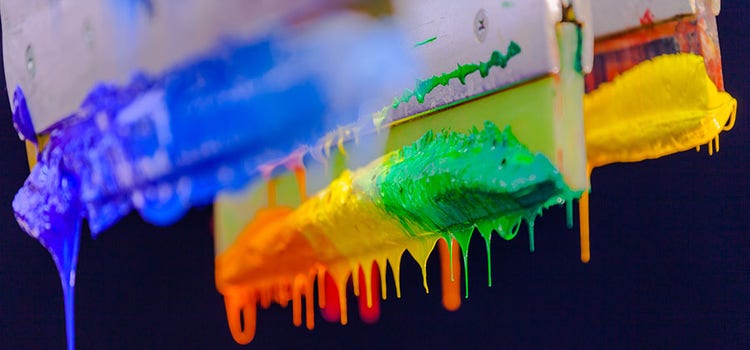
Screen printing (also known as silk screen printing) allows you to create designs by applying multiple layers of colour, using a separate screen for each colour.
If you understand the stencil principle, you'll easily grasp screen printing— as it’s a printing technique that’s derived from it.
What is screen printing used for?
This versatile printing technique works on countless surfaces and is widely adopted because it's simple, produces precise results, and remains cost-effective for bulk production.
Whether you're wondering how screen printing works or looking to understand the screen printing process, the fundamental principle remains the same: each layer of colour creates a distinct, durable impression.
History of screen printing.
Screen printing has ancient roots, originating in China between the 13th and 10th centuries BC. The Japanese later adopted and refined the technique, using it to print patterns on silk and paper.
In Europe, adoption began slowly in the 18th century due to the high cost of silk. It wasn't until the 20th century, when silk prices dropped, that this screen printing technique spread across the continent.
Initially reserved for luxury textile printing, it gradually became one of the most widespread industrial printing methods.
By the 19th century, silk screen printing reached the Americas through Chinese immigration to the United States. Combined with American industrial innovation, the technique gained new dimensions and applications.
Interestingly, it was American soldiers during World War II who helped popularise screen printing across Europe. The US military used this method to print signage at military camps and mark vehicles—effectively spreading the technique across the continent.
Silk screen printing captivated many French artists, including Henri Matisse. The Pop Art movement of the 1960s cemented its popularity, with iconic works like Andy Warhol's Marilyn Diptych and Campbell's Soup Cans showcasing its potential.
Today, the screen printing technique remains prominent in the printing industry. Technological advances mean it can be applied to an impressive variety of surfaces—from signage panels to concert posters and clothing. We encounter screen-printed designs constantly in our daily lives.
Advantages and disadvantages of screen printing.
Colour Iitensity and durability.
Screen printing involves applying thick layers of ink, resulting in particularly intense colour and excellent durability over time. Colours remain vibrant and opaque long-term, and the finish (often matte) is exceptionally refined.
This is one of the key advantages of screen printing for projects requiring lasting impact.
Cost-effective for bulk production.
Once screens are created, they can be reused almost infinitely on various surfaces with minimal distortion, producing consistent results. This is why screen printing for textiles and bulk manufacturing is so popular.
However, due to the upfront preparation time required, screen printing is less economical for small print runs.
Longevity.
Because thick ink layers are absorbed or fixed to the surface, screen-printed designs are more durable than those produced by other printing techniques. Screen printing creates work built to last—an ideal choice when durability matters.
Versatility.
This method applies to numerous surfaces including fabric, paper, metal, glass, wood, and plastic. It's used across virtually unlimited industries—from marketing (printing logos on merchandise) to advertising, signage, textiles, and electronics manufacturing. Few printing methods offer this versatility.
Limited effects range.
Silk screen printing works best for designs with clearly defined outlines and strong contrast between colours. It's not ideal for subtle effects like colour gradients or fine details. This is one key disadvantage of screen printing—designs with bold, contrasting colours produce the best results.
High time investment.
The screen printing process requires significant time investment: preparing screens, decomposing the graphic, creating stencils for each layer, selecting colours, and allowing drying time between layers. Patience is essential, and this investment makes sense primarily for designs you'll reuse.
Understanding the full screen printing process steps helps you plan accordingly.
Screen printing tips and techniques.
Select your colours carefully.
Mastering the art of screen printing starts and ends with colour. Ensure you're satisfied with your colour shade and ink consistency before application.
Ink that's too thick or too thin produces poor results. Prepare your inks in advance to achieve optimal texture by following the product instructions. Note that water-based paints can be diluted slightly with water for better consistency.
Prepare your equipment.
Create your screens and design, ensuring the final result meets your expectations. Run several tests before printing on the final surface—treat it like a rehearsal. Clean your screens, prepare your brushes, and mix your colours before beginning work.
Optimise your workspace.
The screen printing process is straightforward but requires discipline and organisation to avoid errors like ink drying too quickly or insufficient paint application. Arrange your workspace so all tools are within reach and you can respond quickly when needed.
Practice regularly.
Train repeatedly with this printing technique by experimenting with different paint types and surfaces. Test your technique with varying motif sizes and shapes, always starting with simple designs to build confidence. As the saying goes: "You become a screen printer by doing screen printing!"
Enhance your screen printed designs with Adobe.
To create flawless designs perfectly suited for screen printing, refine your drawing skills using these techniques:
1. Master geometric tools in Illustrator. Learn to control Illustrator’s geometric tools to create motifs with sharp, clean edges—ideal for screen printing results. These tools excel at drawing mandalas, simple lines, elliptical shapes, or stars, and creating image repetitions when your design permits.
2. Freehand drawing with precision tools. Explore freehand drawing of simple motifs using the Pen tool and Pencil function. Practice regularly until you feel comfortable and your drawings match your vision.
3. Build colour palettes. Start by defining your design's primary colour, then experiment with simple two-colour motifs. Use the Colour Guide panel to combine analogous or complementary tints and create palettes for more elaborate designs. The Swatch panel and swatch library panels are invaluable allies in this process.
4. Convert images with dynamic vectorisation. Transform existing images into drawings using dynamic vectorisation. This converts your illustration into vector paths while you set options like colour palette predetermination or minimum contour length—perfect for preparing artwork for screen printing.
Frequently asked questions.
How do I do screen printing at home?
Start screen printing at home by separating your design's colours. If you're new to screen printing, choose a very simple motif with one or two colours. You can draw freehand, trace, or print a design downloaded online.
Create individual stencils for each colour layer. Use opaque cardboard layers matching your design's colour layers, and cut out each part's outline as cleanly as possible using a craft knife or precision blade on thick cardboard.
Next, coat your frame's fabric with photosensitive emulsion, then dry it in a dark room without heat sources. Expose each screen by placing your frame on black paper, positioning stencils above the screen, then exposing to UV lamp rays.
Remove the emulsion by washing the screen with warm water. Let it dry face-up, away from heat sources. Repeat this process for each colour layer.
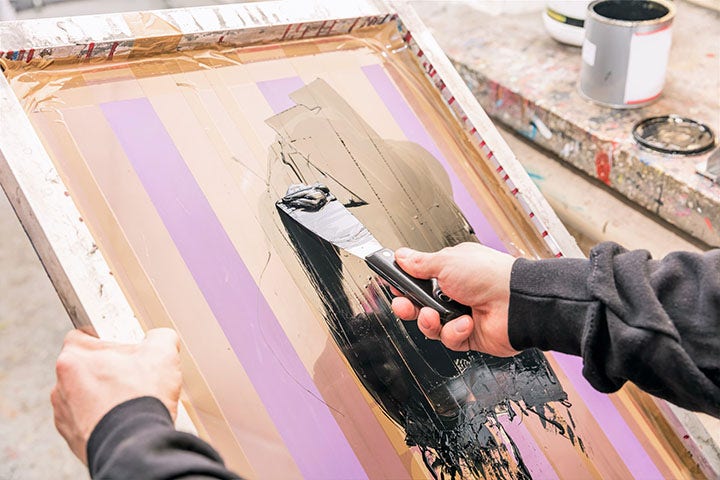
Finally, mix your colours following the product instructions. Place the screen above your printing surface, then tilt it slightly toward you. Deposit a line of your first colour across the screen's width. Lower the screen flat and use a squeegee to spread colour across the entire screen surface, transferring it to unexposed areas. Allow the ink to dry before applying the next colour, repeating for each layer.
Remove the screen and allow your creation to dry fully!
How do I make screen printing screens?
Start by building a frame to the correct dimensions. Stretch your fabric across the frame, securing it around the entire perimeter with staples. Begin with staples at each side's centre, finishing with corners to achieve optimal tension.
Fabric must be perfectly taut to prevent ink spreading, and frame tensioners ensure impeccable results. Alternatively, pre-made wooden or metal screen printing frames are available from most craft or art supply retailers.
Who uses screen printing?
Screen printing is used across diverse fields:
- Visual arts (particularly Pop Art-style creations)
- Advertising (posters, banners, signage, logos)
- Electronics circuit printing
- Signage (registration plates, directional signs)
What's the difference between screen printing and digital printing?
Screen printing applies physical ink layers for durable, vibrant results ideal for bulk orders, whilst digital printing is faster for small runs but offers less durability.
Screen printing excels for textiles and specialty surfaces, whereas digital printing suits detailed, photographic images. Choose screen printing on fabric when longevity and bold colour matter most.
What do I need for screen printing?
Essential screen printing supplies include:
- wooden or metal frames
- fabric mesh
- photosensitive emulsion
- UV lamp
- Squeegee
- screen printing ink
- stencils
- water source
- printing surface.
Many suppliers sell complete screen printing kits for beginners.
What are the limitations of screen printing?
The main limitations of screen printing include:
- restricted special effects (limited gradients)
- high time investment in setup
- the need for design separation into colour layers
- unsuitability for very fine details.
However, these limitations fade when you understand your design should feature bold, contrasting elements.