How to cite multiple authors APA style
Learn how to cite multiple authors in APA style. Master the correct use of "et al." and see examples for multiple authors in parenthetical and narrative formats.

How to cite multiple authors in APA style
The APA 7th edition is the standard for academic and scientific writing across numerous disciplines. Published in 2019, this edition introduced changes to how researchers and students cite an article with multiple contributors. Understanding these guidelines ensures your work maintains credibility and allows readers to locate your sources efficiently.

For works with a single author, simply cite the surname and publication year. When a source has two authors, include both surnames in every citation—using an ampersand (&) for parenthetical citations and the word "and" for narrative citations. For works with three or more authors, APA 7th edition simplifies the process by requiring only the first author's surname followed by "et al." from the very first citation onward.
APA style recognizes two primary citation formats: parenthetical and narrative. Parenthetical citations place all citation information within parentheses at the end of a sentence or clause. For example, a two-author parenthetical citation appears as (Smith & Jones, 2024). Narrative citations integrate the author names into the sentence itself, with only the year in parentheses: Smith and Jones (2024) found that their results supported the hypothesis. Notice the distinction—parenthetical citations use the ampersand symbol, while narrative citations spell out "and."
Page numbers become necessary when you include direct quotations from a source. In these cases, add "p." followed by the page number after the year: (Smith et al., 2024, p. 45). For quotations spanning multiple pages, use "pp." instead: (Smith et al., 2024, pp. 45-47). When writing a research paper, maintaining consistency with these formatting details demonstrates attention to scholarly standards and helps readers verify your sources.
Et al. usage in APA for citing multiple authors
The abbreviation "et al." comes from a Latin phrase meaning "and others." In academic citations, this abbreviation serves as a space-saving convention that prevents lengthy author lists from disrupting the flow of your writing, which becomes essential when working with scholarly articles that frequently involve research teams with multiple contributors.
APA 7th edition establishes a clear rule: use "et al." for any source with three or more authors, beginning with the first citation. This represents a notable departure from APA 6th edition, which required listing all authors (up to five) on the first citation before shortening to "et al." on subsequent mentions. The updated approach reduces confusion and creates consistency throughout academic papers.
When formatting "et al." in your citations, remember that the abbreviation is never italicized in APA style. Always include a period after "al" since it is an abbreviation of "alia." The complete phrase appears as "et al." with no additional punctuation between "et" and "al." These formatting details matter when professors or peer reviewers evaluate your work's adherence to style guidelines.
The following comparison table illustrates how APA in-text citation multiple authors format changes based on author count:
Additional guidance
The same rules apply regardless of source format. Whether your source is a journal article, e-book chapter, or PDF, the author count determines the citation structure. Electronic sources follow identical guidelines to print materials—the number of authors, not the medium, dictates how you format the citation.
One additional consideration involves distinguishing between sources that would otherwise appear identical when shortened. If two different sources with three or more authors would both shorten to the same "et al." citation, include additional author names as needed to differentiate them. This ensures readers can identify which specific source you reference at any given point in your paper.
Examples and best practices
Applying APA citation rules becomes clearer through concrete examples that demonstrate real-world usage. The following scenarios illustrate how to format citations correctly across different author counts and citation styles.
For a single-author work, the citation remains straightforward in both formats. Parenthetical example: Research indicates that sleep deprivation affects cognitive performance (Martinez, 2023). Narrative example: Martinez (2023) demonstrated that sleep deprivation significantly impacts cognitive performance.
Two-author works require both names in every citation, with careful attention to the ampersand versus "and" distinction. Parenthetical example: The study revealed significant correlations between exercise and mental health outcomes (Thompson & Williams, 2024). Narrative example: Thompson and Williams (2024) found significant correlations between exercise and mental health outcomes.
For three or more authors, "et al." simplifies the citation from the first mention. Parenthetical example: Previous research established baseline measurements for comparison (Chen et al., 2023). Narrative example: Chen et al. (2023) established baseline measurements that informed subsequent studies.
When incorporating direct quotations, page numbers are mandatory. Parenthetical example with quote: The researchers concluded that "intervention timing proved critical to positive outcomes" (Rodriguez et al., 2024, p. 127). Narrative example with quote: According to Rodriguez et al. (2024), "intervention timing proved critical to positive outcomes" (p. 127).
When paraphrasing content rather than quoting directly, page numbers are encouraged but not required. However, including them helps readers locate specific information within lengthy sources.
Following these best practices will strengthen your citation accuracy:
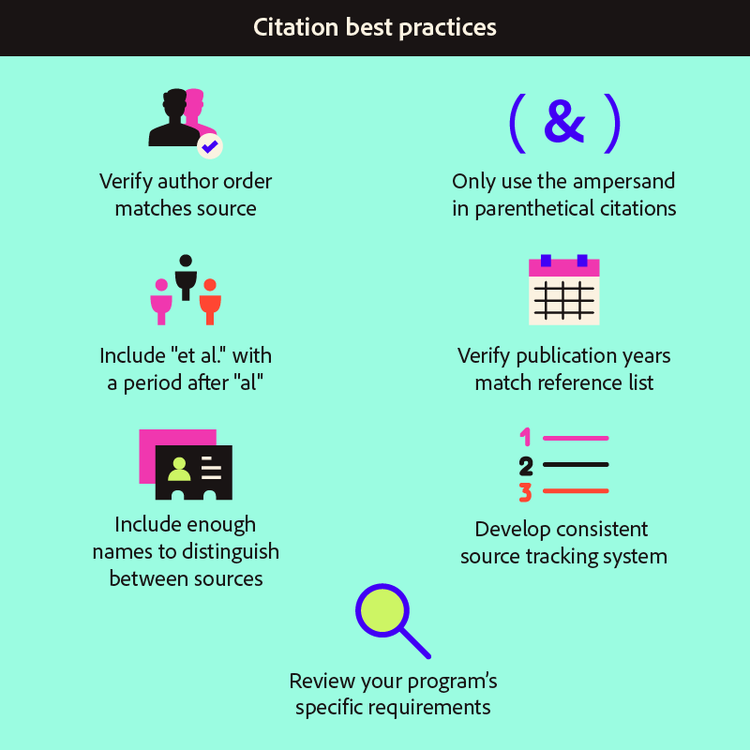
- Always verify that author order in your citation matches the source exactly, as author sequence often indicates contribution level
- Use the ampersand (&) exclusively in parenthetical citations and spell out "and" in narrative citations
- Include "et al." with a period after "al" and never italicize the abbreviation
- Double-check that publication years in your in-text citations match the corresponding reference list entries
- When citing multiple works by the same first author with different co-authors, include enough names to distinguish between sources
- Create a consistent system for tracking your sources as you research to avoid citation errors later
- Review your institution's specific requirements, as some programs have additional guidelines beyond standard APA rules
- Never forget the period after "al" in "et al."—the abbreviation is incomplete without it
- Reserve "et al." for sources with three or more authors; two-author works always list both names
- Do not italicize "et al." as this contradicts APA 7th edition guidelines
- Maintain consistency with ampersand versus "and" usage based on citation type
- Ensure every in-text citation has a corresponding reference list entry with matching author names and year
- Verify that your citations follow the current APA 7th edition rules rather than outdated 6th edition guidelines
Generate APA in-text citation for multiple authors with AI
Managing citations for sources with varying author counts can become time-consuming, especially when working with dozens of references. Artificial intelligence (AI) tools now offer efficient solutions for generating properly formatted APA citations, reducing manual formatting errors and freeing time for research and writing. Read on for a list of ways to use AI in your citations:
- Upload your source document or paste the text you need to cite into an AI-powered tool. PDF files, Word documents, and web pages can all serve as inputs for citation generation.
- Use AI Assistant to identify author names, publication year, and other citation details automatically. When you chat with your PDF, the AI can extract bibliographic information directly from the document.
- Access the citation feature in a student workspace to generate properly formatted APA citations. These tools apply the correct rules based on author count, automatically determining when to use "et al."
- Review the generated citation to verify author order and "et al." usage for three or more authors. While AI tools are highly accurate, a quick review ensures the citation matches your source exactly.
- Copy the formatted citation directly into your paper or reference management system. Many AI tools allow you to export citations in multiple formats for easy integration with your workflow.
- Repeat the process for each source, building a comprehensive and accurately formatted reference list alongside your in-text citations.
AI paraphrasing capabilities complement citation generation by helping you rephrase source material while maintaining academic integrity. When working with complex multi-author sources, these tools ensure you capture ideas accurately without inadvertent plagiarism.
The efficiency benefits extend beyond simple time savings. AI citation tools reduce the cognitive load of remembering specific formatting rules for different author counts. Rather than consulting style guides repeatedly, you can focus on developing your arguments and analyzing sources. Explore AI research tools designed specifically for academic work, and discover how tools like AI quiz generators for students can streamline your entire research and writing process.
Students increasingly rely on these digital solutions to manage the complexities of academic citation. By integrating AI assistance into your workflow, you can ensure consistent application of APA rules for how to cite multiple authors while dedicating more energy to the substance of your research and arguments.
Frequently asked questions
How do you cite 20 authors in APA?
What if two citations shorten to the same "et al." format?
Do I use "et al." differently for first and subsequent citations?
How do I cite a source with no author in APA?
Can I use "and others" instead of "et al."?
How do I cite the same author group multiple times in one paragraph?
You may also like