What is the Retrieval Practice Study Method?
Discover how retrieval practice transforms studying from passive review into active learning that strengthens memory and boosts academic performance.

What is retrieval practice and why does it work?
Retrieval practice is an active form of studying that requires your brain to work harder. Unlike re-reading your notes or highlighting textbook passages, you’re expected to reconstruct knowledge from scratch.
When you attempt to recall information, you strengthen the neural pathways associated with that knowledge. Each time you successfully retrieve a memory, you make it easier to access that information in the future. This phenomenon, known as the testing effect, demonstrates that the act of retrieving information is itself a powerful learning event.
Retrieval practice works through several key mechanisms that make it superior to other study approaches:
- The testing effect strengthens memory more than restudying the same material
- Long-term memory consolidation improves through repeated retrieval attempts
- Knowledge gaps become immediately apparent when you cannot recall information
- Transfer of learning to new contexts increases as understanding deepens
- Forgetting slows significantly over time with regular retrieval practice
The connection between retrieval practice and active recall is fundamental. Both concepts emphasize the importance of generating information from memory rather than simply recognizing it when presented. When you use retrieval practice, you engage in active recall every time you attempt to remember something without looking at your notes.
Understanding how to memorize information quickly becomes much easier when you incorporate retrieval practice into your routine. Rather than spending hours re-reading the same material, you can achieve better retention in less time by testing yourself repeatedly.
Retrieval practice stands apart from passive review methods like highlighting or copying notes. While these approaches might feel productive, they do not require the same mental effort that builds lasting memories. Among effective study methods, retrieval practice consistently outperforms passive techniques in research studies measuring long-term retention.
The effort required during retrieval practice is precisely what makes it effective. When you struggle to remember something, your brain works harder to strengthen that memory. This desirable difficulty is a feature, not a bug, of the retrieval practice study method.
Types of retrieval practice methods
The retrieval practice study method encompasses several distinct techniques, each offering benefits for different learning situations. Understanding these variations allows you to choose the most appropriate approach for your specific study needs and adapt your strategy as you master different material.
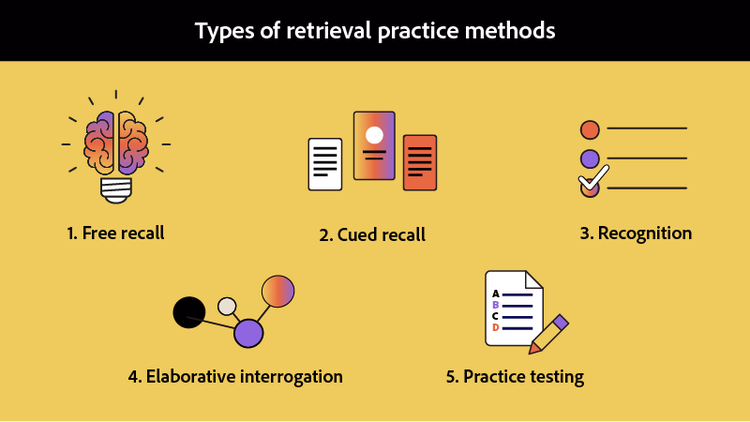
1. Free recall
Free recall is the most challenging form of retrieval practice because it involves retrieving information without any cues or prompts. You simply attempt to remember everything you know about a topic from memory alone.
Practical examples of free recall include writing everything you remember about a chapter after reading it, doing a blank page brain dump after a lecture, or explaining a concept aloud without any notes. This method works particularly well when combined with effective note-taking methods, as you can compare your recalled information against your original notes to identify gaps.
Free recall is demanding but highly effective because it requires your brain to search through memory without assistance. The struggle to retrieve information strengthens the memory traces more than easier retrieval methods.
2. Cued recall
Cued recall uses prompts or hints to trigger memory retrieval. This method reduces the difficulty compared to free recall while still requiring active reconstruction of knowledge.
Common examples include using flashcards where a question or term prompts you to recall the answer, completing fill-in-the-blank questions, or using keyword prompts to trigger recall of associated concepts. A flashcard maker can help you create digital flashcards from your study materials quickly, making cued recall more accessible and efficient.
Cued recall serves as an excellent starting point for students new to retrieval practice or when learning completely unfamiliar material. The prompts provide scaffolding that makes retrieval possible while still engaging active memory processes.
3. Recognition
Recognition involves identifying correct information from options presented to you. While less demanding than recall-based methods, recognition still engages retrieval processes and helps reinforce learning.
Examples include multiple-choice questions, true/false quizzes, and matching exercises. Recognition tasks are useful for initial learning stages and for building confidence before progressing to more challenging retrieval methods.
Though recognition is the easiest form of retrieval practice, it still outperforms passive review. The key is to use recognition as a steppingstone toward more demanding recall-based practice.
4. Elaborative interrogation
Elaborative interrogation involves asking yourself "why" and "how" questions to deepen your understanding of material. This method combines retrieval with explanation, forcing you to connect new information to existing knowledge.
Examples include explaining why a scientific process works the way it does, connecting a historical event to its causes and consequences, or describing how a mathematical concept applies to real-world situations. Using techniques like mind mapping alongside elaborative interrogation can help you visualize connections between concepts.
Elaborative interrogation is particularly powerful for complex subjects where understanding relationships between ideas matters more than memorizing isolated facts.
5. Practice testing
Practice testing involves taking practice exams or quizzes before the actual assessment. This method simulates test conditions while providing opportunities for retrieval and feedback.
Examples include working through past exam papers, completing self-created quizzes, taking online practice tests, or answering end-of-chapter questions. Practice testing not only strengthens memory but also reduces test anxiety by familiarizing you with the assessment format.
The combination of retrieval practice and realistic test conditions makes practice testing one of the most effective preparation strategies available.
Retrieval practice vs. passive study methods
Understanding the difference between retrieval practice and passive study methods helps explain why many students struggle despite spending hours with their materials. Passive study methods include activities like re-reading textbooks, highlighting passages, copying notes, and watching lecture recordings without active engagement.

These passive approaches feel productive because they create a sense of familiarity with the material. When you re-read a chapter multiple times, the content starts to feel comfortable and recognizable. This sensation leads many students to believe they have learned the material thoroughly. However, this feeling is often an illusion.
Researchers call this phenomenon the fluency illusion. The ease with which you can read and recognize information tricks your brain into thinking you can recall it just as easily. Unfortunately, recognition and recall are very different cognitive processes. Just because you recognize information when you see it does not mean you can retrieve it when you need it, such as during an exam.
Multiple research studies have demonstrated that retrieval practice outperforms passive methods significantly. In one classic study, students who practiced retrieving information remembered far more after a week than students who spent the same amount of time re-reading. The retrieval group also showed better transfer of knowledge to new problems and contexts.
The key difference lies in the mental effort required. Passive methods allow your brain to coast along without much engagement. Retrieval practice forces your brain to actively reconstruct information, which strengthens memory traces and builds more durable learning.
This does not mean passive methods have no place in studying. Initial exposure to new material often requires reading and note-taking before you have anything to retrieve. The problem arises when students rely exclusively on passive methods throughout their study process instead of transitioning to retrieval practice once they have initial exposure to the content.
How to implement retrieval practice study method
Getting started with the retrieval practice study method requires shifting your approach from reviewing materials to actively testing yourself. The transition might feel uncomfortable at first, but the improved retention makes the effort worthwhile. Here is a practical framework for implementing retrieval practice into your study routine.
Before you begin retrieval practice, you need something to retrieve. Start by creating a study guide or reviewing your material gives your brain something to work with during retrieval attempts.
Follow these steps to implement retrieval practice effectively:
- Review your study materials once to gain initial familiarity with the concepts and terminology. Take notes during this phase, but do not spend excessive time re-reading.
- Close your materials and attempt to recall key concepts from memory. Write down everything you remember about the topic without looking at your notes. This step is where the real learning happens.
- Check your answers against the source material. Compare what you recalled with the original content to identify what you remembered correctly and what you missed.
- Focus additional practice on areas where you struggled. The concepts you could not recall need more attention than those you remembered easily.
- Space out your retrieval sessions over time. Return to the material after a day, then a few days, then a week. This spaced approach strengthens long-term retention.
Digital tools can significantly enhance your retrieval practice sessions. AI tools for students offer powerful capabilities for generating quiz questions and testing your understanding. You can turn notes into flashcards automatically, saving time while creating effective retrieval practice materials.
Using a quiz maker allows you to create practice tests from your study materials quickly. These self-generated quizzes provide immediate feedback and help you identify knowledge gaps before exams.
Best practices and tips for maximizing retrieval practice
To get the most from retrieval practice, approach it as a learning tool rather than an assessment. The goal is growth and improvement, not achieving a perfect score on every practice session. This mindset shift helps reduce anxiety and encourages you to embrace the productive struggle that makes retrieval practice effective.
Immediate feedback is essential for effective retrieval practice
Embrace difficulty during retrieval practice sessions
Combine retrieval practice with spaced repetition for maximum effect
Vary your retrieval methods to strengthen different memory pathways
Start using retrieval practice early rather than waiting until exam time
Regular retrieval throughout a course produces far better results than cramming everything into the final week. Brief daily retrieval sessions of ten to fifteen minutes outperform hours of last-minute studying.
Use low-stakes practice to reduce anxiety about retrieval. When practice sessions do not count toward your grade, you can focus on learning rather than performance. This relaxed approach makes it easier to embrace mistakes as learning opportunities.
Track your progress to stay motivated and identify patterns
Note which topics you recall easily and which require more work.
Finally, be patient with the process. Retrieval practice requires more mental effort than passive studying, and the benefits accumulate over time. Trust that the struggle you experience during practice sessions is building stronger, more durable memories that will serve you well on exams and beyond.
Frequently asked questions
What are the three methods of retrieval?
What is the main purpose of retrieval practice?
How often should I use retrieval practice?
Can retrieval practice work for all subjects?
What if I cannot remember anything during retrieval practice?
How is retrieval practice different from cramming?
You may also like