The Rise of AI Documents.
Whether you’re summarising reports or translating content, AI is quickly changing how people work with documents. And for millions of employees across the UK, AI tools are becoming a non-negotiable part of their everyday workflow, helping them streamline tasks and save time.
But what are the main uses of AI in the workplace? And how is it reshaping day-to-day working habits? To find out, we analysed the surge in Google searches for AI-powered tools that summarise, edit, or translate documents. Alongside this, we also surveyed 2,000 UK adults to uncover the real impact of AI, including how adoption varies across age groups and industries.
The Rise of AI Documents: Key Takeaways
Our research shows that AI is becoming increasingly embedded in everyday workplace tasks, with employees using it to save time and improve document-heavy workflows.
Most people (27%) rely on AI to help them with creating and editing documents, whether that’s drafting emails and reports, proofreading, or summarising PDFs. 23% use AI for data analysis or technical tasks, including coding and working with spreadsheets, while 22% find it helpful for task management, like taking notes, brainstorming, and scheduling.
Other areas where AI use is high in the workplace include:
- Marketing and sales (16%)
- Translating or localising content (14%)
- HR and operations (14%)
So, it’s clear that AI is no longer limited to niche use or specialist teams, and it’s instead becoming a mainstream tool used across departments to help with an array of tasks.
Does AI tool adoption vary across different industries?
AI adoption varies from industry to industry, with FMCG workers regularly using AI to create or edit documents, as well as proofreading and summarising (50%). 47% of those in IT, Technology, and Telecommunications also use AI for data analysis or technical tasks such as coding and creating spreadsheets.
Marketing professionals are also embracing AI in their daily workflows, with 44% using it for meeting and task management, including scheduling, note-taking, and brainstorming ideas.
Interestingly, we found that 29% of Aerospace and Defence workers use AI for marketing and sales, particularly for content creation, personalisation and visuals. This shows how AI-powered tools are expanding beyond traditional creative industries.
Elsewhere, 27% of Energy & Resource workers use AI for translating or localising content, while 24% of Property & Real Estate workers use AI for HR and operations services such as recruitment, onboarding and customer support.
Finally, half of those in Mining, Quarrying, Oil, and Gas Extraction use AI for industry-specific purposes such as logistics.
The UK’s most in-demand searches for AI assistance
Does AI pose challenges in the workplace?
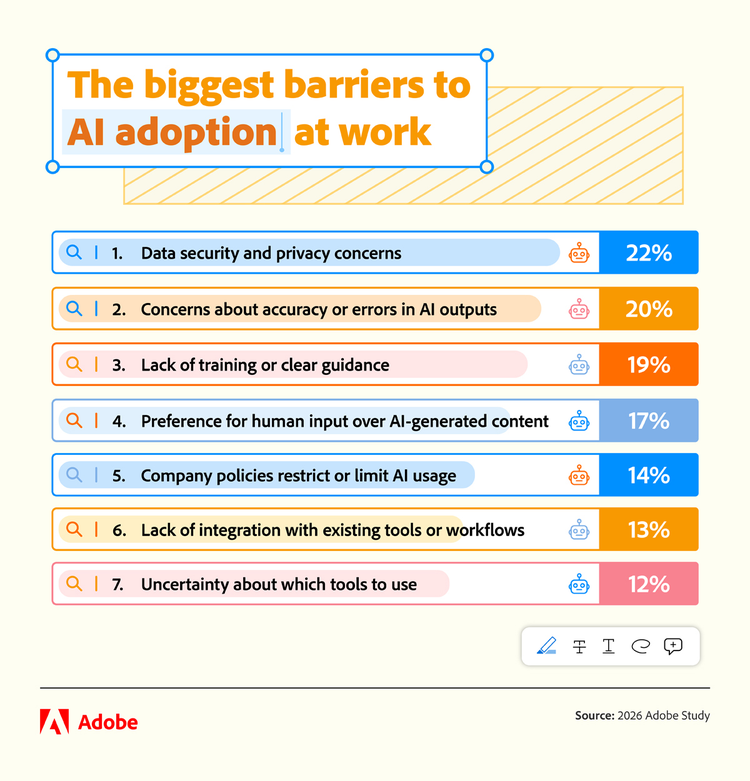
While AI is helping many employees improve their productivity, our survey also highlighted some concerns people have around using it in the workplace. For instance, 22% of people mentioned that they have data security and privacy concerns, while 20% worry about the accuracy of AI outputs in certain scenarios. A further 17% also said that they prefer human input over AI-generated content.
For 19%, challenges surrounding AI have more to do with a lack of training and guidance, while 14% highlighted that they have company policies that restrict AI usage. Other points mentioned include uncertainty around which tools to use (12%) and a lack of knowledge on how to integrate them into existing workflows.
The data also reveals some differences in the way men and women perceive the limitations of AI, with men being slightly more likely to have data security concerns (24%) than women (20%).
The biggest workplace challenges of adopting AI tools
Where employees are turning for AI support
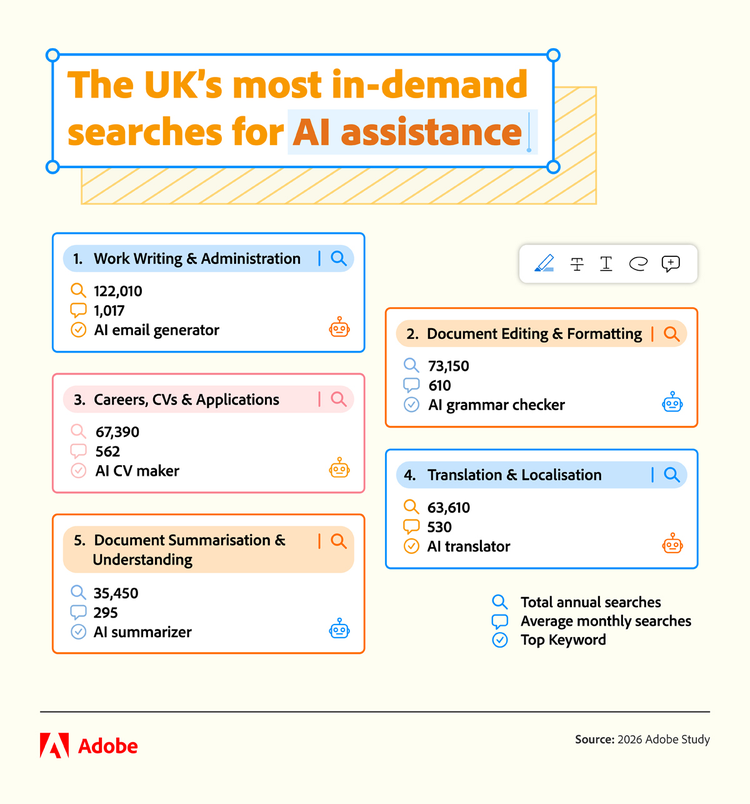
Search behaviour also highlights how employees are turning to AI to solve workplace challenges, particularly when it comes to writing, editing, and productivity. The most searched-for category is work writing and admin support, generating 122,010 total searches. The keyword ‘AI email generator’ alone averages 1,016.8 searches, suggesting a strong demand for tools that help you draft professional communications.
Editing and formatting documents ranks second with 73,150 total searches, and the keyword
‘AI grammar checker’ averages 609.6 searches, reflecting a focus on improving accuracy and polishing work.
Meanwhile, careers, CVs, and applications generate 67,390 monthly searches, with the keyword ‘AI CV maker’ averaging 561.6 searches. Other employees are looking for assistance with translation and localisation (63,610 monthly searches), as well as summarising and understanding documents, with 35,450 total searches.
Regional data also highlights how interest in AI support tools is growing across the UK. Here’s a look at what we found:
- Bradford has seen the biggest uplift in searches for work writing and admin support (133%)
- Southampton has seen the biggest uplift in searches for editing and formatting support (100%)
- Those in Sheffield have seen an uplift in searches for careers, CVs and applications (60%)
- People in Belfast have seen the biggest uplift in searches for translation and localisation support (200%)
The search data shows that AI interest is concentrated around practical, task-based use cases, particularly writing, editing, and document-related tasks.
Streamline your workflow with Adobe Acrobat
So, it’s clear that AI is a core part of how employees manage everyday document tasks, from writing and editing to summarising information. However, with some scepticism lingering around AI and how to integrate it into existing workflows, the data also highlights the need for secure, reliable, and easy-to-use tools that inspire confidence.
With summarisation, editing, and collaboration among the most common AI-assisted workplace tasks identified in our research, Adobe Acrobat helps teams manage documents more efficiently from a single platform. Teams can streamline their workflows and stay productive with our AI capabilities and workspace tools.
For instance, our easy-to-use PDF AI tools make document collaboration simple. You can review PDFs while adding comments, highlighting sections, and sharing feedback, while using our AI Assistant to get guided next steps.
Alongside this, our summary generator helps you identify key themes and insights without having to read an entire document. You’re able to speed up your workflow and keep things moving, boosting productivity, and workflow automation.
Finally, if it’s additional insights you’re looking for, we have additional informational resources.
Methodology
1. The Rise of AI Documents is the result of a comprehensive national survey conducted by 3Gem on behalf of Adobe Acrobat. The survey polled 2,000 UK adults between 18.04.2026 and 22.04.2026.
2. Search data was collected using DataForSEO’s Google Ads search volume API. Related search terms were grouped into task-based keyword sets, so each ranking reflects a broader document workflow problem rather than a single phrase. Keyword sets were localised for each market using native-language phrasing in English, German and Italian. The same number of keywords was used per task wherever possible to improve comparability across countries. Metrics were then rolled up into task-level rankings using average monthly search volume, total 12-month search volume, and recent uplift/trend measures. Raw keywords and monthly data were retained in audit tabs for transparency.
A separate non-AI comparison set was not used in the final analysis because it is difficult to draw a clean line between “AI” and “non-AI” document searches in real user behaviour. Many seemingly generic searches such as “translate PDF”, “summarise PDF” or “edit PDF” can still lead users to AI-powered tools or reflect intent to use AI-assisted products, even if the search does not explicitly mention AI. Because of that overlap, splitting the dataset into AI and non-AI buckets risked creating a false distinction. Instead, the methodology focused on capturing the real document tasks people are searching for and measuring the scale and momentum of those behaviours across markets.