How to get your GPA up fast
Whether you're aiming for the dean's list, preparing for graduate school applications, or recovering from a tough semester, understanding how to get your GPA up quickly can help you take better control of your academic future.

How is GPA calculated
Understanding how your GPA is calculated helps give you insight into how to raise it. At its core, it boils down to a formula: divide your total grade points by your total credit hours. Each letter grade corresponds to a point value—typically an A equals 4.0, a B equals 3.0, a C equals 2.0, a D equals 1.0, and an F equals 0. Multiply each grade's point value by the course's credit hours, add those products together, and divide by your total attempted credits.
Several factors influence your GPA beyond just the grades you earn:
- Credit hours per course determine how heavily each grade weighs in your overall calculation
- Course weights for honors, Advanced Placement (AP), or college-level classes may add extra points to your scale
- Grade point values vary slightly between institutions, so check your school's specific scale
- Cumulative GPA reflects all semesters, while semester GPA shows only current performance
- Pass/fail courses typically do not affect your GPA but may not count toward requirements
- Withdrawn courses usually do not impact GPA if dropped before the deadline
Once you understand this calculation, you can make smarter decisions about which courses to prioritize and where to focus your energy. For example, earning an A in a four-credit course has twice the impact of earning an A in a two-credit course. This knowledge becomes the foundation for setting academic goals that are both ambitious and achievable.
How to get your GPA up
Raising your GPA requires a combination of immediate actions and sustained effort over time. While dramatic improvements rarely happen overnight, students who commit to strategic changes typically see meaningful results within one to two semesters. The exact timeline depends heavily on how many credits you have already completed—students earlier in their academic careers will see faster changes because each new grade carries more weight in the cumulative calculation. If you have completed 60 credits, for instance, it takes more high grades to move your GPA significantly compared to a student with only 15 credits. However, with consistent effort over two to three semesters, most students can achieve meaningful improvement regardless of where they start.
To get started, adopt the mindset that every assignment, quiz, and participation point contributes to your final grade. Small improvements across multiple areas compound into significant GPA gains. Here are six actionable steps you can take starting today.

1. Take advantage of office hours and tutoring
Professors and teaching assistants (TAs) hold office hours specifically to help students succeed. These one-on-one sessions allow you to clarify confusing concepts, get feedback on your work before submission, and demonstrate your commitment to learning. Many students overlook this free resource, but those who attend regularly often see their grades improve. Additionally, campus tutoring centers and peer tutoring programs offer structured support for challenging subjects, often at no cost.
2. Retake courses or use grade replacement
Many colleges offer grade replacement policies that allow the new grade to replace the old one in your GPA calculation. This can be particularly valuable for core courses where you earned a C or below. Before registering, check your school's specific policy—some institutions average both grades, while others completely replace the original. Strategically retaking courses where you know you can significantly improve offers one of the most direct paths to GPA recovery.
3. Manage your course load strategically
Balancing your semester schedule can prevent burnout while maximizing your GPA potential. Avoid stacking multiple difficult courses in the same semester. Instead, pair challenging classes with subjects where you naturally excel or courses known for being more manageable. Consider how credit hours distribute across your schedule—taking too many credits can spread your attention thin, while too few may slow your progress toward graduation.
4. Never miss extra credit opportunities
Extra credit points may seem small individually, but they accumulate throughout a semester. A few bonus points on multiple assignments can push your final grade from a B-plus to an A-minus. Always complete optional assignments, attend extra review sessions, and participate actively in class when participation counts toward your grade.
5. Prioritize high-credit courses
Since courses with more credit hours have greater impact on your GPA, direct your best effort toward them. A strong performance in a four-credit course compensates more effectively for a weaker grade elsewhere than excelling in a one-credit elective. Review your schedule and identify which courses carry the most weight.
6. Improve assignment and test preparation
Your grades ultimately depend on how well you perform on assignments and exams. Developing effective test preparation techniques can transform your results. Start studying earlier, break material into manageable chunks, and practice with past exams when available. Submit assignments early to allow time for revision and avoid last-minute mistakes.
Strategies to raise your GPA
Effective study techniques are essential for translating your time and effort into higher grades. Research in cognitive science has identified specific methods that enhance learning and retention far more effectively than passive reading or highlighting. Understanding how to raise your GPA means adopting these evidence-based approaches and making them part of your regular routine.
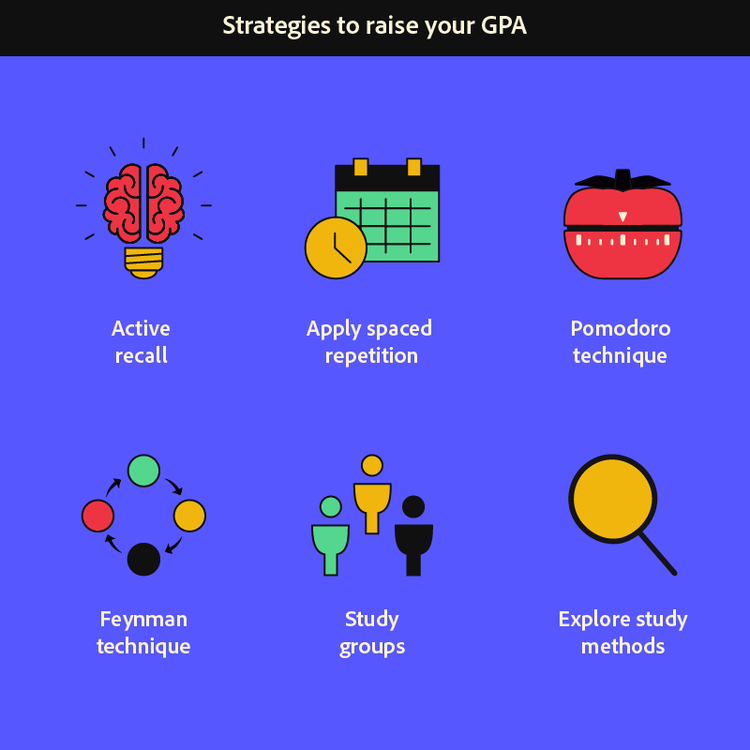
1. Use active recall for better retention
2. Apply spaced repetition
3. Try the Pomodoro technique for focus
4. Use the Feynman technique for complex topics
5. Form or join study groups
6. Explore different study methods
How to raise your GPA with AI
Artificial intelligence tools have emerged as powerful study companions that can help you raise your GPA more efficiently. These tools work best when they supplement—rather than replace—your active learning efforts. Used strategically, AI can help you process information faster, create better study materials, and identify knowledge gaps before exams.
Summarizing dense textbooks and lengthy lecture notes becomes manageable with AI assistants like Student Spaces in Acrobat. Upload your course materials and ask for concise summaries of key concepts, chapter overviews, or explanations of complex topics in simpler language. This helps you quickly identify what to focus on during deeper study sessions without getting lost in pages of text. Student Spaces can condense a 50-page chapter into the essential points you need to understand, saving hours of reading time while ensuring you capture the critical information.
Generating personalized study guides tailored to your specific courses saves hours of manual organization. AI can analyze your syllabus, lecture notes, and textbook chapters to create structured outlines highlighting the most important information. You can request study guides formatted around your exam topics or organized by difficulty level. These customized guides ensure you focus on exactly what your professor emphasizes rather than generic textbook content.
Creating flashcards for memorization no longer requires tedious manual work. A digital flashcard maker can transform your notes and PDFs into ready-to-use flashcard sets in minutes. Focus on the actual learning process rather than spending valuable study time on card creation. This automation means you can generate hundreds of flashcards from your course materials and immediately begin using spaced repetition techniques.
Building practice quizzes from your course materials helps you apply active recall before the real exam, and a quiz maker can generate questions based on your uploaded documents, allowing you to test yourself repeatedly on the specific content you need to master. This targeted practice identifies weak areas while reinforcing what you already know. You can create multiple quizzes from the same material, testing yourself from different angles until you achieve mastery.
Frequently asked questions
What is the fastest way to improve my GPA?
Is it possible to raise my GPA from 2.6 to 3.0 in two semesters?
Does retaking a class replace the old grade?
How much can one bad grade affect my GPA?
Should I take easier classes to raise my GPA?
Can extra credit really make a difference?
You may also like