
Acrobat
Convert handwritten notes to text: An OCR guide for PDFs.
Learn how to turn handwritten notes into searchable, editable documents using OCR technology on your smartphone or online tools.


Acrobat
Learn how to turn handwritten notes into searchable, editable documents using OCR technology on your smartphone or online tools.

JUMP TO SECTION
What is OCR scanning and how does it work?
How to turn handwritten text into PDF with OCR
Quick tips for converting scanned handwriting to text with OCR
Does the quality suffer when you scan handwriting to text using online OCR to create a create a PDF?
Explore more resources on OCR and PDFs
OCR technology converts scanned images of handwritten or printed text into digital, editable, and searchable formats - it works by:
Here's how you can convert handwritten text to PDF using OCR:
An OCR-enabled scanner app, such as the Adobe Scan app, makes it simple to digitise your handwritten notes. Follow these steps:
This is convenient, especially for students to take notes in classrooms or professionals capturing meeting minutes. This way, handwritten content remains accessible and editable on digital platforms. By digitising handwritten notes, you can also share important information quickly across devices, ensuring seamless collaboration.
Many smartphones in India offer built-in handwriting to text apps with OCR capabilities, like Notes or Google Lens. Here’s how you can use your mobile device to convert handwriting to text:
Edit and use the copied text.
Such handwriting scanner apps are user-friendly and accessible for individuals who use their phones for note-taking and document management. This feature is particularly beneficial for quickly digitising handwritten notes while on the go, saving time and effort.
Adobe Acrobat offers both a desktop app and an online platform for converting OCR to editable PDF text, with advanced OCR functions and editable tools. Here's how you can do it:
To use Acrobat online, go to the OCR PDF tool page and upload your scanned PDF. Adobe will automatically convert your file into an editable and searchable format. This approach ensures that scanned documents retain their original layout while allowing for easy updates and modifications.
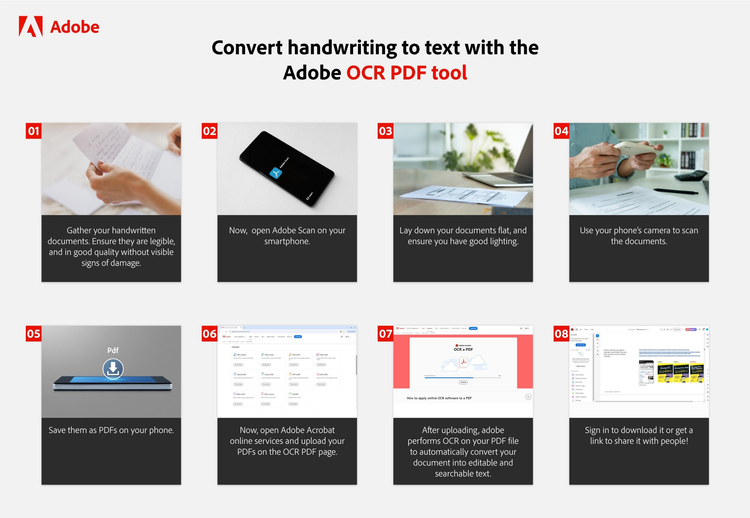
This method ensures high-quality OCR conversion, retaining document fidelity for efficient text manipulation in academic, professional, and other use cases.
To achieve the best OCR results when converting handwritten text, follow these tips:
For optimal results, scan documents in a well-lit environment to minimise shadows that may interfere with text recognition.
OCR technology is great at converting neatly handwritten content into digital text with minimal quality compromise. Using advanced AI and machine learning (ML), it identifies text and images on multiple levels by:
However, the legibility and clarity of handwriting significantly impact OCR accuracy. For Indian languages, Adobe OCR tool has limited capability. Hence, it is best to stick to English, or the approved set of languages for now. When scanning handwritten content, ensure consistent spacing and neatness to improve recognition accuracy, especially for complex scripts.
Explore additional functionalities using Adobe Acrobat OCR PDF tool:
These resources empower Indian users to leverage OCR capabilities and enhance productivity in document processing across diverse workflows.
When using Adobe Acrobat’s OCR tool, ensuring document security and privacy is essential.
While OCR primarily focuses on converting scanned content into editable text, Adobe Acrobat and similar tools offer additional features to enhance text quality. After conversion, you can use the formatting tools to adjust font styles, sizes, and alignments. Keep in mind that spell-checking functionalities typically depend on the software environment where the edited text is being processed, such as Microsoft Word or Google Docs.
To maintain consistent formatting, apply style changes within Acrobat before exporting to other platforms.