What is a competitive analysis and how do you conduct one?
Learn what a competitive analysis is and how to create a competitive analysis presentation in our guide.
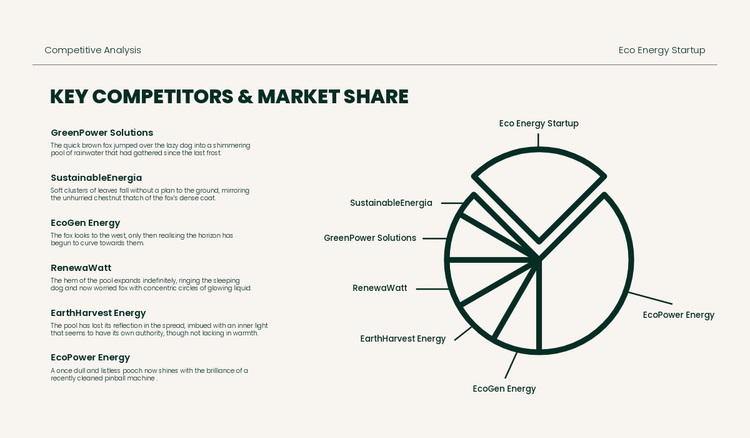




Wondering how your business holds up against the competition? A competitive analysis allows you to compare your brand against competitors to see how their unique selling points (USPs), products, strengths and weaknesses compare to yours. It can give you some pointers on what top-performing companies in your industry are doing well, offering learnings for your own company.
With Adobe Express, you can create a custom competitive analysis presentation in minutes. Read on to learn more about what a competitive analysis is and how to get started building out your own.
What is a competitive analysis?
A competitor or competitive analysis is a method of gathering data and insights about your direct competition – including its products, sales and marketing strategies – to examine their processes and performance. Analysing what your competitors are doing is important as it can give you a better insight into how your own business compares in these areas.
This competitive analysis can also help you identify opportunities or gaps in the market for your business to capitalise on, allowing you to get a better understanding of what your competitors may be doing that pose a potential threat to your business.
These insights help you learn what you’re doing well and where you need to improve to stay ahead of the curve. You can also put together a competitor analysis presentation and present these findings as part of a wider business overview or marketing strategy.
When should you do a competitor analysis?
It can be useful to conduct a competitor analysis at any point, as markets are always evolving and a potential new competitor can enter the industry at any time. Trends are also subject to change, so it can be beneficial to see what’s working for others and what your target audience is responding to in the best way.
It’s common for businesses to conduct a competitive analysis before their launch, as this gives them insight into the market they’re entering. Many also put together a competitive analysis presentation when they want to implement a strategic change, especially if they want to justify the strategy to key stakeholders.
It’s recommended that companies do a competitor analysis at least twice a year to stay on top of industry trends. It can also be effective to do one on a monthly or quarterly basis to evaluate your main competitors.
Free competitor analysis template ideas for marketers.
recipe
What should I include in a competitive analysis?
There are several elements you can cover in a competitive analysis. These include:
- Overview. A summary of the competitor company, including where it is located, who their target market is, how long they’ve been a competitor, etc.
- Products and services. A breakdown of what products or services they offer and how they compare against your own.
- Pricing. A comparison between their pricing and your own, including any additional perks or features they might offer. Make note of things like free delivery models or loyalty schemes.
- Marketing strategies. Analyses what your competitors are currently doing well on their different marketing channels. For example, how do their social media channels compare to your own? What is the digital experience like on their website or app? Do they use other advertising channels? Or do they have a newsletter?
- Customer ratings. What are customers saying about their brand versus your own? Online reviews, trust websites and social media can usually be good sources of information to discover what people are saying.
How to make your own competitive analysis presentation with Adobe Express.
Adobe Express can help you put together an impressive competitive analysis presentation to help you display your key findings and communicate them effectively to key stakeholders.
Here are some ways you can make the most of our tools:


Find examples of competitive analysis templates.
Add infographics, charts and graphs.
Use the animation tool to bring your analysis to life.
Get tips on how to make your presentation engaging.
Rebrand your business.
Benefits of a competitive analysis.
There are many benefits you can get from performing a competitive analysis. For instance, it can help you:
Analyse competitor marketing strategies.
Conducting a competitive analysis can help you identify marketing strategies that your target audience best responds to. For example, if you find that customers engage well with a brand’s social media posts on Instagram, you can boost your activity on this platform and see if this leads to an increase in traffic or conversions.
Identify gaps in the market.
Examining your competitors’ offerings can help you identify gaps in the market. Often, it’s easier to spot where others can improve, and you can take your findings and implement them at your business to enhance your products and services.
Stay up to date with the latest industry trends.
Every business should aim to stay up to date with the latest trends in their industry. The last thing you want is to be left behind. Keeping an eye on what your competitors are doing can help you stay relevant. According to research, 95% of customers in the UK think it’s important for brands do a good job at keeping up with culture online. So, ultimately it can help to boost your brand identity.
Makes you more aware of what’s already out there.
Knowing what’s already out there in your field can help you figure out what you need to do to bring something unique to the table. You can strengthen your business offerings by adding products and services that customers can’t find anywhere else.
Establish benchmarks for your own goals and performance.
Your competitor analysis may reveal that some of your competitors are doing things slightly better than you are – whether it’s marketing or customer service. But don’t be discouraged, this can help you set benchmarks for your goals and performance, giving you something to measure your performance against. Remember, there’s nothing wrong with a bit of healthy competition.
Ultimately, a competitor analysis can provide valuable insights to help you make informed decisions about your own business and offerings. Comparing your brand to the competition can help you capitalise on their weaknesses. It can also help you build a stronger brand, which is essential for long-term success.
4 editable competitor analysis presentation examples.
recipe
How can I conduct a competitive analysis?
Not sure how to conduct a competitive analysis? No problem. This step-by-step guide will help you navigate the process and create a clear presentation of your competitors.
1. Draw up a list of your key competitors.
The first step to creating a competitive analysis is to identify your competitors. It may help to categorise your competitors into direct and indirect competitors.
Direct competitors are companies who sell the same product to the same audience as you. Indirect competitors can be companies who sell the same product to a different audience, or a slightly different product to a similar audience.
An example of direct competitors might be two coffee shops located in your local train station. Whereas an example of indirect competition might be a coffee shop and a supermarket in the same train station – both offer lunch options, but with slightly different products and price points. The same logic applies for eCommerce businesses too.
2. Conduct your market research.
The next step is to conduct market research to examine your competitors closely. This can involve analysing market share to understand which competitors have the biggest influence over your audience.
You may want to combine primary and secondary research tactics here. For example, primary research may involve purchasing competitors’ products or services, interviewing customers, or conducting online surveys. While secondary research may include examining competitors’ websites and reading company records.
3. Review their products, pricing and promotions.
Next, it’s time to compare your products or services against competitor offerings. This can include analysing key features such as:
- Price
- Style and design
- Ease of use
- Product quality
- Cost
- Product benefits.
4. Explore their marketing channels and how they reach customers.
The next step of your competitor analysis will involve analysing the marketing efforts of your competitors. Key areas to focus on here include:
- Social media
- Website (design, SEO & copy)
- Paid advertisements
- Press releases
- Product copy.
5. Conduct a SWOT analysis.
A SWOT analysis can help you turn the focus of your analysis back to your own company. It allows you to identify strengths and weaknesses within your business and any threats you may face from your competition. Key things to ask yourself when conducting a SWOT analysis include:
- What are you doing well?
- Are there any areas you can improve on?
- Are there any gaps in the services / products you offer?
- Are there any market trends you need to be aware of?
Learn how to do a SWOT analysis.
6. Identify your position in the marketplace.
The final step is to identify where you currently stand in the market landscape. You can use a graph to do this by creating two axes that represent the most important factors for being competitive in your market.
You can then plot each competitor on the graph and add your own company to the chart. This should give you a better idea of where you currently stand in relation to your competitors.
7. Present your findings to colleagues and key stakeholders.
Once you’ve completed your competitive analysis, it’s time to showcase your research. Compile your data into a selection of simple slides that outline the highlights of your analysis. You can use charts, infographics and other design elements to bring the findings to life. This will also make it easier for stakeholders, investors or other internal teams to digest the information.
Make competitive analysis slides easily with Adobe AI Presentation maker
With our easy-to-use AI Presentation Maker you can create an impressive competitor analysis presentation in no time. Import and edit PowerPoint slides and watch the tool work its magic. Use different design assets, templates, and powerful generative AI tools to show your key findings and ideas in a more engaging way.
Customise your presentation with branded colours, fonts and logos, them add in some captivating visuals to make your research more memorable. Once you’re done, invite other collaborators to view the presentation so they can make suggestions and ensure you’re all set to wow your audience when it’s time to present.
You might also like...