


Hiring managers expect employees to use AI tools, but without a human eye, a cover letter will sound generic and get you nowhere in a sea of applicants. Some elements of your cover letter can be driven by AI, but AI can never replace your voice — which is what hiring managers want to hear. Learn tips for using AI as a tool, not a replacement for the real you.
AI’s not the problem.
According to an Adobe resume survey, 56% of hiring professionals say a cover letter is helpful, and 64% are not only fine with some use of AI, but they also approve of using it on resumes. In a 600-manager hiring survey by TopResume, 14.5% of managers said candidates shouldn’t use artificial intelligence at any stage of the job application process, but just over half (52%) said they accept AI for proofreading or drafting.
For the most part, AI use in cover letters isn’t an issue, since results matter more than how the cover letter was created. What matters most in a cover letter is showing why your experience matches the position and company you’re applying to.
What hiring managers actually object to.
Hiring managers object to AI when they can tell a cover letter was written by AI. In the same TopResume survey, over a third (33.5%) of recruiters claim they can spot an AI-generated resume, and one in five (19.6%) would reject a candidate with an AI-generated resume or cover letter.
The problem with AI is when you let it generate a cover letter that sounds like the hundreds or thousands of others hiring managers sift through every day. Using AI can defeat the entire purpose of a cover letter: to help the hiring manager learn specifics about a candidate that aren’t in a resume. AI is a great collaborator but a poor replacement for a human, especially as it often includes incorrect or vague information. Employers want to get to know you, not an AI version of you.
What makes writing sound AI-generated.
While most people claim to be able to identify AI-generated writing, the reality is more complicated:
- The most-mentioned markers of AI writing are em dashes and “not X, but Y” constructions, but neither of these is backed by science.
- A 2025 analysis of PubMed abstracts found that large language models (LLMs) have led to an abrupt increase in terminology — terms with the highest increases include delve, underscore, primarily, meticulous, and boast. AI leaves a fingerprint detectable by researchers, though it’s less clear how well humans can detect it in cover letters.
- Another common indicator for AI-generated cover letters is paragraphs of uniform length, shape, and structure. By focusing on the average, AI produces less variety, and it shows.
The biggest problem with using AI to write a cover letter probably isn’t anything that gives it away as AI. It’s what the AI can’t do — tell your story.
The 4 things an AI model can’t supply.
Use AI as a tool, not a replacement. Consider the needs of a cover letter and how AI can’t provide the following four elements:
- The specific reason you want the job. Only you can describe the truly human reason you want to work for a specific company or in a particular position. AI may help you research a company to learn how your values overlap, but only you can convey why that matters.
- Your story. Only you can tell your story. AI may help you clean it up, remind you to include data to back it up, or review the grammar, but only you know the experiences behind your qualifications. Write your first draft before using AI to help you refine and tailor it to a specific quality.
- Measurable impact. You know best the impact you’ve had and how to measure it. AI can generate numbers, but you’re the one who actually knows them.
- Your voice. It can be hard to define or describe, but the voice of a human is conveyed in small ways, from idiosyncratic vocabulary and varied sentence lengths to particular expressions and more. Your voice can make all the difference because, ultimately, your cover letter needs to connect with a hiring manager who wants to meet the person who wrote it.
AI models can give you the average of a billion cover letters, but it can’t write one that sounds just like you.
Draft it yourself and use AI to refine.
Once you’ve thought through what you want to write in your cover letter, you can start to draft the content. But no matter how you create the first draft of your cover letter, make sure it’s you.
You may brainstorm or use AI to parse a job post and generate a list of qualities a hiring manager is looking for, but once you have that, you should make a list of experiences that showcase those qualities with the details of what you did and the numbers (if you have them) of your impact. The draft can be messy, wordy, and full of contractions and misspellings, but use your own words.
Next, use AI to tighten what you’ve written, organize your content, and make sure every part of your letter is doing its job. Additionally, as hiring professionals noted in the Adobe survey, spelling or grammatical errors top the list of resume red flags, and they’re the one problem a proofreading pass reliably catches.
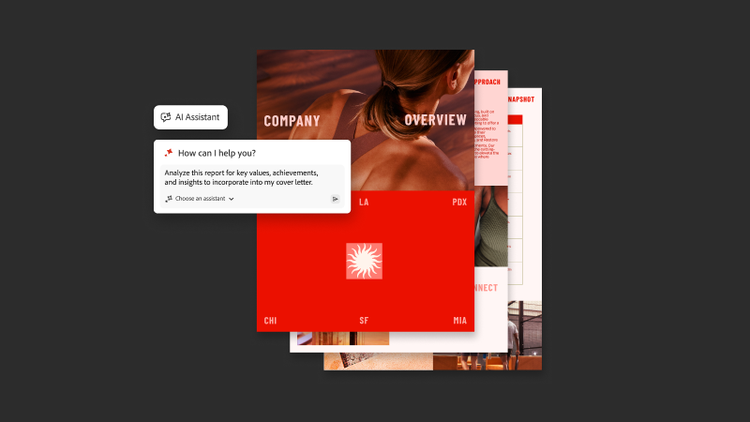
After AI has helped you clean up the draft, read it out loud. Delete or rewrite anything that sounds awkward or unnatural. Remember, whatever AI does, you’re the one who’s presenting yourself to a prospective employer, so make it sound like you.
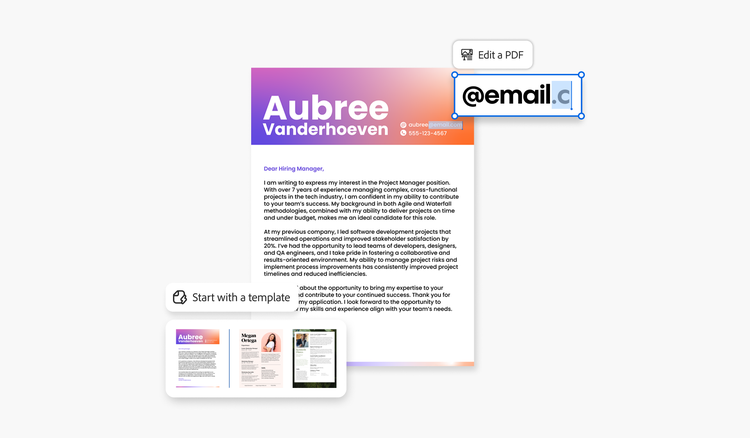
Once you have the letter written and sounding the way you want, explore free cover letter templates to help it stand out. Templates can also help restyle and format your writing so it stays clean and consistent.
How to structure your cover letter.
Cover letters are short yet formulaic. Use the following guidelines to write a cover letter worth sharing.
Headings
Headings can easily be delegated to a template or AI to personalize for different letters, as they all contain the same basic information:
- Contact information
- Date
- Address of organization
Introduction
An introduction is one of your first chances to show hiring managers who you are. Include:
- A greeting (the more specific, the better)
- The position you’re applying for
- Any connection you have with the company or its people
- The main reason(s) you are a good candidate
Body content
Create three-to-four body paragraphs that expand on your accomplishments as shown in your resume, but don’t repeat what’s already there. Write these yourself, with AI support to correct and ensure you didn’t miss anything important. Some writing prompts may include:
- State a quality you have that makes you a good candidate
- Describe a specific experience that shows you have that quality
- Include any numbers that back up the effectiveness of that quality or experience (like quantitative measures of your impact)
- Discuss how you learned a specific skill
- Show how you demonstrated a desirable characteristic through previous work experience
Closing paragraph
The closing paragraph is your final chance to make a positive impression. Your closing and signature may be part of a template and written with AI support. Keep your closing short but incorporate these characteristics:
- Reemphasize why you make a good candidate
- Express how you look forward to an interview or next step
- Thank them for their time
- Sign your name
The words should be yours. The layout doesn’t need to be. Start with a free cover letter template and spend your time on the parts AI can’t write.
Frequently asked questions
Always be honest, but a hiring manager will most likely not ask. If the topic comes up, talk about how you use AI to sharpen your voice rather than replace it.
Yes. While many positions don’t ask for them, cover letters can still help you stand out and move to the next stage.
When applying to the same position at different companies, pay attention to what each job post is looking for and which qualities it emphasizes. Tailor your cover letter accordingly.
Follow the guidelines included in the job posting. Commonly, you can upload a PDF of your cover letter along with your resume into the company’s hiring system, but some applications ask you to send the letter via email.
You may also like
title
How to write a cover letter with AI.
cardImageAltText
A cover letter being created from a template.
cardImage
Tags
caas:content-type/article,caas:products/acrobat,caas:topic/job-search,topic/resume-ai

