Key findings:
- Most workers (90%) say they are interested in using creative AI tools at work, yet only 9% say they use AI for mostly creative purposes.
- Seventy-two percent of workers believe AI has the potential to make them more creative at work.
- Seventy-three percent of workers who use creative AI at work say it improves their ability to communicate complex ideas.
- Workers estimate they spend an average of 7.5 hours a week (or nearly 400 hours a year) on tasks that could be enhanced by greater use of creative AI tools.
- Workers estimate that 32% of their regular responsibilities could be enhanced by greater use of creative AI tools.
- One in three workers say they would like to use AI tools for image and video generation, but currently do not.
- One in three workers have received training on creative AI tools from their employer.
For all the discussion of AI transforming the workplace, the large majority of employees still utilize it for relatively ordinary tasks. Drafting emails, summarizing documents, and answering simple questions are all helpful use cases, but one has to wonder if we have even begun to scratch the surface in terms of truly transformative uses of AI in the workplace.
To better understand the current state of creative AI adoption, we surveyed over 1,000 full-time workers who use AI at work at least once a week. The findings reveal a growing gap between workers’ interest in creative AI tools and the frequency with which they actually use them in practice. From AI image generators and AI video generators to brainstorming and visualization tools, employees recognize the value of creative AI workflows, but many still face barriers around training, implementation, and understanding how these tools apply to their role.
Ninety percent of workers are interested in using creative AI
Interest in creative AI at work is high, but actual usage tells a different story.
Before diving into the data, it helps to understand how creative and technical AI use differ in practice and are defined in this study.
Creative AI uses: tools used for visual or imaginative tasks: AI image or video generation, designing graphics, brainstorming ideas, creative writing, and visualizing concepts.
Technical AI uses: tools used for analytical or task-based work: summarizing documents, drafting and editing content, researching topics, analyzing data, and automating workflows.
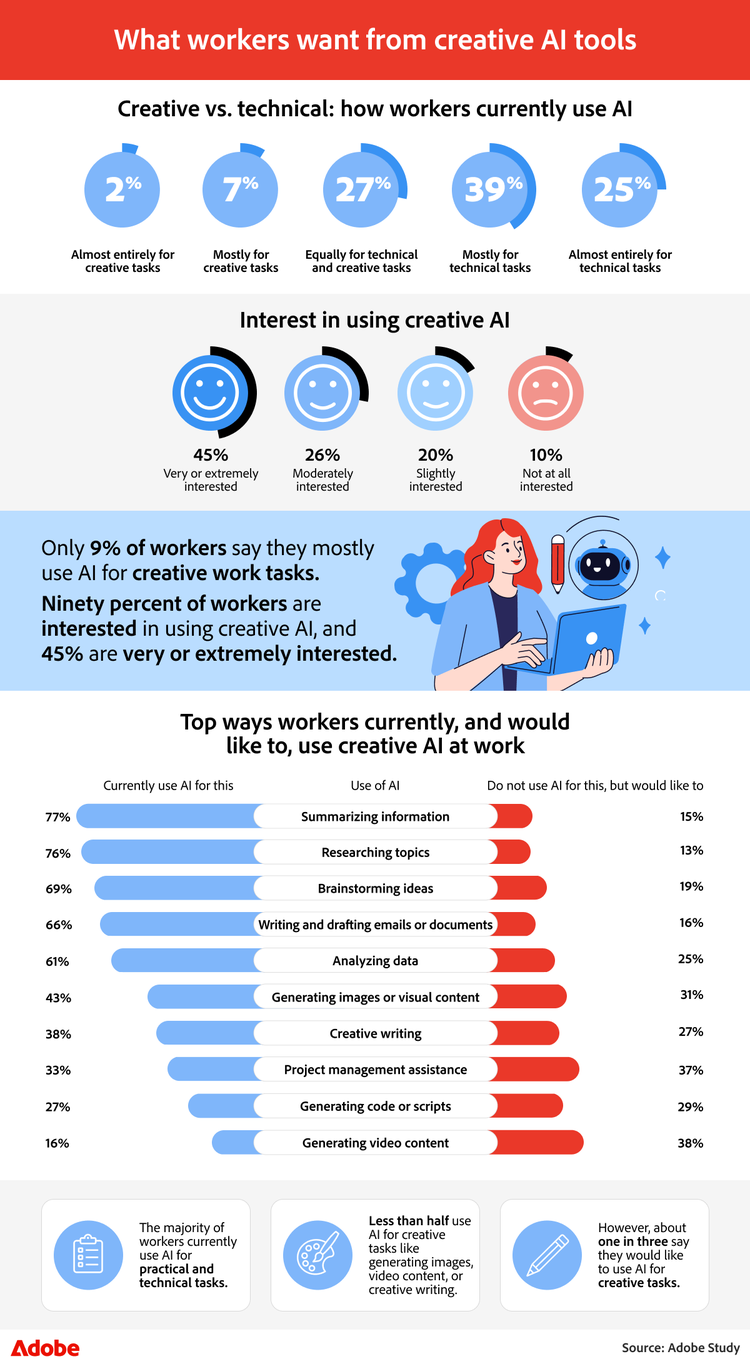
Workers are most likely to use AI for practical tasks like summarizing information (77%), researching topics (76%), brainstorming ideas (69%), and drafting documents (66%). Only 9% of workers say they mostly use AI for creative work tasks, highlighting a significant gap between current usage and future interest. One in three workers say they would like to use AI for generating images or video content, but currently do not, suggesting that many employees are still early in exploring creative AI workflows.
The percentage of workers who are very or extremely interested in using creative AI rises from 45% overall to 63% among those in primarily creative roles, reinforcing that tools like text-to-image platforms and AI photo generators are becoming part of modern creative workflows. Younger workers are also driving adoption, with 44% of Gen Z and millennials reporting that they are very or extremely interested in creative AI tools at work. As more employees experiment with creative AI tools, AI becomes a more collaborative resource, helping teams communicate ideas and visualize concepts.
Who is ahead of the creative AI curve?
While some industries are moving quickly to integrate creative AI tools into everyday workflows, others are still facing barriers around resources, training, and implementation.
How does your organization compare to others in its adoption of creative AI?
Industry
Ahead
Behind
Technology & Innovation
37%
28%
Finance, Legal & Real Estate
29%
33%
Business & Professional Services
22%
45%
Healthcare & Life Sciences
20%
35%
Retail, Food & Hospitality
16%
37%
Education
13%
40%
Workers in Technology & Innovation are the most likely to say their organization is ahead of the curve in adopting creative AI, with 37% describing their company as leading compared to competitors. Meanwhile, sectors including Business & Professional Services, Retail, and Healthcare are more likely to feel they are falling behind, suggesting that while interest in creative AI is widespread, implementation remains inconsistent across workplaces.
Education stands out as one of the industries least likely to feel ahead in creative AI adoption, with only 13% saying their organization is leading and 40% saying they feel behind. While educators increasingly recognize the potential of AI tools to support communication, lesson planning, and visual learning, many institutions may still be navigating limited budgets, stricter policies, and fewer training resources compared to other industries. As creative AI tools continue to evolve, from brainstorming support to generating visuals through text-to-image workflows, organizations that invest in training and practical adoption strategies may be better positioned to help employees integrate AI into their day-to-day work.
Workers say a third of their work could be enhanced by creative AI
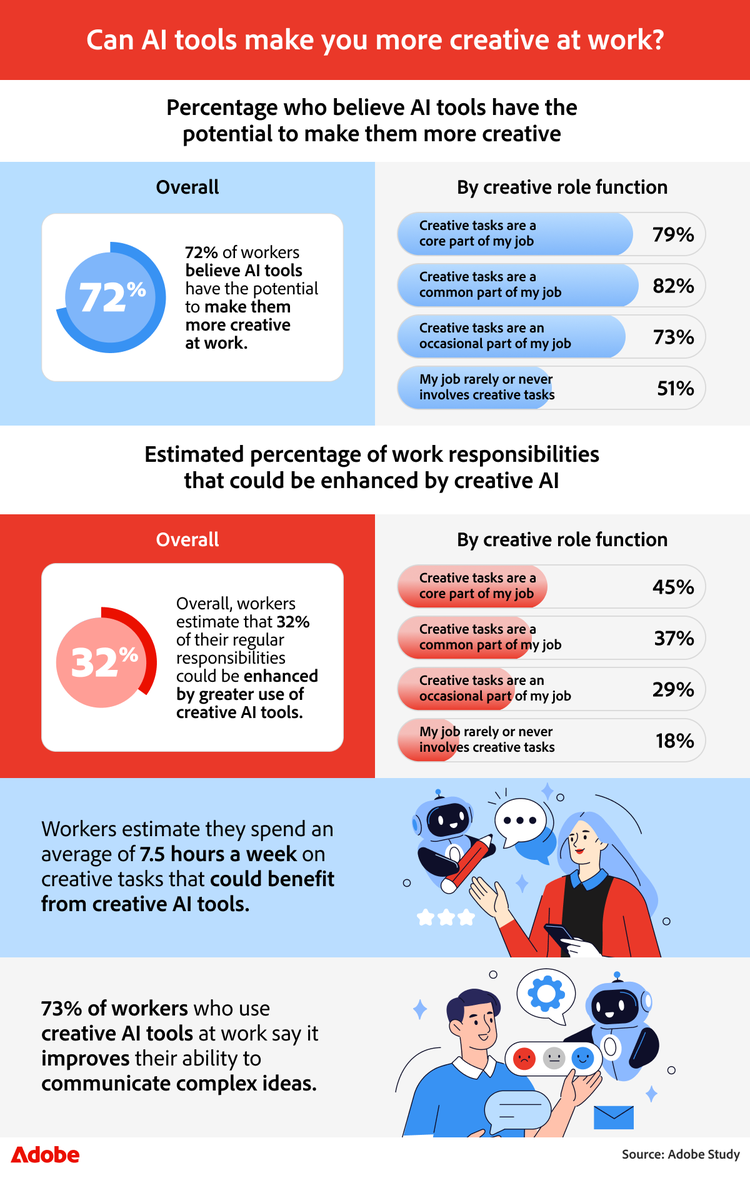
Overall, 72% of workers believe AI tools have the potential to make them more creative at work, reinforcing the growing shift toward AI-supported creative workflows. Workers estimate that nearly one-third of their regular responsibilities could be enhanced through greater use of creative AI tools, while also reporting that they spend an average of 7.5 hours a week on tasks that could benefit from creative AI support.
The impact is especially noticeable among younger workers and employees in creative roles. Workers whose jobs involve many creative tasks estimate that as much as 45% of their responsibilities could be enhanced by creative AI, while 71% of Gen Z and millennials say AI tools have the potential to make them more creative at work.
Belief in creative AI’s potential is also consistently high across different sectors. Below are the percentage of workers who believe AI has the potential to make them more creative, by industry:
- Technology & Innovation: 86%
- Retail, Food & Hospitality: 85%
- Healthcare & Life Sciences: 85%
- Business & Professional Services: 83%
- Education: 83%
- Finance, Legal & Real Estate: 79%
At the same time, workers are already reporting measurable benefits from using creative AI tools in practice. Employees in Business & Professional Services are the most likely to say creative AI has improved their work (80%), followed by:
- Retail, Food & Hospitality: 74%
- Technology & Innovation: 73%
- Healthcare & Life Sciences: 71%
- Finance, Legal & Real Estate: 68%
- Education: 67%
As more employees experiment with AI-generated images, brainstorming tools, and visual workflows, creative AI is becoming increasingly integrated into how modern teams develop, communicate, and refine ideas at work.
One in three workers have received training on creative AI tools
Interest in creative AI tools is growing, but many workers are unsure about how to incorporate them into their everyday roles. While more employers are encouraging AI adoption, formal training and clear guidance are still lacking in many workplaces.
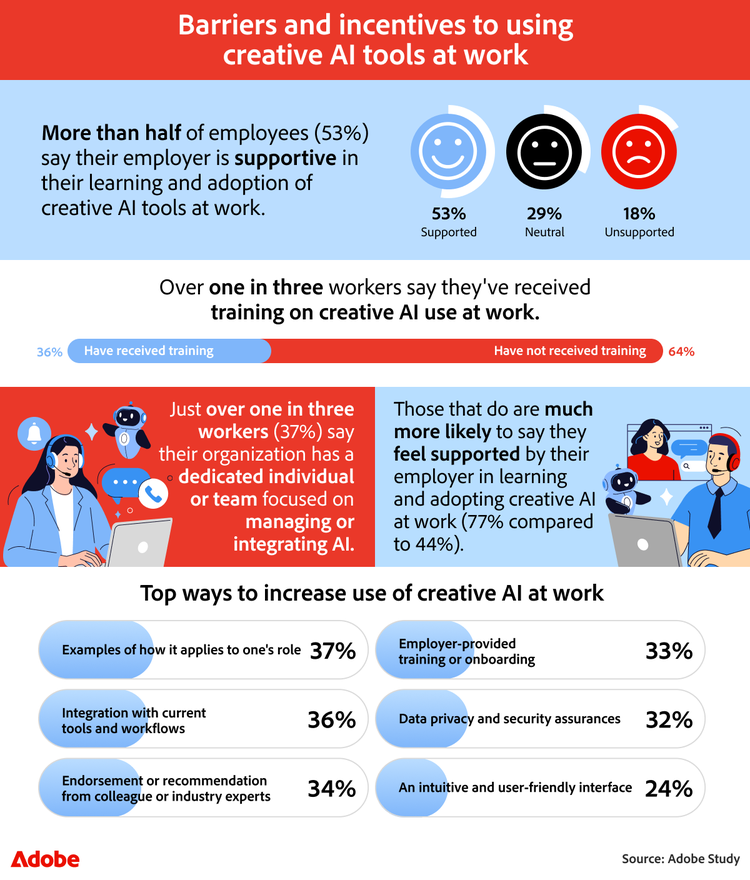
More than half of workers (53%) say their employer supports learning and adopting creative AI tools at work, yet only one in three reports receiving formal training on creative AI use. Employees are interested in experimenting with creative AI, but many lack the training needed to confidently integrate these tools into their roles. Workers say the biggest factors that would increase adoption include:
- Examples of how AI applies to their specific role: 37%
- Better integration with existing tools and workflows: 36%
- Recommendations from colleagues or industry experts: 34%
- Employer-provided training or onboarding: 33%
- Data privacy and security assurances: 32%
Organizational investment plays a major role in how supported employees feel when adopting creative AI. Workers whose organizations have dedicated individuals or teams focused on AI integration are significantly more likely to feel supported in learning and experimenting with new tools. As creative AI becomes more integrated into workplace communication and content creation, tools like AI summary generators, AI document generators, and AI video generators are increasingly being viewed as practical workflow tools rather than niche creative software. However, employees appear to be looking for clear guidance on how these tools fit into their existing responsibilities before they fully embrace them at work.
Creative AI blockers
For many employees, the challenge of using creative AI tools is less about willingness to use AI and more about understanding how these tools fit into their specific role and existing workflows.
Top barriers to using creative AI at work
Perceived relevance to role
47%
Lack of training or resources
29%
Lack of clear company policy or guidelines
29%
Difficulty integrating with existing workflows
27%
Cost of tools
26%
Lack of access to tools
24%
Lack of knowledge on how to use creative AI tools
24%
Time constraints
20%
Resistance from colleagues/management
13%
The biggest barrier to adopting creative AI at work is relevance: nearly half of workers (47%) say they are unsure how it applies to their role. Other leading challenges include lack of training or resources (29%), unclear company policies (29%), and difficulty integrating AI into existing workflows (27%). Many workers still associate AI primarily with technical tasks, even as tools like AI video generators and text-to-image platforms become more accessible across industries.
For many employees, creative AI tools can serve as support systems that improve communication and development, rather than replacing existing workflows altogether. Workers can use creative AI to:
- Brainstorm ideas or develop early concepts
- Refine rough ideas into more polished presentations
- Visualize workflows, processes, or campaign ideas that are difficult to explain with text alone
- Quickly create mockups, presentations, or AI-generated images for collaboration
- Support creative problem-solving and faster iteration
Wider adoption may depend less on the tools themselves and more on helping workers understand how creative AI can support the work they already do. As organizations continue experimenting with AI integration, providing clearer examples, practical training, and workflow-specific use cases may help employees feel more confident using creative AI in meaningful and productive ways.
Closing the creative AI gap at work
Creative AI adoption is increasingly limited by implementation. Workers across industries recognize the potential of creative AI tools to improve communication, streamline workflows, and support more creative thinking at work, yet many still primarily use AI for technical or administrative tasks because they lack the knowledge and training to integrate them into their workflows. As AI tools continue to evolve, workers can learn to apply creative AI to improve collaboration, ideation, and problem-solving.
Tools like Adobe Firefly and Adobe Acrobat help bridge that gap by giving workers ways to create, refine, and present ideas across both creative and technical workflows. As organizations continue adapting to the next phase of AI adoption, the employees and teams who embrace experimentation, continuous learning, and creative AI fluency will likely be best positioned to work more efficiently, and more creatively, in the evolving workplace.
Methodology
To explore how Americans’ perceptions and experiences around AI use at work, we surveyed 1,002 people who are employed full time who use AI at work once a week or more often. The data has a 95% confidence level and a low three percent margin of error. Because this exploratory research relied on self-reported data, respondents may have biases, and discrepancies may exist between their answers and their actual experiences.
Keep exploring
title
The AI Use Iceberg: Moving Beyond Basic Tasks at Work
cardImageAltText
Illustration of a person standing in the middle of a vortex of charts, calendars, clocks, code, and other digital tools that symbolize the difficulties and roadblocks of navigating AI use and adoption in the workplace.
cardImage