Key findings:
- Employees report receiving an average of 13 individual onboarding documents and spending 12 hours reviewing materials in the first week of a new job.
- The top 10 percent of employees receive more than 30 documents and spend more than 35 hours reviewing.
- Employees say only 60 percent of all onboarding materials are truly necessary or important to their role.
- Forty-four percent of employees say they retain half or less of their onboarding materials.
- IT information, legal & compliance, and AI use policies are the least retained onboarding topics.
- One in four employees say confusion or gaps in their onboarding had a significant or moderate negative impact on their job performance or confidence.
- More than one in five employees questioned their decision to join a company due to their onboarding experience.
- Forty-one percent of employees have signed or acknowledged an onboarding document without fully reading it.
- The top onboarding improvement employees want is a single searchable hub for all documents or materials.
Starting a new job often means navigating a large volume of paperwork, policies, training materials, and administrative tasks in a short amount of time. As onboarding processes become increasingly digital, especially in hybrid and remote workplaces, employees are expected to quickly review, retain, and acknowledge important information across multiple documents and systems. While onboarding is designed to help employees feel prepared, disorganized or overwhelming experiences can negatively impact their confidence, clarity, and early job performance.
To better understand how employees experience onboarding today, we surveyed over 1,000 fully employed people in the U.S. who started a new job within the last two years. The findings reveal a growing gap between the amount of onboarding information employees receive and how much they actually retain.
How much onboarding information is too much?
For many employees, the onboarding process requires reviewing a large volume of documents and information in a short amount of time. As onboarding materials continue to expand across digital platforms, employees may struggle to retain the information that matters most.
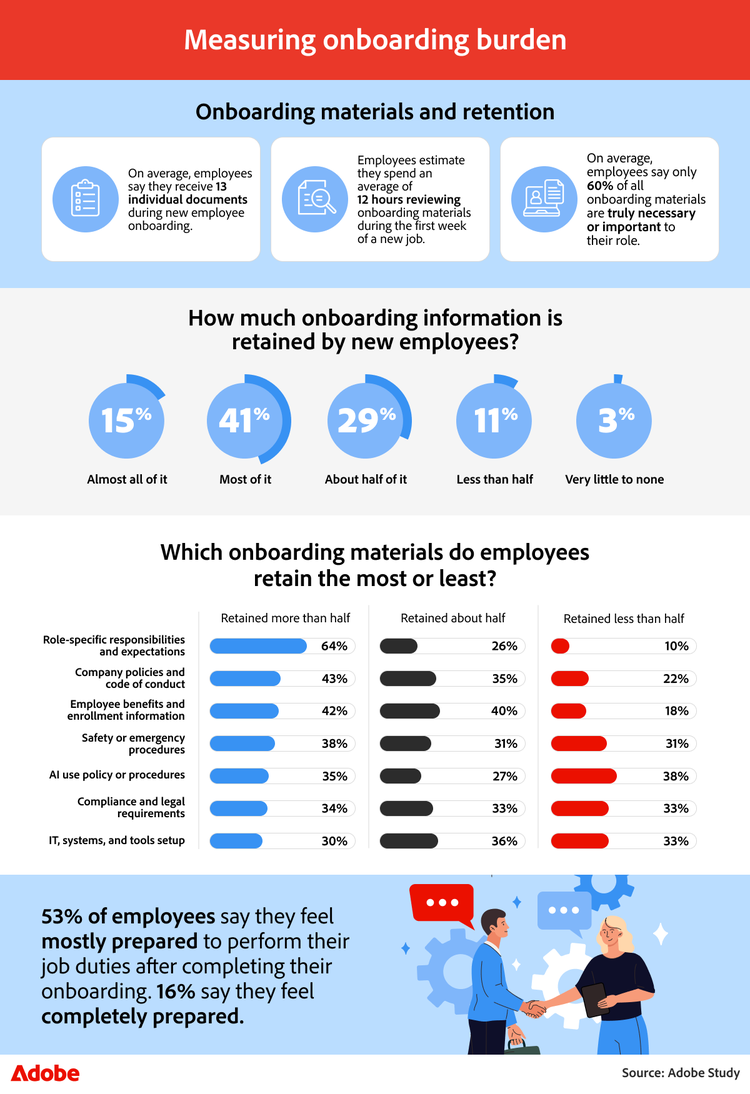
Employees report receiving an average of 13 individual onboarding documents and spending roughly 12 hours reviewing materials during their first week at a new job. Despite the amount of information shared, employees say only 60 percent of onboarding materials are truly necessary or important to their role. While 56 percent of employees say they retain more than half of their onboarding materials, 44 percent retain about half or less, highlighting how difficult it can be to absorb large amounts of information all at once.
Since onboarding can sometimes prioritize volume over clarity, there are clear gaps in which onboarding materials employees remember most. Role-specific responsibilities and expectations are the most retained topics, while IT information, legal and compliance requirements, and AI use policies are among the least retained. Thirty-eight percent of employees report that their onboarding did not include any information on AI use policies, the highest among any onboarding category. Of employees who did have AI policy info in their onboarding, 38 percent said they retained less than half and 14 percent said they retained little to none of it.
Hybrid employees report the lowest retention overall, with only 47 percent saying they retain more than half of their onboarding information compared to 59 percent of both fully remote and fully on-site employees. Retention also varies by generation and industry, with Baby Boomers and employees in education reporting some of the lowest levels of onboarding retention overall. At the same time, fully remote employees are the most likely to describe their onboarding experience as mostly or very organized, reinforcing how centralized and searchable onboarding materials may help employees better navigate document-heavy onboarding processes.
For organizations managing large onboarding packets, tools that can merge PDF files, organize materials in one place, and simplify how employees review or sign PDF documents may help reduce some of the friction new hires experience during their first weeks. For teams exploring how to combine PDF files into more centralized onboarding packets, simplifying document access may also help employees retain important information more effectively.
Files and formats
Onboarding occurs across digital documents, training platforms, videos, and shared systems, but some file formats are more common than others for distributing important onboarding information.
Most common files and formats used in onboarding
PDF documents
58%
A digital HR portal or onboarding platform
52%
Interactive training or courses
48%
Printed or physical documents
47%
Video or multimedia content
43%
A shared drive or cloud folder (e.g., Google Drive, SharePoint)
34%
Verbal instruction, with no accompanying documents or media
30%
PDF documents are the most commonly used onboarding format, with 58 percent of employees saying they received onboarding materials in PDF form. Digital HR portals and onboarding platforms follow closely behind, while interactive training courses, printed materials, and video content also remain common parts of the onboarding experience. The findings suggest that while onboarding has become increasingly digital, many organizations still rely heavily on document-based workflows to share policies, collect signatures, and organize employee information.
Consequences of poorly organized onboarding
Many employees say poor onboarding experiences affect not only how informed they feel, but also their confidence, stress levels, and overall perception of a new employer.
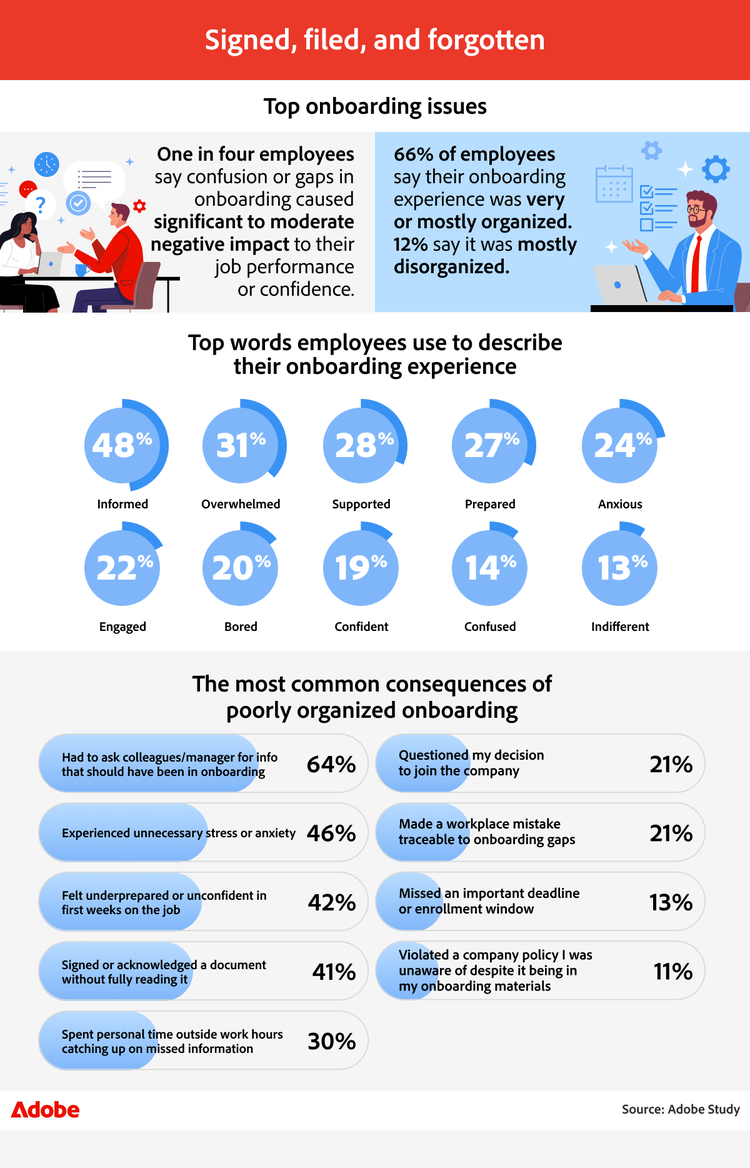
One in four employees says confusion or gaps in their onboarding had a moderate or significant negative impact on their job performance or confidence. While many employees describe their onboarding experience positively overall, the findings reveal that disorganized onboarding can still create lasting friction during the first weeks of a new role. Nearly half of employees say onboarding caused unnecessary stress or anxiety, while 42 percent say they felt underprepared or uncertain in their role because important information was unclear, difficult to locate, or never fully explained.
The findings also suggest that information overload may be causing employees to disengage from onboarding materials altogether. More than two in five employees say they signed or acknowledged a document without fully reading it, while 64 percent say they had to rely on coworkers or managers for information that should have been covered during onboarding. In many cases, employees report spending additional personal time outside of work catching up on onboarding processes or revisiting materials they struggled to retain initially.
Employee experiences also vary depending on workplace setting. Hybrid employees are the most likely to describe onboarding as overwhelming or boring, while remote employees are more likely to report feeling frustrated or indifferent toward the process. At the same time, in-office employees are the most likely to describe onboarding as informative and confidence-building. Remote workers also report some of the highest rates of feeling underprepared during their first weeks on the job, reinforcing how difficult it can be to navigate onboarding when documents, policies, and resources are spread across multiple systems or platforms.
As onboarding becomes increasingly digital, employees may benefit from workflows that make important documents easier to revisit, search, organize, and complete.
Employer onboarding mistakes
Many onboarding frustrations are not caused by the amount of information employees receive, but by how that information is delivered and organized. Employees say unclear communication, repetitive paperwork, and difficult-to-navigate documents are among the most common onboarding problems they encounter.
Most common issues employees experience with new employee onboarding
Having to provide the same personal information multiple times across different forms
63%
Policies listed in writing but never verbally explained or discussed
56%
Onboarding materials that did not reflect the actual culture or day-to-day
41%
Being unable to locate a document or resource after my first week
38%
Materials written in overly complex or legalistic language
38%
Documents that contradicted each other or contained outdated information
28%
A benefits or compliance deadline that was unclear or easy to overlook
25%
The most common onboarding issue employees report is having to provide the same personal information multiple times across different forms and systems, with 63 percent saying they experienced this during onboarding. More than half of employees also say policies were listed in writing but never properly explained or discussed, while others report receiving onboarding materials that did not reflect the actual day-to-day reality of the role. As a result, onboarding can begin to feel fragmented rather than functioning as a clear, centralized process.
The experience also varies depending on the workplace setting. Hybrid employees are significantly more likely to receive onboarding materials written in overly complex or legalistic language, while remote employees are more likely to encounter documents containing contradictory or outdated information. Remote workers are also the most likely to say they struggled to locate onboarding resources after their first week.
As organizations continue managing onboarding digitally, tools like Adobe Acrobat, online PDF editor workflows, and other PDF editor free tools can help teams keep onboarding materials updated, organized, and easier to navigate across remote, hybrid, and in-office environments.
What employees want from the onboarding experience
While many employees say they were generally satisfied with their onboarding experience, the findings suggest there is still significant room for improvement. Employees increasingly want onboarding processes that feel more organized, searchable, and easier to navigate long after the first week on the job.
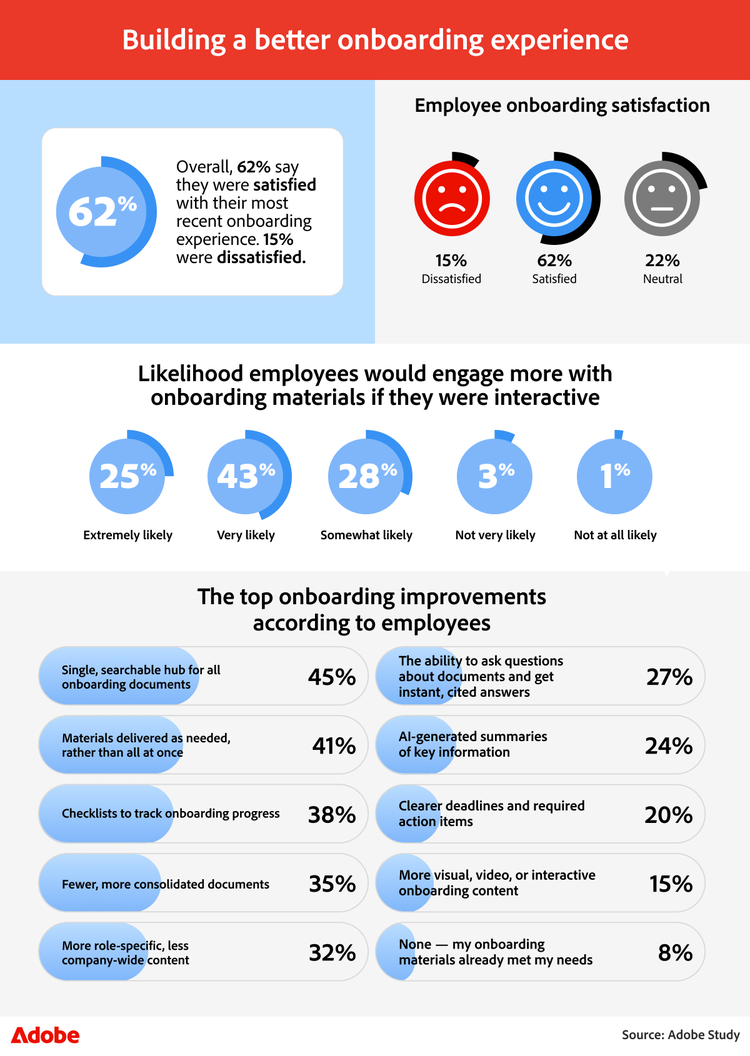
Sixty-two percent of employees say they were satisfied with their most recent onboarding experience, though satisfaction levels vary by seniority and industry. Director- and manager-level employees report the highest onboarding satisfaction rates, while employees in education and creative industries report some of the lowest. Even across different workplace environments, employees share similar concerns about onboarding materials feeling disorganized, repetitive, and difficult to access over time.
The most requested onboarding improvement is a single, searchable, centralized hub for onboarding documents and resources. Employees also want fewer, more consolidated documents, clearer onboarding checklists, and onboarding materials delivered gradually rather than all at once.
Many employees also say they would engage more with onboarding materials if the experience felt more interactive, visual, or easier to navigate digitally. Younger employees, in particular, are more likely to want role-specific onboarding content and centralized document access, reinforcing the idea that onboarding expectations continue to evolve alongside modern digital workflows.
Satisfaction with onboarding also appears closely tied to the format and accessibility of materials employees receive.
These are percentage of employees who reported they were satisfied with their onboarding experience, by the formats their onboarding materials were provided in:
- PDF documents: 60 percent
- A digital HR portal or onboarding platform: 55 percent
- Printed or physical documents: 49 percent
- Interactive training or courses: 48 percent
- Video or multimedia content: 44 percent
- A shared drive or cloud folder (e.g., Google Drive or SharePoint): 35 percent
- Verbal instruction, with no accompanying documents or media: 27 percent
Employees value onboarding systems that make information easier to review, search, revisit, and organize over time. Tools like Adobe Acrobat can help support these workflows by allowing teams to combine PDF files into more streamlined onboarding packets, simplify document sharing, and create searchable onboarding resources that employees can easily return to after their first week.
Better onboarding starts with better information management
Modern onboarding is no longer just an introduction to a company, it’s an exercise in navigating documents, systems, policies, and digital workflows in a short amount of time.
While many employees report positive onboarding experiences overall, the findings reveal clear opportunities for organizations to simplify how information is shared, accessed, and retained. Employees are looking for onboarding processes that feel more centralized, easier to navigate, and less overwhelming, especially as remote and hybrid work continue to reshape onboarding.
As onboarding continues to evolve in increasingly digital workplaces, tools like Adobe Acrobat can help organizations streamline onboarding workflows by making it easier to sign PDF documents, organize materials under a single source, and create more accessible onboarding experiences for employees across all workplace settings.
Methodology
To explore employee onboarding experiences, we surveyed 1,006 fully-employed people in the U.S. who started a new job within the last two years. The data has a 95 percent confidence level and a low three percent margin of error. Because this exploratory research relied on self-reported data, respondents may have biases, and discrepancies may exist between their answers and their actual experiences.
Keep exploring
title
Onboarding Overload: Tips to Streamline New Hire Info
cardImageAltText
A white silhouette of a person walking while many red and white papers and documents float around it, demonstrating the overwhelming paperwork during new hire onboarding for employees.
cardImage