#1E1E1E

Adobe Acrobat

Why India sits within a new generation of markets fast adopting AI for technical tasks

India is emerging as one of the most dynamic economies adopting AI for technical and analytical workflows, as younger professional populations integrate intelligent tools directly into daily business operations. This article explores how Indian professionals and growing businesses are embedding AI into technical documentation, reporting, and data handling to accelerate productivity, strengthen compliance and maintain competitive advantage.

Explore Acrobat Studio

AI engineers in India collaborating on technical tasks at a modern office workstation

https://main--da-dc--adobecom.aem.page/in/dc-shared/fragments/promo-banners/acrobat-studio

AI in technical workflows is no longer limited to large enterprises or specialist innovation teams. Across fast growing economies, it is becoming a practical tool used daily to process documents, analyse data, and manage increasingly complex reporting requirements.

Recent research shows a clear relationship between workforce age and the share of technical documents processed with AI. Countries with older median populations tend to show higher levels of technical AI use, reflecting the scale and complexity of long-established business environments. However, younger professional economies are integrating AI into their workflows earlier in their growth cycle rather than waiting for enterprise scale infrastructure.

India reflects this shift clearly. With a median age of roughly 28 and technical AI use already just over 5% (approximately 5.5%), recent research from Adobe Data Insights shows that professionals and growing businesses are embedding AI directly into core business activities. Many Indian teams now see AI as a daily productivity tool used to analyse documents, summarise reports, and support operational decisions.

For SMB owners, founders, and next generation professionals, this early adoption is shaping how technical work is completed. AI for business leaders and operational teams alike is becoming a practical layer within daily workflows, enabling faster delivery, clearer insights, and stronger governance across expanding operations.

Why younger professional economies are integrating AI into technical work earlier

In many established markets, AI adoption has traditionally followed a staged approach, beginning with experimentation before expanding into enterprise wide deployment. Younger professional economies are taking a more direct path by integrating AI into everyday work from the outset.

This shift reflects practical necessity. Fast growing service businesses in India often manage increasingly complex technical and analytical workloads without the large support teams typically found in older markets. Founders, managers, and young professionals frequently handle documentation, reporting, and data interpretation themselves. AI tools provide a way to maintain speed and accuracy without increasing administrative burden.

As competition increases across global service industries such as consulting, finance, marketing, and technology, the ability to complete technical work quickly and accurately is becoming a defining advantage. AI allows professionals to analyse reports, interpret data, and prepare documentation efficiently while maintaining quality and consistency.

Rather than treating AI as a specialist capability reserved for innovation teams, many organisations are embedding it directly into daily document workflows. This approach enables them to scale operations effectively while maintaining oversight across technical, financial, and compliance related activities.

How AI helps Indian businesses streamline document workflows

AI powered analysis and summarisation for technical files

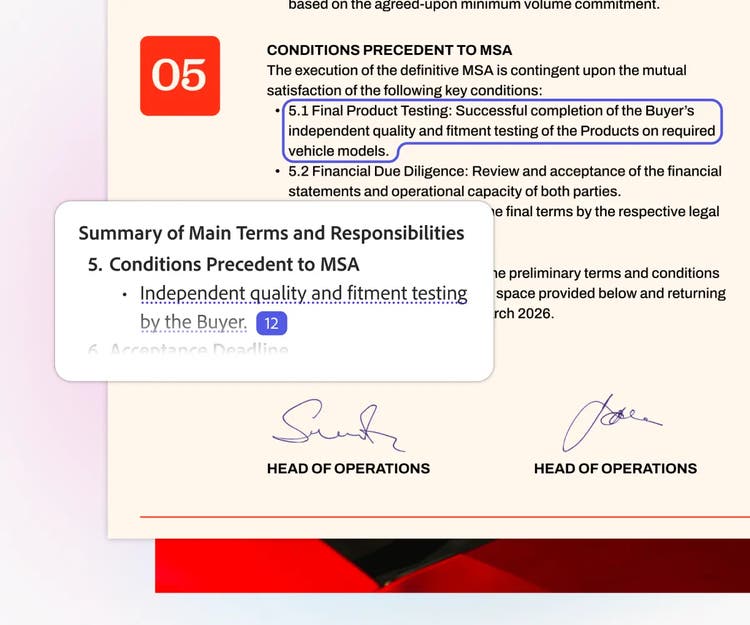
AI-generated summary highlighting terms in business contract

Technical documentation often includes detailed reports, contracts, data sheets, and analytical summaries. Reviewing these materials manually can slow decision making and increase the risk of oversight. AI powered document analysis tools allow professionals to extract key insights quickly, highlighting relevant data points, obligations, and trends.

For organisations building a clear AI governance framework, this capability supports informed decision making across leadership and operational roles. Professionals can interpret complex technical documents without relying on specialist software or extensive manual review, allowing them to maintain clarity and control as operations expand.

Converting and editing technical documents efficiently

Editable PDF interface displaying a fashion trend report cover, with highlighted text elements being modified using an “Edit a PDF” tool.
AI-powered tools offer PDF, Word, Excel, and image conversion options over eCommerce sales data charts.

Many businesses receive technical reports, contracts, and data documents in formats that are difficult to edit or reuse. Converting these files into usable formats can slow workflows and create unnecessary friction.

Fast conversion tools allow professionals to transform reports, contracts, and technical documentation into editable formats within seconds. This simplifies collaboration, reporting updates, and data extraction. For fast growing teams, the ability to repurpose technical documentation quickly supports greater agility and responsiveness.

Mobile first workflows for modern professionals

India’s professional workforce is highly mobile and digitally connected. Many teams operate across locations, client environments, and remote settings. Mobile first document workflows allow professionals to review, edit, and share technical files from smartphones or tablets without losing functionality.

This flexibility ensures that reporting, approvals, and technical updates continue without interruption. Whether reviewing documents between meetings or approving reports while travelling, mobile access supports continuous productivity and faster decision cycles.

Secure sharing and version control for business documentation

As technical and analytical documentation grows, maintaining secure access and version control becomes essential. Permission based sharing ensures that only authorised individuals can access specific documents, while version tracking provides visibility over edits and updates.

These capabilities support AI compliance by ensuring that sensitive information is managed securely and that document histories remain transparent. For organisations handling financial, legal, or operational data, secure collaboration is essential to maintaining trust and regulatory alignment.

Simplifying complex document handling without specialist tools

AI strategy planning roadmap with PDF spaces, growth metrics, and data statistics in red design

Many growing organisations operate without large IT departments or dedicated document management teams. Tools that simplify complex document handling allow professionals to manage technical workflows independently.

From summarising data heavy reports to preparing structured presentations and updating contracts, AI powered document tools enable teams to handle complex documentation efficiently. This accessibility allows businesses to maintain professional standards while scaling operations.

How AI improves compliance and governance in fast-growing economies

As organisations expand and technical workloads increase, maintaining compliance becomes more complex. Regulatory documentation, contractual obligations, and reporting requirements must all be managed accurately and consistently.

AI is playing an increasingly important role in supporting these responsibilities. Many organisations are adopting AI-assisted compliance workflows to track obligations, highlight risks, and maintain structured documentation across business activities. These tools help reduce manual workload while improving oversight and accuracy.

For leaders and managers, understanding how can AI help in regulatory compliance is becoming increasingly important. AI can identify key clauses within contracts, highlight regulatory requirements within documents, and maintain structured audit trails that support accountability.

Integrating AI into document workflows also strengthens governance. Clear version histories, secure sharing protocols, and automated summaries ensure that decisions are based on accurate and up to date information. As a result, businesses can maintain strong governance practices while continuing to scale.

Data Privacy

Your work. Your data. Always protected.

With AI Assistant, your content stays yours because it’s never used to train Adobe’s AI models. Your documents, chats and interactions are fully protected. Plus, AI responses are always cited back to your source documents for full transparency.

Learn more | Learn more about how your docs and data are safe when using AI Assistant.

Why early AI adoption gives Indian SMBs a competitive advantage

India’s fast AI adoption reflects a shift towards embedding AI directly into daily technical workflows, rather than relying on large enterprise systems. This enables teams to handle complex tasks without adding administrative overhead.

Reports are analysed faster, documents updated efficiently, and decisions validated with greater confidence. For Indian SMBs, early AI adoption creates a clear competitive advantage and helps maintain speed, accuracy, and compliance while scaling.

As competition intensifies, the ability to process information quickly will define success, with India well positioned to lead this shift.

Frequently asked questions.

How does early AI adoption create a competitive advantage for Indian SMBs?
Early integration of AI into technical workflows allows businesses to operate with leaner teams while maintaining high output quality. This improves turnaround time, strengthens accuracy in reporting and documentation, and enables faster response to client and market demands. For service based businesses competing globally, the ability to complete technical work quickly and reliably becomes a clear operational and commercial advantage.
How can smaller teams build an AI governance framework without complexity?
An effective AI governance framework does not require large enterprise systems. Smaller teams can begin by standardising document workflows, enabling version tracking, restricting access permissions, and defining clear usage policies for AI assisted document analysis and reporting.
What risks should businesses consider when using AI for technical documents?
Key considerations include data security, version control, and regulatory alignment. Using secure document platforms with permission based sharing and audit trails helps reduce risk while maintaining productivity.
How can AI help in regulatory compliance as businesses scale?
AI can flag contractual obligations, highlight compliance requirements in documentation, and maintain structured audit trails. This reduces manual review time and strengthens oversight as regulatory complexity increases.
How is AI adoption in India likely to evolve beyond current levels?
Given India’s young workforce, mobile first professional culture, and expanding service economy, technical AI adoption is likely to rise significantly. As more businesses integrate AI into core documentation and reporting workflows, usage is expected to move well beyond current levels.

More resources

Content as a Service v3 - Thursday, 2 April 2026 at 11:15