.

The Digital Skills Gap.

From editing documents and analysing data to collaborating remotely across different teams, digital skills are crucial in many modern workplaces. Whether you work in marketing or manufacturing, the ability to use digital tools confidently is required in almost every sector. Yet despite this growing reliance on technology, a gap remains between the skills people need and the confidence they have.

Infographic showing the title The Digital Skill Gap

With this in mind, we decided to survey 2,000 UK adults to reveal the digital skills considered the most crucial in today’s workplaces. We also analysed Google search behaviour to uncover some of the most common daily struggles and frustrations, revealing where gaps in knowledge are likely to disrupt work.

Alongside our findings, we’ve included some practical tips to help employees build confidence and work more effectively, including how Adobe Acrobat can help with managing, editing, and sharing documents.

The Digital Skills Gap: Key Takeaways

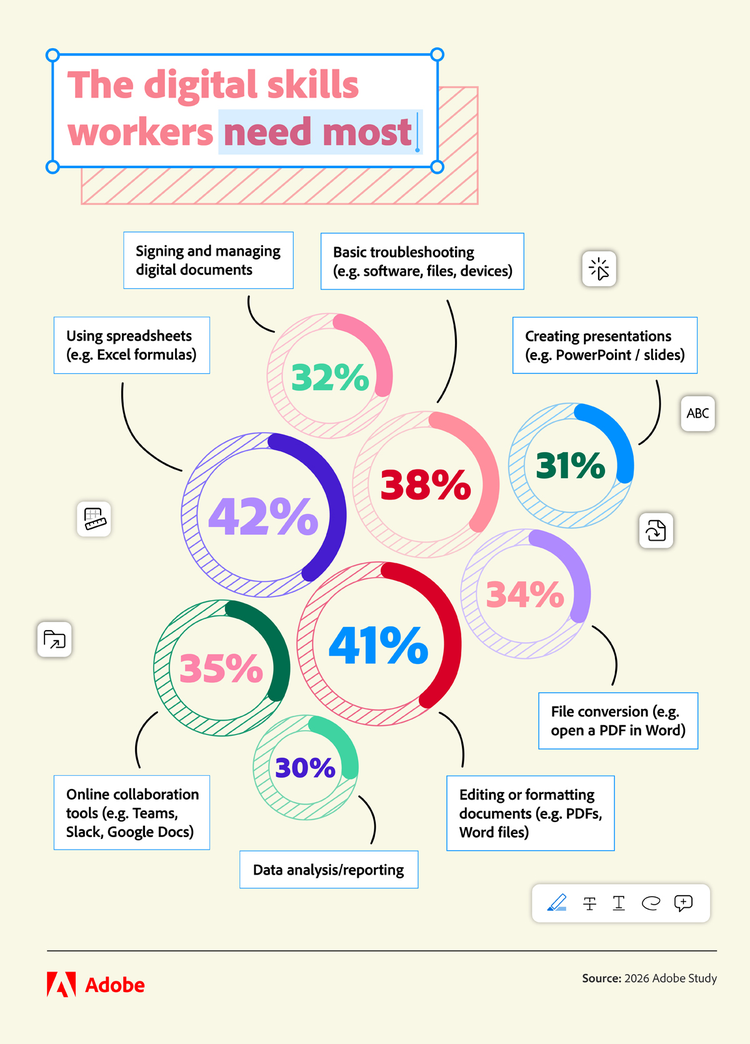
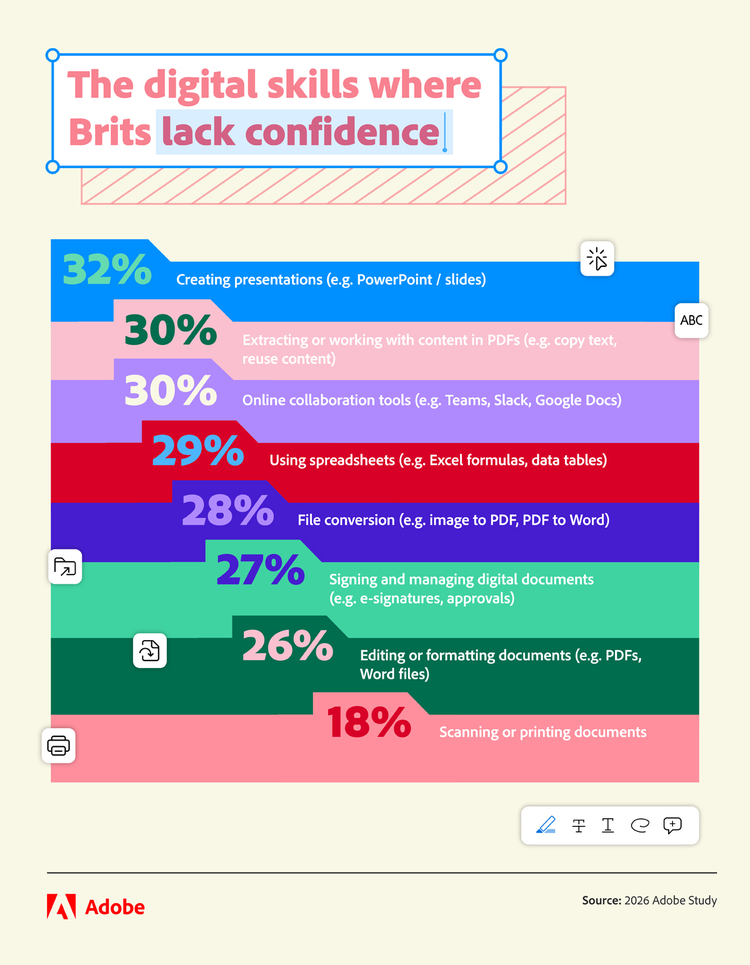
Our findings point to a clear disconnect between the skills people believe are essential and what they feel confident doing day-to-day. For instance, we found that using spreadsheets and formatting documents are considered the most essential digital skills in the workplace (mentioned by 42% and 41% of those we surveyed), yet 26% admitted that they lack confidence in these areas. Additionally, 32% said that they often struggle to create polished PowerPoint presentations.

Another area where people lack confidence is PDFs, with the following struggles mentioned:

  • 30% don’t feel confident extracting or working with content in PDFs
  • 28% struggle with file conversion, such as image to PDF or PDF to Word
  • 27% lack confidence signing and managing digital documents

These challenges are also reflected in Google search data, with thousands of people each month searching for help with common PDF tasks. The most popular searches include compressing PDFs, with 137,966 average monthly searches, and merging and combining PDFs, with 88,298. Those searching for help with editing PDFs also generated 60,258 average monthly searches and 723,100 total searches over twelve months.

Searches for signing PDFs are also rising, with a recent 3-month uplift of 23.5%, as well as filling in PDFs which has seen a 23.2% rise. Searches for rearranging the pages in a PDF have risen by 11.6% too, while searches for how to add a signature to a PDF have risen by 11.1%, reflecting the shift towards more digital-first workflows.

While many workers are relying on traditional search engines like Google to help them develop new digital skills, 42% of those we surveyed are also relying on colleagues and friends to assist them.

Infographic showing essential digital skills: Using spreadsheets (42%), editing or formatting documents (41%), basic troubleshooting (38%), online collaboration tools (35%), file conversion (34%), signing and managing digital documents (32%), creating presentations (31%), data analysis/reporting (30%), source Adobe study 2026

The digital skills workers need most

How do digital skills vary by age?

The adoption of digital skills varies by age group too, including where people lack the most skills, the impact this has on their work, and what they’re doing to upskill and develop.

We found that people over the age of 55 are more likely to think using spreadsheets is the most important digital skill (46%), compared to just 34% of those aged between 18-34. Meanwhile, those in the 35-54 age group deem editing documents and mastering online collaboration tools the most important (43%).

Where employees tend to seek help, people aged 55+ are the most likely to ask a colleague or friend for assistance with digital tasks, whereas younger generations prefer to search online for instructions (40% of 18-34 and 44% of 35-54). Interestingly, only 7% of those over 55 would use AI to solve a query, yet this rises to 29% for those aged 18-34.

But which digital skills do people really feel most confident using? Well, regarding editing and formatting documents, younger generations are far more confident, with 77% of those aged 18-34 feeling very confident, whereas this falls to just 47% of those aged 55+. It’s a similar story when looking at creating presentations, with 76% of the 18-34 age group feeling confident, compared to just 35% of those who are over 55.

When it comes to signing and managing digital documents, the 35-54 age group expressed the most confidence (74%), and this age group is also the most confident when scanning and printing (80%). Overall, younger generations tend to feel more confident across most digital workplace tasks than their older colleagues.

Digital skill adoption across different industries

As with age, the digital skills gap varies significantly from industry to industry, with different sectors facing distinct challenges depending on the nature of their work.

First, we found that in fast-paced environments like FMCG, 50% of workers report lacking confidence with editing or formatting documents like PDFs. Meanwhile, in the Arts and Culture sector, 39% are not fully confident in using spreadsheets or doing file conversion. While these skills may not be crucial to creative roles, they still play an important part in planning and organisation

As expected, industries with fewer desk-based jobs tend to struggle more with formal digital processes: half of those in Mining, Quarrying, Oil and Gas Extraction aren’t confident in signing and managing digital documents with e-signatures. Additionally, over half of those in the Transport and Storage industry lack confidence in creating presentations. Those in Mining, Quarrying, Oil and Gas Extraction are also more likely to ask a colleague for help (50%), compared to 36% of those in Transport.

Elsewhere, 42% of employees in Non-Profits or Charities struggle when extracting or working with content in PDFs, while 38% of people in Scientific and Technical Services aren’t confident in online collaboration tools such as Teams, Slack or Google Docs. Finally, we found that 36% of people working in Agriculture, Forestry and Fishing lack confidence when it comes to scanning or printing documents.

While not every digital skill is equally relevant across all roles, these findings highlight that confidence gaps do exist across sectors, and perhaps more importantly, that there’s room for improvement when supporting the development of digital skills.

Infographic showing least confident digital tasks: creating presentations (32%), extracting or working with content in PDFs (30%), online collaboration tools (30%), using spreadsheets (29%), file conversion (28%), signing and managing digital documents (27%), editing or formatting documents (26%), scanning or printing documents (18%), source Adobe study 2026.

The digital skills where Brits lack confidence

Improving your digital skills in the workplace

So, it’s clear that small gaps in digital skills are having a larger impact on day-to-day tasks in the workplace. However, the good news is that alongside methods like online research and peer support, there are new tools that can help you build confidence and streamline tasks.

From AI capabilities and workspace tools to PDF collaboration features, here’s how Adobe Acrobat can help:

  • Edit and update documents with ease: Instead of starting from scratch or struggling with formatting, you can edit PDFs using Adobe Acrobat. Whether you want to annotate a specific section or highlight some of your key findings, Acrobat can help you work quickly and efficiently no matter the task.
  • Quickly convert files: Whether you need to convert a PDF to Word or an Excel to PDF, Acrobat’s simple file conversion tools to help you save time.
  • Sign and share: You can fill and sign PDFs online for free, making approvals and admin tasks much more efficient. Just type, draw, or upload an image of your signature to speed up your workflow.
  • Collaborate with team members: Our document collaboration tools make working together more straightforward. Whether you’re reviewing or sharing feedback, you’re able to reduce back-and-forth and keep things moving along.

The findings highlight the digital skill gaps present in many of today’s workplaces. It’s clear that while challenges are still widespread, there are a variety of resources and tools available to help employees build confidence and work more efficiently.

If you’re looking to discover more insights and continue building on your skills, we have plenty more resources for you to explore.

Methodology

The Digital Skills Gap is based on a comprehensive national survey conducted by 3 Gem on behalf of Adobe Acrobat. The survey polled 2,000 UK adults between 18.04.2026 and 22.04.2026.

We used Google search volume data collected via DataForSEO. Keywords were grouped into comparable task-based sets to reflect how people search for documents and PDF help online. Where exact brief terms had limited search volume, broader but relevant search variants were used instead. German and Italian keyword sets were translated and localised to better reflect native search behaviour. Data was collected at both the country and city levels where relevant. Due to API constraints, monthly search volume covers the latest 12 months rather than a longer 3 to 5-year period.