APA vs. MLA: key differences
Whether you're writing a psychology paper or analyzing literature, choosing the right citation style can make or break your academic work. Learn the essential differences between American Psychological Association (APA) and Modern Language Association (MLA) formats to ensure your papers meet professional standards.

What are APA and MLA styles?
Citation styles provide standardized systems for crediting sources in academic writing. These frameworks ensure readers can locate your sources while demonstrating the depth of your research. When writing a research paper or literary review, using the appropriate citation style signals your understanding of disciplinary conventions and strengthens your credibility as a scholar.
Both APA and MLA have evolved over decades to address changing research practices, digital sources, and academic standards. Understanding their origins helps explain why each style emphasizes different elements in citations. Students across all disciplines benefit from mastering both systems, as interdisciplinary work often requires flexibility in citation approaches.
What is APA style?
The American Psychological Association developed its citation style in 1929 to standardize scientific writing. Now in its 7th edition, APA style prioritizes the recency of research by emphasizing publication dates in citations. This focus reflects the sciences' need for current data and evolving findings.
APA formatting includes specific requirements for title pages, running headers, and abstract sections. The style uses an author-date citation system, placing the publication year prominently to help readers quickly assess how recent a source is. Scientific fields value this approach because research findings can become outdated as new studies emerge.
The structure of APA papers typically includes four major sections: the title page, abstract, main body, and references. Each section follows precise guidelines regarding spacing, margins, and content organization. Professional papers may also include additional elements such as author notes and appendices.
What is MLA style?
The Modern Language Association introduced its style guide in 1951 to serve scholars in literature, languages, and related humanities fields. Currently in its 9th edition, MLA style emphasizes locating specific passages within texts by highlighting page numbers in citations.
MLA formatting takes a more streamlined approach than APA, eliminating the need for a separate title page in most cases. The style uses an author-page citation system, reflecting the humanities' focus on close reading and textual analysis. When scholars discuss specific arguments or literary passages, page numbers help readers find exact quotations quickly.
The 9th edition of MLA introduced the concept of containers, which helps writers cite sources found within larger works, such as articles in journals or episodes within television series. This flexible approach accommodates the many types of sources humanities scholars encounter in their research.
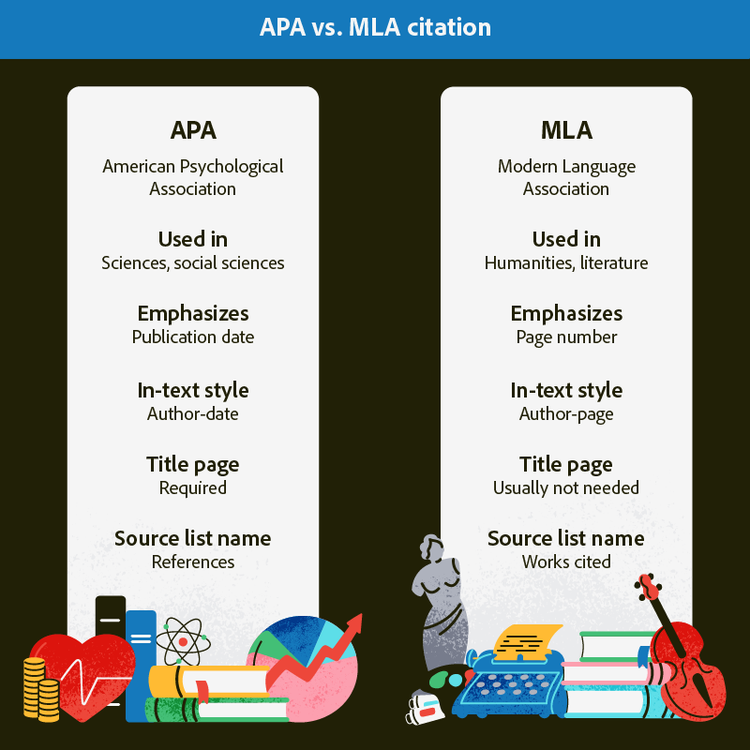
The disciplines you study typically determine which style you'll use most often:
- APA style is typically used in: psychology, education, social sciences, nursing, business, economics, criminal justice, and other scientific disciplines where research timing matters
- MLA style is typically used in: literature, humanities, language arts, cultural studies, philosophy, religious studies, and other fields focused on textual analysis and interpretation
Your professor's syllabus or assignment guidelines will usually specify which format to use. When in doubt, ask your instructor before you begin writing. Many student resources are available to help you master both citation styles throughout your academic career. Taking advantage of these resources early in your studies establishes good habits that will serve you well in advanced courses and professional settings.
APA vs. MLA citation differences
In-text citations appear within your paper's body whenever you quote, paraphrase, or reference another author's ideas. These brief citations direct readers to your full source information at the end of your document. Getting citations right demonstrates academic integrity and allows others to verify your claims.
The fundamental difference between APA and MLA citation approaches lies in what information they emphasize. APA prioritizes when research was published, while MLA prioritizes where information appears within a text. Understanding this core distinction helps you remember the specific formatting requirements for each style.
Differences and examples of in-text citations
APA format places the publication year directly after the author's name, separated by a comma.
Example: (Johnson, 2023).
MLA format pairs the author's last name with a page number, without any comma between them.
Example: (Johnson 45)
When naming the author in your text, only the page number goes in parentheses.
Example: Johnson argues that citation styles matter (45).
When including a direct quote in APA, add the page number after the date.
Example: (Johnson, 2023, p. 45). Note that APA uses "p." before single page numbers and "pp." for page ranges.
For APA citations with two authors, include both names every time, connected by an ampersand within parentheses.
Example: (Smith & Johnson, 2023).
When the authors' names appear in the sentence itself, use "and" instead.
Example: Smith and Johnson (2023) found significant results.
With three or more authors, use the first author's name followed by "et al." from the first citation onward.
Example: (Williams et al., 2022).
MLA citations with two authors include both names separated by "and" in all contexts.
Example: (Smith and Johnson 78). For three or more authors, MLA also uses "et al." after the first author.
Example: (Williams et al. 112).
In APA, use the first few words of the reference list entry (usually the title) in place of the author name, followed by the year. Titles of articles and chapters appear in quotation marks, while titles of books and reports are italicized.
Example: ("Understanding Citation," 2023).
MLA similarly uses shortened titles when no author is available. The punctuation conventions for titles in MLA match those in APA, with shorter works in quotation marks and longer works italicized.
Example: ("Understanding Citation" 15).
APA allows abbreviations after the first citation if the organization is well-known.
Example: first citation (American Psychological Association [APA], 2020), subsequent citations (APA, 2020).
APA vs. MLA: reference list vs Works Cited page
The final pages of your paper list all sources you cited, but APA and MLA use different names and formats for this section. APA calls it a "References" page, while MLA titles it "Works Cited." These aren't just different labels—each reflects distinct approaches to presenting source information and emphasizes different elements for readers.
Both styles alphabetize entries by authors' last names and use hanging indents, where the first line of each entry sits flush left while subsequent lines indent half an inch. However, the order and format of information within each entry differ significantly, reflecting each discipline's priorities.
APA inverts all authors' names (last name first) and uses initials instead of full first names: Johnson, M. R.
MLA inverts only the first author's name and includes full first names: Johnson, Michael R.
For titles, APA capitalizes only the first word and proper nouns in book and article titles (sentence case), while MLA uses title case throughout, capitalizing all major words. Publication dates appear early in APA entries (right after the author) but near the end in MLA entries.
The following comparison highlights how each style handles key elements:
Differences and examples of bibliography
APA places the date immediately after the author and uses sentence case for the title.
APA format: Williams, R. T. (2023). Understanding academic writing: A comprehensive guide (3rd ed.). Academic Press.
MLA places the date at the end and capitalizes all major words in the title.
MLA format: Williams, Robert T. Understanding Academic Writing: A Comprehensive Guide. 3rd ed., Academic Press, 2023.
APA uses an ampersand between author names, and places article titles in sentence case without quotation marks.
APA format: Chen, L., & Martinez, S. (2024). Citation practices in undergraduate writing. Journal of Academic Communication, 15(2), 45-62.
MLA spells out "and," and uses title case with quotation marks.
MLA format: Williams, Robert T. Understanding Academic Writing: A Comprehensive Guide. 3rd ed., Academic Press, 2023.
APA strongly prefers DOIs over URLs because DOIs remain stable even when web addresses change.
Format DOIs as clickable links. When no DOI is available, include the URL without an access date, as APA assumes online content is stable.
APA format: https://doi.org/xxxxx.
MLA includes URLs but often requires access dates since web content can change over time. The access date appears at the end of the citation.
MLA format: https://doi.org/xxxxx. Accessed 15 Jan. 2024
Key differences in formatting
Beyond citations and references, APA and MLA have distinct requirements for page layout, typography, and document structure. These formatting differences affect how your paper looks from the first page to the last, contributing to its overall professional appearance.

Understanding these requirements before you begin writing saves time during the revision process. Many students lose points for formatting errors that proper planning would have prevented. Creating templates for each style can help you start new papers correctly from the outset.
The following table summarizes the major formatting distinctions between the two styles:
Font and spacing considerations
Both APA and MLA require double-spacing throughout the document, including the reference list or Works Cited page. Single-spacing or 1.5 spacing is not acceptable in either style, even for block quotes or footnotes.
APA's 7th edition expanded acceptable font options beyond Times New Roman to include Calibri 11-point, Arial 11-point, Lucida Sans Unicode 10-point, and Georgia 11-point. This flexibility accommodates accessibility needs and personal preferences while maintaining readability.
MLA continues to recommend Times New Roman 12-point as the standard font, though instructors may accept other legible fonts. The emphasis is on clarity and consistency rather than strict adherence to a single typeface.
When preparing final documents, you may need to convert Word to PDF to preserve your formatting across different devices and platforms. PDF format ensures your margins, fonts, and spacing remain exactly as you intended, regardless of what software your instructor uses to view your work. This step is particularly important when submitting papers through online portals or email.
Frequently asked questions about APA and MLA
How do I know if I should use MLA or APA?
Is APA harder than MLA?
You may also like