
A paragraph is a self-contained unit of writing that develops one main idea. While there is no universal rule for how long a paragraph should be, typical lengths range from three to eight sentences or roughly 75-200 words. The ideal length depends on your writing context: academic essays, fiction, and digital content each have different conventions for effective paragraph structure.
Paragraph length is one of those writing fundamentals that seems simple on the surface but has a profound impact on how readers experience your work. Whether you're crafting an academic argument, building a fictional world, or writing marketing copy, the length of your paragraphs shapes how easily readers can follow your ideas and how engaged they remain throughout your piece.
A paragraph is a group of sentences that work together to develop one main idea. At its core, every paragraph follows a basic structure: a topic sentence that introduces the central point, supporting sentences that develop or explain that point, and often a concluding thought that wraps up the idea or transitions to the next. These building blocks form the foundation of all effective writing, whether you're working from an essay outline template or drafting a quick email.
Understanding why paragraph length matters goes beyond following arbitrary rules. Paragraphs that run too long overwhelm readers with dense blocks of text, making it difficult to absorb information or stay focused. On the other hand, paragraphs that are too short can feel choppy and disconnected, preventing ideas from developing fully. Finding the right balance for your specific writing context helps ensure your message comes through clearly and keeps readers engaged from start to finish.
How many sentences should a paragraph have?
The most common question writers ask about paragraph structure is how many sentences they should include. The honest answer is that it depends on what you're writing and why. However, general guidelines can provide a helpful starting point when you're wondering how long is a paragraph in different contexts.
Most paragraphs contain between three and eight sentences. This range allows enough space to introduce an idea, support it with evidence or explanation, and wrap it up effectively. The traditional guideline of five sentences per paragraph comes from classroom instruction, where teachers use it as a helpful framework for students learning to organize their thoughts. But in practice, seven sentences or even more might be appropriate when you're developing a complex argument, while three sentences might be perfect for a simpler point.
The complexity of your idea is the primary factor that should determine your sentence count. A straightforward observation might need only a few sentences, while a nuanced argument requires more space to develop fully. Consider your audience as well, expert readers can handle denser paragraphs, while general audiences benefit from shorter, more digestible chunks. The purpose of your writing matters too. Are you informing, persuading, or entertaining? Each goal may call for different paragraph structures. Finally, the medium plays a role: print publications can support longer paragraphs than digital content, where readers often scan rather than read every word.
If you're asking how long is one paragraph supposed to be, remember that context drives the answer. A long paragraph in an academic essay might be 200 words, while a long paragraph in a blog post might only be 100 words. Understanding how long can a paragraph be in your specific writing situation helps you make informed decisions about structure.
How to get the right paragraph length
Achieving the ideal paragraph length becomes easier when you follow a structured approach:
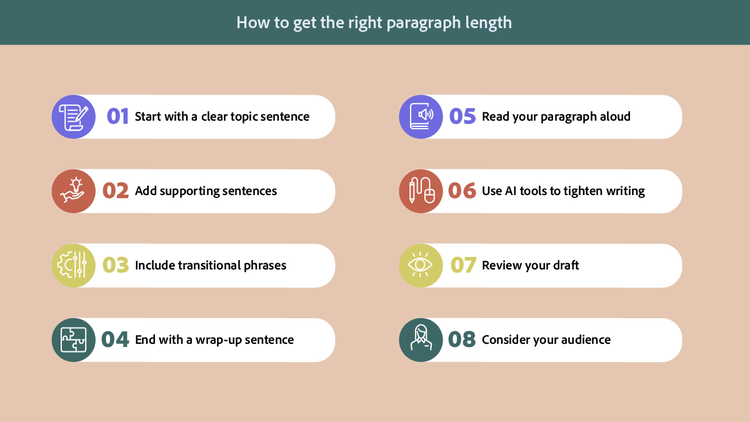
1. Start with a clear topic sentence that states your main idea upfront, giving readers an immediate understanding of what the paragraph will cover.
2. Add supporting sentences that develop, explain, or prove your point through evidence, examples, or analysis.
3. Include transitional phrases to connect ideas smoothly within the paragraph and create logical flow.
4. End with a sentence that wraps up the idea or provides a bridge to the next paragraph.
5. Read your paragraph aloud to check for natural flow and rhythm—if you run out of breath, the paragraph might be too long.
6. Use AI tools to help rewrite, summarize, or reorganize lengthy paragraphs that need tightening.
7. Review your draft to ensure each paragraph focuses on a single main idea without drifting into tangential topics.
8. Consider your audience's reading level and adjust complexity and length accordingly.
Generative AI has become an invaluable tool for writers looking to refine their paragraph structure. You can use AI prompts to analyze and improve your writing. For example, try a prompt like "Rewrite this paragraph to be more concise while keeping the main idea" to get suggestions for tightening your prose. Another effective prompt is "Break this long paragraph into two or more paragraphs with clear topic sentences for each." You might also try "Summarize this 300-word paragraph in 100 words without losing key information" to practice condensing your ideas.
You can also chat with your documents to get feedback on structure, identify paragraphs that might need splitting, or find opportunities to combine related ideas more effectively. Ask questions like "Which paragraphs in this document are too long?" or "How can I reorganize section three for better flow?" These AI-assisted approaches help you develop stronger instincts for paragraph length over time.

How long is a paragraph in academic essays?
Academic writing follows stricter conventions for paragraph structure than most other forms of writing. In scholarly contexts, paragraphs typically range from 100 to 200 words, with 150-200 words being ideal for most essay types. This length provides enough space to develop an argument with proper evidence and analysis while maintaining focus on a single main point.
If you're wondering whether 500 words is too long for a paragraph, the answer is almost always yes. A paragraph of that length likely contains multiple ideas that should be separated into distinct paragraphs. Readers struggle to follow arguments when too much information is packed into a single block of text, and instructors often view overly long paragraphs as a sign of disorganized thinking. Understanding how long can a paragraph be before it becomes unwieldy helps you maintain clarity throughout your academic work.
Academic paragraphs follow a predictable structure that helps readers track your argument. Begin with a topic sentence that presents the paragraph's main claim or argument. Follow this with evidence—quotations, data, or examples—that supports your claim. Then provide analysis that explains how your evidence supports your argument and why it matters. Finally, include a transition that connects this paragraph's idea to the next paragraph's focus.
Different types of academic writing call for slightly different paragraph lengths. Research papers often feature longer paragraphs of 150-200 words because they need space to develop complex arguments and integrate multiple sources. Argumentative essays work well with moderate-length paragraphs of 100-150 words, allowing for clear point-by-point structure that readers can follow easily. Short-answer responses and exam essays benefit from concise paragraphs of 75-100 words that deliver direct, focused answers.
When you write a college essay, remember that varying your paragraph length creates better rhythm and keeps readers engaged. A series of identically-sized paragraphs can feel monotonous, while mixing longer analytical paragraphs with shorter transitional ones creates natural flow. Learning to write a conclusion for an essay effectively also helps tie your paragraphs together into a cohesive whole.
The question of how long is one paragraph in academic writing ultimately depends on the depth of analysis required. Simple supporting points might need only 75-100 words, while central arguments deserve fuller development. Pay attention to your professor's feedback on paragraph structure, as different disciplines sometimes have varying expectations for how ideas should be organized and developed.
How long is a paragraph in fiction?
Fiction offers writers far more flexibility with paragraph length than academic or professional writing. While essays demand structured paragraphs that develop arguments logically, fiction uses paragraph breaks as a tool for pacing, emphasis, and reader experience. How long is a paragraph in creative writing? The answer varies dramatically based on the effect you want to achieve.
Single-sentence paragraphs can create powerful dramatic impact in fiction. When a character makes a crucial decision or a plot twist unfolds, isolating that moment in its own paragraph draws the reader's attention and creates emphasis. Conversely, longer paragraphs work beautifully for descriptive passages and exposition, where you want readers to sink into the world you're creating. A long paragraph of rich sensory detail can immerse readers in a scene in ways that choppy, fragmented text cannot.
Dialogue follows its own conventions in fiction. The standard practice is to start a new paragraph each time a different character speaks, which helps readers track conversations without confusion. Dialogue paragraphs tend to be shorter than narrative paragraphs because they often contain just a line of speech plus a brief dialogue tag or action beat. This creates natural white space on the page and keeps conversations moving at a realistic pace.
Narrative and descriptive paragraphs vary widely based on their purpose. Scene-setting and atmospheric description often use longer paragraphs of 100-200 words, immersing readers in the environment. Action sequences typically work better with medium-length paragraphs of 50-100 words, maintaining momentum while still providing enough detail. Short paragraphs of one to three sentences create emphasis and urgency, perfect for moments of tension or revelation.
Understanding how paragraph length affects pacing is essential for fiction writers. Short, punchy paragraphs speed up the reading experience and create tension. Longer paragraphs slow the pace, allowing for reflection, atmosphere-building, or emotional depth. Many writers use generative AI for PDFs to analyze the pacing in their manuscripts, identifying sections where paragraph length might be adjusted to better serve the story's rhythm.
Genre conventions also influence paragraph length expectations. Literary fiction often features longer, more complex paragraphs that reward careful reading. Thrillers and mysteries tend toward shorter paragraphs that maintain suspense and keep pages turning. Romance novels balance dialogue-heavy scenes with descriptive passages, creating varied paragraph lengths throughout. Understanding your genre's conventions helps you meet reader expectations while still developing your unique voice.
How long is a paragraph in digital content?
Digital content follows different rules than print because online readers behave differently. Research consistently shows that people scan web content rather than reading word-by-word, looking for key information and deciding quickly whether to continue or click away. This scanning behavior means shorter paragraphs perform better online, making the question of how long is a paragraph particularly important for digital writers.
For most digital content, paragraphs of 40-100 words work best. This translates to roughly two to four sentences per paragraph. Mobile screens amplify the importance of brevity—a paragraph that looks reasonable on a desktop monitor can appear as an intimidating wall of text on a smartphone. Breaking content into smaller chunks with plenty of white space makes it easier for readers to scan and absorb information quickly. A long paragraph that might work perfectly in print can cause readers to bounce from your page in digital contexts.
Blog posts and web articles benefit from generous use of subheadings to break up longer sections, giving readers clear signposts as they navigate through content. Each subheading essentially resets the reader's attention, making it easier to continue reading. White space between paragraphs improves readability on screens by giving readers' eyes natural resting points. Bullet points and numbered lists also help break up dense information into scannable formats.
Social media and marketing copy push brevity even further. Many social media posts use single-sentence paragraphs, with each sentence appearing on its own line for maximum impact. Email marketing follows similar principles, using scannable short paragraphs that allow busy readers to grasp key messages at a glance. Landing pages often feature extremely brief paragraphs designed to drive action rather than provide detailed information.
When considering how long can a paragraph be in digital formats, always err on the side of brevity. If a paragraph exceeds 100 words, look for opportunities to split it or condense the information. Use formatting tools like bold text for key phrases, helping scanners find important information without reading every word.
When sharing documents digitally, formatting consistency matters. You can convert Word documents to PDF to ensure your paragraph formatting stays intact across different devices and platforms. For longer documents that need to be shared with digital audiences, an AI summary generator can create concise versions that respect digital reading preferences while preserving essential information.
Frequently asked questions
A paragraph can technically consist of just one sentence, though two to three sentences represents the practical minimum for most writing contexts. Single-sentence paragraphs are generally reserved for emphasis or stylistic effect rather than serving as the norm. In academic writing, aim for at least three sentences to properly develop your idea.
Yes, single-sentence paragraphs are acceptable and even encouraged in certain contexts. Fiction writers and journalists frequently use them to create dramatic emphasis or highlight important moments. In academic writing, however, single-sentence paragraphs are rare and may signal underdeveloped ideas that need further expansion.
Start a new paragraph when you introduce a new idea, shift to a different topic, change speakers in dialogue, or transition to a new time or place. If you find yourself using phrases like "on the other hand" or "however," that's often a signal that a new paragraph is appropriate. Trust your instincts—if something feels like a natural breaking point, it probably is.
No, varying paragraph length creates better rhythm and maintains reader interest. A mix of longer paragraphs for complex ideas and shorter paragraphs for transitions or emphasis keeps your writing dynamic. Aim for variety while ensuring each paragraph is long enough to develop its idea fully. Monotonous paragraph lengths can make even interesting content feel tedious to read.
Look for places where you've introduced a second main idea—that's a natural splitting point. Remove redundant sentences that repeat information already stated. AI writing tools can help identify what can be condensed without losing essential meaning. You can also try reading the paragraph aloud and cutting any sentences that don't directly support your main point.
Shorter paragraphs improve readability scores, which affects how users engage with your content. Higher engagement signals—like time on page and scroll depth—can indirectly benefit search rankings. Most SEO experts recommend keeping web paragraphs under 150 words for optimal readability. Search engines increasingly prioritize user experience metrics, making readable content structure more important than ever.
Paragraph length varies significantly by format. Academic essays typically use paragraphs of 100-200 words | fiction paragraphs range from single sentences to 200+ words depending on pacing needs | digital content works best with 40-100 word paragraphs | and social media often uses single-sentence paragraphs. Understanding these conventions helps you adapt your writing to different contexts effectively.
You may also like
title
How long is a paragraph?
cardImageAltText
Student reviewing paragraph structure in a document
cardImage
Tags
caas:content-type/article,caas:products/acrobat,caas:topic/students,caas:topic/edit-pdf

