#1E1E1E

ACROBAT | 6-MINUTE READ

How to summarize an article.

Learn how to summarize an article with step-by-step instructions.

Explore Acrobat Studio

A man reads through articles on a tablet.
#f8f8f8
Have you ever looked at a long article or block of text and wished you could just get the main points faster? Maybe the information is for work or a school assignment, or you’re just catching up on the news. Learning how to summarize an article helps you understand ideas faster and save effort. This guide demonstrates how to write an article summary to comprehend and share the central message of any piece of content easily.

Looking at multiple articles of text can be quite a challenge, and always reading every single word of every document that comes your way is often impractical and unrealistic. The good news is, you don’t always have to.

Learning how to summarize an article offers many benefits. For one, it saves a lot of time. Think about needing to quickly understand a new client proposal or wanting to refresh your memory on a tough concept for an exam.

Summaries help you grasp information faster, remember it more easily, and share key insights with others without making them go through the entire original text. This method applies broadly from academic writing, such as crafting an argumentative essay or a critical review to understand another author’s core work, to various parts of your professional and daily life.

Let’s dive into how to summarize an article.

#f5f5f5

What is an article summary?

An article summary is a concise, shorter account of a longer document. The summary captures the central message and the most important supporting details from the article. Its purpose is to provide a quick understanding of the original text’s main content. Knowing how to summarize an article accurately will help you create valuable overviews when needed.

The content of your summary should vary depending on the type of article you’re summarizing. For argumentative articles, focus on identifying the author’s thesis or main claim, the key arguments that support it, and any counterarguments addressed. For empirical or research-based articles, highlight the research question, methods, major findings, and conclusions. If you’re summarizing a review article, concentrate on the scope of the review, the main themes or trends discussed, and any critical evaluations or recommendations made by the author. In all cases, avoid inserting personal opinions and aim to reflect the article’s intent as objectively and clearly as possible.

How to summarize an article step-by-step.

Summarizing an article involves two distinct phases: understanding the original content and then writing your article summary. We’ll break down both parts into distinct, manageable steps.

Before you start writing your article summary, you should truly understand the original article or text. Consider these steps as your preparation, designed to set you up for success when it comes time to write a summary of an article.
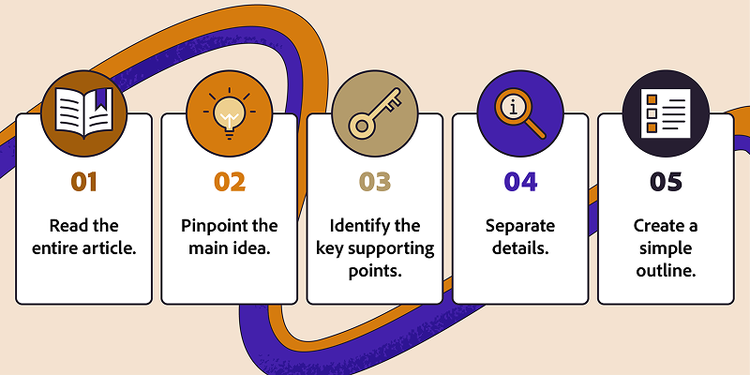

  1. Read the entire article. This task might seem obvious, but it’s an important first step. Read the whole article to get a general feel for its content and the author’s overall message.

  1. Pinpoint the main idea. Ask yourself to identify the author’s most significant point. This central message is usually in the introduction or conclusion.

  1. Identify the key supporting points. Once the main idea is understood, look for the major arguments or evidence that support it.

  1. Separate details. For each key point, distinguish the broad idea from the specifics used to illustrate it. Focus on the big ideas, not the small details.

  1. Create a simple outline. Make a quick outline or list of the main idea and key supporting points. This task will help in how to write a summary of an article.

Once you feel like you have the article’s content thoroughly understood and have your outline ready, it’s time to put that understanding into a well-written article summary.

Follow these steps to write your summary:


  1. Review your outline. Look over the notes or outline you created after reading the article.

  1. Drat your opening sentence. Begin your summary with a single sentence that introduces the article and its main argument.

  1. Present supporting ideas. Follow your opening with sentences that explain each supporting point from your outline.

  1. Use your own words. Rephrase the author’s information in your language. Avoid copying sentences directly to show understanding and prevent plagiarism.

  1. Stay objective. Present only the author’s ideas. Do not add your personal opinions, agreements, or disagreements.

  1. Keep it concise. Aim for roughly 10%–20% of the original article’s length. Remove any unnecessary words or phrases.

  1. Conclude effectively. Briefly restate the main idea in a new way or offer a final sentence that ties it all together.

#f5f5f5

Tips for an effective summarization.

Beyond the step-by-step process, a few additional practices can greatly improve the quality of your article summary.

  • Consider your audience. Adjust the language and level of detail in your summary based on who will read it and what information they need to know.
  • Skim strategically. Before detailed reading, quickly skim the article’s structure. Look at headings and subheadings to get an overview.
  • Prioritize main sections. Focus your deep reading on the introduction, conclusion, and topic sentences of key paragraphs.
  • Annotate thoughtfully. As you read, make brief notes or highlight only necessary information and phrases directly on the document.
  • Use the big five technique. Also known as the five Ws and one H, this is a useful trick, especially when learning how to summarize an article that tells a story or explains a process. Ask yourself the following:
    • Who? Who are the main people or groups involved?
    • What? What is the central event or topic discussed?
    • When? What is the timing, if important?
    • Where? What is the location, if relevant?
    • Why? What is the reason or purpose behind it?
    • How? What was the process or method described?

You can ask these questions for almost any article. For instance, if summarizing a scientific finding, you might ask, “Who made the discovery? What exactly was discovered? When was the study published? Where was the research conducted? Why is this discovery considered important? And how does the new process or finding work?”

  • Check for accuracy. Make sure that your summary reflects the author’s original meaning and doesn’t introduce your own interpretations or biases.
  • Avoid new information. Your summary should only contain information from the original article. Do not add outside facts or personal opinions.
  • Proofread carefully. Review your summary for any grammar, spelling, or punctuation errors.
  • Re-read the original. If time permits, read the original article one more time after drafting your summary to catch any missed points or inaccuracies.

Use smart tools. Use technology like an online PDF editor and artificial intelligence (AI) to provide instant overviews or quick article summaries of PDFs.

Frequently asked questions.

How can I use summaries for education and study?

Summaries are useful for education and studying. You can use AI tools to make flashcards of key ideas, create quick study guides for exam preparation, or get the main points from long readings. They help you remember core concepts better.

What if the article I’m summarizing doesn’t have a clear main idea?

If the main idea isn’t apparent, synthesize the key arguments presented in the article for your summary. Sometimes you have to construct the main idea from the supporting points.

Should I include my personal opinion in a summary?

No, an article summary should be objective. Its purpose is to represent the author’s ideas accurately, not to include your thoughts or judgments.

What is the difference between summarizing and paraphrasing?

Paraphrasing rewrites a small piece of text in your own words, keeping a similar length. Summarizing condenses a whole text into a much shorter version, focusing only on main ideas.

What is the difference between an abstract and an article summary?

An abstract is found at the start of a scholarly article, written by the author to introduce their work. An article summary is written by a reader to condense a text they’ve read.

Can I use direct quotes in my summary?

Generally, avoid direct quotes. Show your understanding by using your own words. Use a very short, cited quote only if its unique wording is truly irreplaceable.

Are there tools that can help you summarize things automatically?

Yes. Tools with AI features can generate quick overviews and summaries of articles. These are great for quickly understanding lengthy reports. Always remember to review and refine for accuracy when using AI tools.

What is an AI document summarizer?

An AI document summarizer is a tool that uses artificial intelligence to read a document and create a concise summary of its content. This tool helps save time by automatically providing the main points.

You can ask specific questions about the content to help clarify anything in the text. Examples include “What are the three main causes of X?”, “Who is the author quoting here?”, or “Can you explain the conclusion in simpler terms?”

How does interacting with my document using AI chat work?

When you use an AI chat feature, you upload your document to a platform. You can then type questions directly into a chat interface. The AI reads the document and provides answers, often with references back to the original text for verification.

Keep exploring

https://main--dc--adobecom.aem.live/dc-shared/fragments/seo-articles/seo-caas-collection

https://main--dc--adobecom.aem.live/dc-shared/fragments/seo-articles/acrobat-color-blade