How to use an AI reference letter generator
AI reference letter generators help you create personalized, professional recommendations quickly. Discover how to use these tools effectively while maintaining authenticity.

An AI reference letter generator streamlines the process of creating compelling recommendations by combining your insights with intelligent drafting capabilities. These tools help professionals craft polished letters efficiently.
Key takeaways:
- Save significant time on initial drafts while maintaining personalization
- Generate professional structure and language that enhances your recommendations
- Easily customize output to reflect your authentic voice and observations
- Create consistent, well-formatted letters across multiple recommendation requests
What is a reference letter
A reference letter is a formal document that vouches for someone’s qualifications, character, or abilities. These letters serve as third-party endorsements that help recipients—whether employers, academic institutions, or landlords—make informed decisions about candidates. The person writing the letter typically has direct experience working with, teaching, or knowing the subject in some meaningful capacity.
Reference letters appear across many contexts in professional and personal life. Employers write them for departing team members seeking new opportunities. Professors compose them for students applying to graduate programs or competitive internships. Friends and colleagues craft character references for volunteer positions, custody proceedings, rental opportunities, or community board applications. Each type serves a distinct purpose, but all share the common goal of providing an honest, detailed assessment of someone’s strengths.
The demand for reference letters continues to grow as hiring processes become more competitive and thorough. Many professionals find themselves writing multiple recommendations each year, which can become time-consuming. This reality has driven interest in tools that can assist with the drafting process, including AI reference letter generator solutions that help produce well-structured initial drafts.
Understanding what makes a strong reference letter helps you appreciate how artificial intelligence (AI) tools can assist in the drafting process. Whether you’re using a reference letter template or starting from scratch, certain elements consistently appear in effective recommendations. The best letters combine genuine personal insight with professional presentation.
What makes a strong reference letter:
- Specific examples of the person’s skills and accomplishments rather than vague praise
- Honest assessment of character and work ethic that rings true to readers
- Clear relationship context between writer and subject explaining how you know them
- Professional formatting and appropriate length that respects the reader’s time
- Tailored content matching the opportunity being pursued
- Concrete metrics or achievements that demonstrate the candidate’s impact
- A confident recommendation statement that clearly endorses the candidate
Before you begin writing—whether with AI assistance or independently—gathering comprehensive information ensures you can write a professional business letter that truly represents the candidate. Taking time upfront to collect relevant details makes the writing process smoother and produces stronger results.
Information to gather before writing:
- The applicant’s current resume or curriculum vitae (CV)
- The job description or opportunity details they’re pursuing
- Specific achievements or projects to highlight from your time working together
- The history and duration of the relationship you’ve shared
- Any specific points the applicant wants emphasized in the letter
- The deadline for submission and any format requirements
- Contact information for the recipient if direct submission is required
The intersection of traditional letter-writing and modern technology has created new possibilities for busy professionals. Reference letter AI tools can analyze the information you provide and generate coherent drafts that follow established conventions for professional recommendations. This approach combines the efficiency of automation with the irreplaceable value of your personal knowledge and genuine assessment.
Many professionals worry that using technology might diminish the authenticity of their recommendations. However, the most effective approach views AI as a collaborative tool rather than a replacement for human insight. Your unique observations, specific memories, and honest evaluation remain central to any meaningful reference letter. AI simply helps organize and express those thoughts in polished, professional language.
How to generate a reference letter with AI
AI has transformed how professionals approach reference letter writing. Rather than staring at a blank page, you can now use AI tools to generate well-structured drafts that capture the essential elements of a strong recommendation. These tools analyze your inputs and produce coherent, professionally formatted letters that serve as excellent starting points.
The key to success lies in viewing AI as a collaborative partner rather than a replacement for your personal insight. Generative AI for documents excels at organizing information, suggesting appropriate language, and ensuring proper structure. However, your unique knowledge of the candidate—their specific accomplishments, personality traits, and growth over time—remains irreplaceable. The most effective AI-generated reference letter combines technological efficiency with authentic human perspective.
Adobe Acrobat AI Assistant offers powerful capabilities for writing, rewriting, and rephrasing content that can significantly enhance your reference letter drafting process. These features help you refine language, adjust tone, and ensure your recommendations read professionally while maintaining your authentic voice.
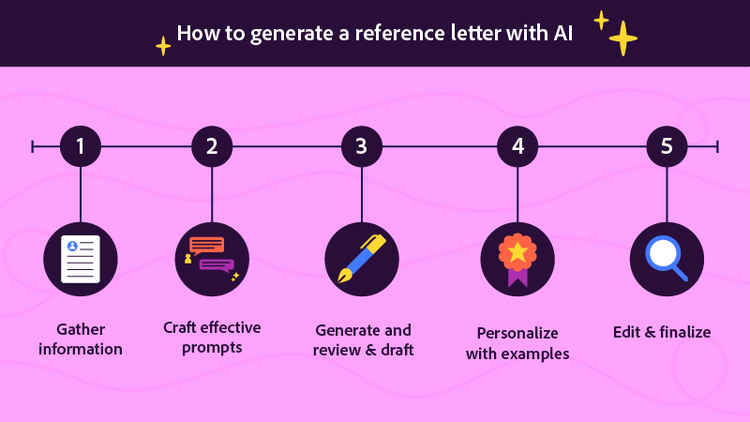
1. Gather information about the candidate
Before opening any AI tool, compile comprehensive details about the person you’re recommending. Start with their resume or CV, noting specific accomplishments, skills, and experiences relevant to the opportunity they’re pursuing. Review the job description or program requirements to understand what qualities the recipient values most. This preparation phase sets the foundation for generating a truly personalized recommendation.
Think about your personal observations of the candidate. What projects did they excel at? How did they handle challenges? What makes them stand out from others in similar roles? Consider both professional achievements and character traits that demonstrate their suitability for the opportunity.
The more specific details you gather, the more personalized and compelling your AI-generated letter will be. Generic information produces generic results, so invest time in recalling concrete examples and memorable moments from your interactions with the candidate.
2. Craft effective AI prompts
The quality of your AI output depends directly on the quality of your input. Write clear, detailed prompts that include the candidate’s name, your relationship to them, specific accomplishments you want highlighted, and the context of the recommendation. Mention your preferred tone—whether formal, warm, or enthusiastic—and specify the desired length.
Understanding how to write effective AI prompts dramatically improves your results. Include specific metrics, project names, and outcomes whenever possible to give the AI concrete material to work with.
For example, rather than asking for “a reference letter for John,” provide context:
Sample prompt #1: “Write a professional reference letter for John Smith, who worked as a marketing coordinator on my team for three years. Highlight his campaign management skills, his leadership during the product launch in 2023, and his collaborative approach with cross-functional teams. The letter should be approximately 400 words with a warm but professional tone.”
Sample prompt #2: “Write a professional reference letter recommending Sarah Martinez for a senior project manager position. I supervised Sarah for five years at Tech Solutions Inc. where she managed our mobile app development team. Highlight her successful delivery of the customer portal project that came in 15% under budget, her ability to manage remote teams across three time zones, and her mentorship of junior team members. Keep the tone professional and confident, approximately 450 words.”
3. Generate and review the initial draft
Once you’ve crafted your prompt, generate the initial draft and review it carefully. Look for accuracy in the facts presented, appropriateness of tone, and overall structure. AI tools can occasionally make assumptions or include generic phrases that don’t quite fit your situation. Reading through the complete draft helps identify areas needing revision.
Use a PDF editor to make annotations and track changes as you review. Mark sections that need more specific details, flag any inaccuracies, and note places where the language feels too generic or formulaic.
Pay attention to whether the letter flows naturally and whether it captures the candidate’s unique qualities. This initial review sets the foundation for the personalization work ahead. Don’t hesitate to regenerate sections if the first output doesn’t meet your expectations.
4. Personalize with specific examples
This step transforms a competent draft into a compelling recommendation. Replace any generic statements with real anecdotes from your experience with the candidate. Instead of “She demonstrated strong leadership skills,” write “When our team faced a tight deadline on the Henderson account, she organized daily stand-ups and personally mentored two junior team members through the process.”
Add specific metrics or achievements wherever possible. Numbers and concrete outcomes carry more weight than abstract praise. If the candidate increased sales by 30%, reduced processing time by half, or managed a team of twelve, include those details. These specifics demonstrate your genuine familiarity with their work and make your recommendation more credible.
Consider adding personal observations that only someone who worked closely with the candidate would know. Perhaps they stayed late to help a struggling colleague, handled a difficult client with exceptional grace, or proposed an innovative solution during a challenging project. These details make your letter memorable and authentic.
5. Edit for authenticity and finalize
Read through the entire letter, adjusting language to match your natural voice. AI-generated text sometimes sounds slightly formal or uses phrases you wouldn’t typically choose. Replace these with expressions that feel authentic to how you communicate professionally. The goal is a letter that sounds like you wrote it, because ultimately you did—with AI assistance.
Check for any remaining generic phrases that could apply to anyone. Strong reference letters feel personal and specific to the individual being recommended. Review transitions between paragraphs to ensure smooth flow, and verify that the opening and closing statements make strong impressions.
Once satisfied with the content, convert your document to PDF to create a polished, professional document. If the recipient requires a signed copy, electronic signatures streamline the finalization process while maintaining document integrity.
Examples of AI-generated reference letter
Seeing AI-generated reference letters in action helps illustrate how these tools work and how to customize their output effectively. The following examples demonstrate different contexts where AI assistance proves valuable, from employment recommendations to character references. Each scenario shows the prompt used and the type of output you might receive.
Using an AI reference letter generator becomes more intuitive once you see how different inputs produce tailored outputs. These examples also highlight the importance of providing specific, detailed prompts to achieve the best results.
Example 1: Employment reference letter
Scenario: A former manager recommending a team member for a senior analyst position at a consulting firm.
Sample prompt input: “Write a professional reference letter for Maria Chen, who reported to me as a data analyst for four years at Westfield Financial. Highlight her expertise in predictive modeling, her role in developing our customer churn prevention system that saved $2.3 million annually, and her ability to present complex findings to executive leadership. The letter should be warm but professional, approximately 400 words.”
Sample output excerpt: “I am pleased to provide this recommendation for Maria Chen, who worked under my supervision as a data analyst at Westfield Financial from 2019 to 2023. During her tenure, Maria consistently demonstrated exceptional analytical capabilities that directly impacted our bottom line.
Her development of our customer churn prevention system exemplified her ability to translate complex data patterns into actionable business strategies. This initiative alone generated $2.3 million in annual savings by identifying at-risk accounts before they closed. Maria not only built the predictive models but also presented the findings to our executive committee with clarity and confidence that earned immediate buy-in for implementation.
What distinguished Maria from other analysts was her combination of technical excellence and communication skills. She could dive deep into statistical analysis while also explaining implications to non-technical stakeholders in accessible terms...”
This type of employment reference benefits from professional formatting as a PDF for easy sharing with potential employers.
Example 2: AI character reference letter
Scenario: A longtime friend providing a personal reference for a rental application.
Sample prompt input: “Write a character reference letter for David Park, whom I’ve known for eight years as a neighbor and friend. He’s applying to rent an apartment and needs a reference attesting to his reliability and character. Mention that he’s helped organize our neighborhood watch program, always maintains his property well, and is considerate of neighbors. Keep the tone friendly but professional, approximately 300 words.”
Sample output excerpt: “I am writing to recommend David Park as a prospective tenant. I have had the pleasure of knowing David for eight years as both a neighbor and close friend, and I can confidently attest to his character and reliability.
Throughout this time, David has consistently demonstrated the qualities that make him an ideal tenant: responsibility, consideration for others, and genuine care for his community. When our neighborhood established a watch program in 2021, David volunteered to coordinate scheduling and communication among participants. His organizational skills and dependability made the program successful and strengthened our community bonds.
As his neighbor, I have observed how meticulously David maintains his property. His lawn is always well-kept, his home exterior is consistently clean and presentable, and he addresses any maintenance issues promptly. He understands that property upkeep benefits the entire neighborhood and takes that responsibility seriously...”
For rental applications, understanding what landlords look for helps you craft effective recommendations. A landlord reference letter addresses specific concerns about tenancy reliability and property care. Using AI to create a character reference letter can save time while ensuring you cover all the important points.
Example 3: Professional development reference
Scenario: A supervisor recommending an employee for a project management certification program.
Sample prompt input: “Write a reference letter for Jennifer Torres, who works in my department and is applying for the Project Management Professional certification program. Highlight her successful management of our office renovation project, her natural ability to coordinate cross-departmental teams, and her commitment to professional growth. The tone should be supportive and encouraging, approximately 350 words.”
Sample output excerpt: “I am delighted to recommend Jennifer Torres for admission to the Project Management Professional certification program. As Jennifer’s direct supervisor in the operations department for the past three years, I have witnessed firsthand her remarkable aptitude for project management and her dedication to professional development.
Jennifer’s oversight of our recent office renovation project showcased her organizational skills and leadership abilities. Despite coordinating with seven different vendors, managing a $450,000 budget, and navigating unexpected supply chain delays, Jennifer delivered the project on time and under budget. Her ability to anticipate problems, communicate proactively with stakeholders, and adapt plans as circumstances changed demonstrated natural project management instincts.
What particularly impressed me was Jennifer’s skill in bringing together team members from different departments who had never collaborated before. She established clear communication channels, facilitated productive meetings, and resolved conflicts diplomatically...”
Tips and best practices for using AI to write reference letters:
- Always verify factual claims before sending to ensure accuracy and maintain your credibility
- Maintain the letter’s personal voice throughout by adjusting AI-generated language to match your natural style
- Use AI as a starting point, not the final product you send—personalization is essential
- Keep copies of reference letters for consistency in future recommendations and to track what you’ve written
- Update prompts based on the specific opportunity and recipient to ensure relevance
- Review for any overly generic or formulaic language that weakens the recommendation’s impact
- Include specific metrics, dates, and project names whenever possible to add credibility
- Read the letter aloud to catch awkward phrasing or sections that don’t flow naturally
- Ask the candidate to review the letter if appropriate to catch any factual errors
Ethical considerations regarding AI-generated reference letters
Using AI to assist with reference letter writing raises important questions about transparency, authenticity, and professional responsibility. While these tools offer significant time savings and can help overcome writer’s block, they also require thoughtful consideration of ethical boundaries. Understanding these considerations helps you use AI responsibly while maintaining the integrity of your recommendations.
The fundamental question centers on authenticity. A reference letter carries implicit weight because it represents one person's genuine assessment of another. When AI generates significant portions of that content, the letter’s meaning potentially shifts. The most ethical approach involves using AI as a drafting assistant while ensuring the final letter accurately reflects your own observations, opinions, and voice.
Consider the purpose of reference letters in professional and personal contexts. Recipients rely on these documents to gain insight into a candidate that they cannot obtain through resumes or interviews alone. They trust that the letter writer has genuine knowledge of the subject and is sharing honest assessments. This trust forms the foundation of the reference letter system.
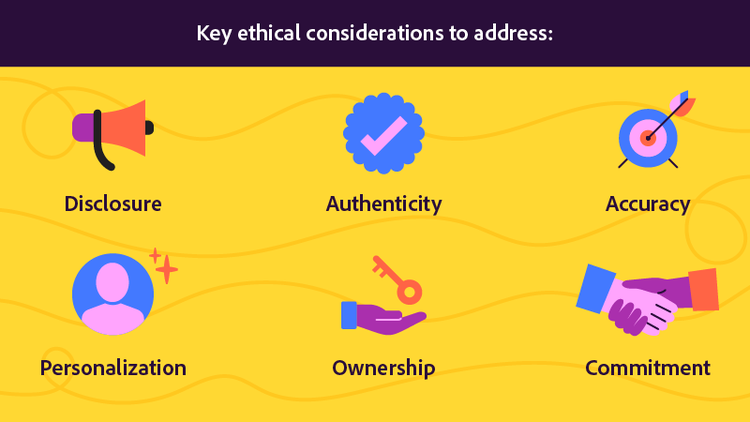
Key ethical considerations to address:
- Disclosure: Most professional contexts don’t require disclosure of AI assistance in writing, but the letter must still represent your genuine views and honest assessment
- Authenticity: Every statement in the final letter should reflect your actual knowledge and honest opinion of the candidate, not AI-generated speculation
- Accuracy: Verify all claims and statements are truthful, as AI may generate plausible-sounding but incorrect details based on common patterns
- Personalization: You bear responsibility for reviewing and customizing AI output to reflect your unique perspective and actual experiences with the candidate
- Ownership: You remain accountable for the final letter’s content regardless of how it was drafted or what tools assisted in the process
- Commitment: Only write reference letters for individuals you can genuinely recommend—AI cannot manufacture authentic endorsement
Balancing efficiency with integrity means embracing AI’s ability to structure and draft while maintaining your role as the letter’s true author. The goal isn’t to produce letters faster—it’s to produce better letters more efficiently. Tools that let you chat with PDF documents can help you review and refine letters by identifying areas that need more personalization or specificity.
The distinction between assistance and replacement matters significantly. Using AI to help organize your thoughts, suggest professional phrasing, or ensure proper formatting differs fundamentally from having AI fabricate a recommendation for someone you barely know. The former enhances your genuine endorsement; the latter undermines the entire purpose of reference letters.
Professional communities continue to discuss evolving norms around AI use in document creation. What remains constant is the expectation that a signed reference letter represents the author’s actual assessment. As long as you ensure your final letter meets this standard—containing only statements you genuinely believe and can support—AI assistance remains an ethical tool for improving your writing efficiency.
Some professionals worry about detection tools flagging AI-assisted content. The best approach focuses not on evading detection but on creating genuinely personalized letters. A thoroughly customized letter incorporating your specific observations, authentic voice, and real examples will naturally read as human-written because it fundamentally is—you simply used AI to help draft and organize your thoughts.
Frequently asked questions
Can AI write me a reference letter?
Are reference letters checked for AI?
How long should an AI-generated reference letter be?
Can I use AI to write a character reference letter?
What information should I include in my AI prompt for a reference letter?
How can I make an AI-generated reference letter sound more personal?
Should I tell the candidate I used AI to help write their reference letter?
What are the limitations of AI-generated reference letters?
You may also like