


Mastering professional email writing techniques helps you communicate clearly, build credibility, and achieve your business objectives more efficiently.
What is a professional email?
A professional email is a written communication that follows established business conventions for tone, structure, and formatting. Unlike casual messages to friends or family, professional emails maintain a level of formality that reflects respect for the recipient and demonstrates your competence as a communicator.
Not every email requires the same level of formality. A quick message to a close colleague about lunch plans differs significantly from correspondence with a potential employer or new business contact. The key is recognizing when a situation calls for professional formatting and adapting your approach accordingly.
Professional emails typically share several characteristics: they have clear subject lines, appropriate greetings, well-organized content, and proper closings. They avoid slang, excessive punctuation, and overly casual language that might undermine your credibility.
Common situations that call for professional email formatting include:
- Meeting requests with supervisors, clients, or external contacts
- Interview follow-ups and job application correspondence
- Communication with business partners and vendors
- Reaching out to new contacts for networking or collaboration
- Project updates and status reports
- Formal requests or proposals requiring documented communication
- Client correspondence regarding services, products, or ongoing projects
Understanding when and how to apply professional email conventions helps you navigate workplace communication effectively and build stronger professional relationships.
How to write a professional email
Before you begin typing, take a moment to consider your audience, your purpose, and your desired outcome. Who will read this email? What do you need to communicate? What action or response do you hope to receive? These questions shape everything from your tone to your level of detail.
Many professionals now use generative AI tools to help draft and refine their emails. While these tools can provide helpful starting points, understanding the fundamentals of professional email writing ensures you can evaluate and improve any draft—whether written by you or assisted by technology.
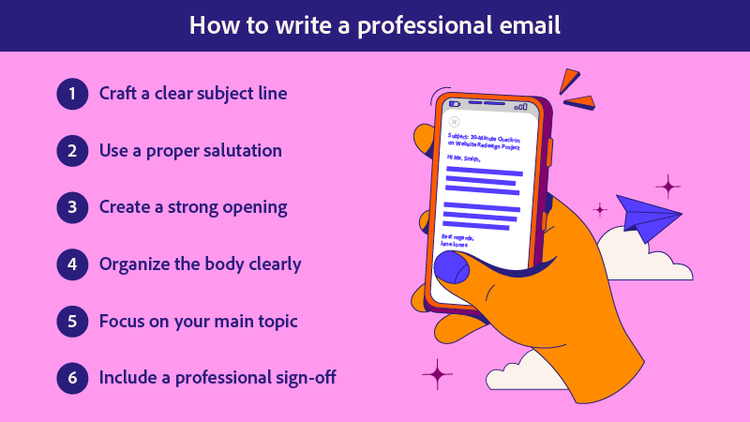
1. Write a clear subject line
Your subject line serves as both a headline and a filing system for your recipient. A strong subject line communicates the email's purpose at a glance and helps the reader prioritize their response.
Effective subject lines are specific and action-oriented. Compare these examples:
- Weak: "Meeting"
- Strong: "Request: 30-Minute Strategy Meeting for Q3 Planning"
- Weak: "Question"
- Strong: "Input Needed: Budget Approval for Marketing Campaign"
- Weak: "Following up"
- Strong: "Follow-Up: Product Demo Discussion from Tuesday"
Aim for subject lines between five and ten words that clearly indicate what the email contains and what action, if any, you need from the recipient.
2. Use a proper salutation
Your greeting sets the tone for the entire message. The appropriate salutation depends on your relationship with the recipient and the formality of the context.
For formal situations or first-time contacts, use "Dear Mr./Ms. [Last Name]" or "Dear [Full Name]" if you're unsure of the recipient's preferred title. For ongoing professional relationships, "Hello [First Name]" or simply "Hi [First Name]" often works well.
When you introduce yourself in an email for the first time, err on the side of formality. You can always adjust to a more casual tone as the relationship develops based on how the other person responds.
Avoid overly casual greetings like "Hey" or "What's up" in professional contexts, even with colleagues you know well, as emails may be forwarded or referenced later.
3. Craft a strong opening
Your first sentence should immediately establish why you're writing. Avoid vague openings that force the reader to hunt for your purpose.
Instead of starting with "I hope this email finds you well," which adds no information, lead with your main point: "I'm writing to schedule a follow-up meeting about the Shawl project" or "Thank you for meeting with me yesterday—I wanted to share the resources we discussed."
If context is necessary, keep it brief. One sentence of background is usually sufficient before stating your purpose.
4. Structure the body clearly
The body of your email should be easy to scan and understand. Use short paragraphs—typically two to four sentences each—to break up information into digestible chunks.
When you have multiple points to address, consider using bullet points or numbered lists. This formatting helps readers quickly identify key information and reduces the chance that important details get overlooked.
Place your most important information near the beginning. Many readers skim emails, especially on mobile devices, so front-load essential content rather than burying it in later paragraphs.
5. Stay focused on your main topic
Professional emails work best when they address one primary topic or request. If you need to discuss multiple unrelated matters, consider sending separate emails so each topic can be tracked and responded to independently.
Before sending, review your draft to eliminate tangents or unnecessary details that don't support your main message. An AI assistant for conversational document review can help you identify areas where your message might be losing focus or becoming too lengthy.
Ask yourself: does every paragraph contribute to my stated purpose? If not, consider cutting or condensing that content.
6. Include a professional sign-off
Your closing should match the tone of your email and leave a clear path forward. Common professional closings include:
- "Best regards" or "Regards" for most professional contexts
- "Sincerely" for formal correspondence
- "Thank you" when you've made a request
- "Best" or "Thanks" for less formal ongoing exchanges
Below your closing, include a complete signature block with your full name, title, company, and relevant contact information. This makes it easy for recipients to respond through their preferred channel and provides context about your role.
Professional email writing tips and examples
Applying professional email principles becomes easier with practice and concrete examples. The following professional email writing tips and sample scenarios will help you handle common professional email situations with confidence.
Keep these guidelines in mind when learning how to write an email professionally:
- Keep messages concise and scannable by using short paragraphs and strategic formatting
- Proofread before sending to catch typos, grammatical errors, and unclear phrasing
- Avoid jargon and overly casual language that might confuse or alienate readers
- Address recipients appropriately based on your relationship and the context
- Include clear calls to action so readers know exactly what you need from them
- Mind your tone and word choice, reading your email aloud to catch unintended harshness
Meeting request emails
Meeting request emails should clearly state your purpose, propose specific times, and make it easy for the recipient to respond. Include enough context for the recipient to prepare, but keep the message brief.
Example 1: Internal meeting request
Subject: Request: 30-Minute Check-In on Website Redesign Project
Hi Sarah,
I'd like to schedule a brief meeting to discuss the timeline adjustments for the website redesign project. Specifically, I want to review the updated developer estimates and confirm our launch date with stakeholders.
Are you available Thursday afternoon between 2:00 and 4:00 PM, or Friday morning before 11:00 AM? I'm happy to work around your schedule.
Please let me know what works best.
Best regards, [Your name]
Example 2: External meeting request
Subject: Meeting Request: Partnership Discussion with Meridian Tech
Dear Ms. Chen,
I'm reaching out to explore potential partnership opportunities between our organizations. Based on your company's recent expansion into educational technology, I believe there may be valuable synergies with our content development services.
Would you be available for a 30-minute introductory call next week? I'm flexible on timing and happy to accommodate your schedule.
Thank you for considering this request.
Sincerely, [Your name]
Interview follow-up emails
Send interview follow-up emails within 24 hours of your conversation. Reference specific topics discussed to demonstrate your engagement and reinforce your qualifications.
Example 1: Post-interview thank you
Subject: Thank You for the Marketing Manager Interview
Dear Mr. Rodriguez,
Thank you for taking the time to meet with me today about the Marketing Manager position. I enjoyed learning about Cascade Media's expansion plans and the team's approach to integrated campaigns.
Our discussion about data-driven content strategy particularly resonated with me. My experience leading the analytics initiative at my current company aligns well with your goals for the role.
I'm excited about the possibility of contributing to your team and look forward to hearing about next steps.
Best regards, [Your name]
Example 2: Follow-up after no response
Subject: Following Up: Marketing Manager Application
Dear Mr. Rodriguez,
I wanted to follow up on my interview for the Marketing Manager position two weeks ago. I remain very interested in the opportunity and would welcome any updates on the hiring timeline.
Please let me know if you need any additional information from me.
Thank you for your consideration.
Best regards, [Your name]
Business partner communications
Communications with business partners require a balance of professionalism and relationship-building. Be clear about expectations while maintaining a collaborative tone.
Example 1: Addressing a concern
Subject: Discussion Needed: Q3 Delivery Schedule
Dear Patricia,
I wanted to reach out regarding the delivery timeline for our Q3 order. We've noticed a pattern of shipments arriving 3-5 days later than the dates in our agreement, which has affected our inventory planning.
Could we schedule a call this week to discuss solutions? I'd like to understand any challenges on your end and explore options that work for both our teams.
Thank you for your partnership.
Best regards, [Your name]
Example 2: Proposal for expanded collaboration
Subject: Proposal: Expanding Our Distribution Partnership
Dear Marcus,
Following our successful collaboration over the past year, I'd like to propose expanding our partnership to include the Midwest region. Our sales data indicates strong demand in that market, and your established distribution network would be invaluable.
I've attached a brief overview of the opportunity. Would you have time next week to discuss this further?
Looking forward to your thoughts.
Best regards, [Your name]
New contact outreach emails
When reaching out to someone for the first time, establish credibility quickly, explain your purpose clearly, and make your request specific and reasonable.
Example 1: Networking outreach
Subject: Fellow UX Professional Seeking Brief Conversation
Dear Dr. Patel,
I recently read your article on accessibility in mobile design and was impressed by your research methodology. As a UX designer transitioning into research, I'm eager to learn from experienced professionals in the field.
Would you be open to a 15-minute phone conversation about your career path? I'd greatly appreciate any insights you could share.
Thank you for considering my request.
Best regards, [Your name]
Example 2: Business development outreach
Subject: Streamlining Document Workflows for Healthcare Providers
Dear Ms. Thompson,
I noticed Lakeside Medical Group recently expanded to three new locations. Congratulations on your growth.
Many healthcare organizations face document management challenges during expansion. Our team has helped similar practices reduce administrative processing time by 40% through streamlined digital workflows.
Would you be interested in a brief conversation about your current document processes? I'm happy to share some strategies that have worked well for organizations like yours.
Best regards, [Your name]
Project update emails
Project update emails should be structured for quick scanning while providing enough detail for stakeholders to understand progress and any issues requiring attention.
Example 1: Regular status update
Subject: Weekly Update: Mobile App Development - Week 12
Hi Team,
Here's our weekly progress update for the mobile app project:
Completed this week:
- User authentication module testing
- Payment integration with Stripe API
- Performance optimization for image loading
In progress:
- Push notification implementation (70% complete)
- Final security audit preparation
Blockers:
- Awaiting API documentation from the analytics vendor (requested Monday)
We remain on track for our March 15 beta release. Please let me know if you have questions.
Best, [Your name]
Example 2: Milestone completion update
Subject: Milestone Achieved: Phase 2 Complete for Henderson Project
Dear Stakeholders,
I'm pleased to report that Phase 2 of the Henderson project has been completed on schedule. All deliverables have been submitted and approved by the client.
Key accomplishments:
- Website redesign launched with 99.9% uptime during transition
- Content migration completed for 2,400 pages
- Training delivered to 15 client team members
Phase 3 kickoff is scheduled for Monday, February 3. I'll circulate the updated timeline and resource allocation by end of day Friday.
Thank you to everyone who contributed to this milestone.
Best regards, [Your name]
Frequently asked questions
Start with an appropriate greeting based on your relationship with the recipient. Use "Dear Mr./Ms. [Last Name]" or full name for formal contexts or first-time contacts, and "Hello [First Name]" for established professional relationships. Follow immediately with a sentence stating your purpose—avoid generic pleasantries that delay your main message.
The 5 C's are Clear (state your purpose directly), Concise (eliminate unnecessary words), Correct (check grammar, spelling, and facts), Courteous (maintain a respectful tone), and Complete (include all necessary information). Applying these principles helps ensure your emails communicate effectively and professionally.
Avoid using all caps (which reads as shouting), excessive exclamation points, slang or overly casual language, vague subject lines, and lengthy paragraphs without breaks. Also avoid sending emails when emotional—draft your message, then review it later with fresh eyes before sending.
Most professional emails should be readable in under two minutes—roughly 150 to 200 words for simple requests or updates. Complex topics may require more detail, but consider whether a meeting or phone call might be more efficient for lengthy discussions. When longer emails are necessary, use formatting like bullet points to improve readability.
Use formal tone for first-time contacts, senior executives, clients, external partners, and sensitive topics like complaints or negotiations. Casual tone is appropriate for colleagues you work with regularly, ongoing relationships where both parties have adopted informal communication, and internal team discussions. When uncertain, start formal and adjust based on how the other person responds.
You may also like
title
How to write a professional email
cardImageAltText
Professional reviewing email on laptop screen
cardImage
primaryTag
caas:content-type/article
Tags
caas:content-type/article,caas:products/acrobat,caas:topic/ai-chat-pdf,caas:topic/students,caas:topic/grammar

