
Key findings:
- With 85% of small business owners surveyed adopting AI, 65% report that using the technology has boosted their confidence in their company’s future.
- AI implementation is translating into tangible gains, with 47% of small-business owner respondents experiencing a revenue boost, averaging a 21% increase.
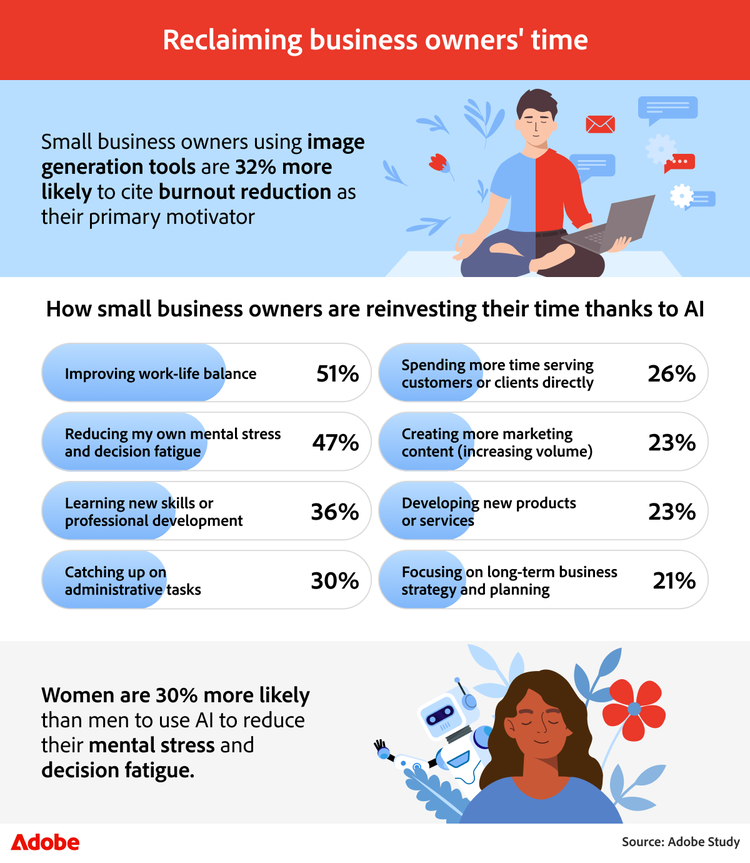
- Beyond productivity, 51% of small business owners surveyed use the time saved to improve work-life balance, and 47% use it to reduce mental stress and decision fatigue.
- Social media content has emerged as the top AI-driven task for small business owner respondents (38%), resulting in an average time savings of 175 hours per year.
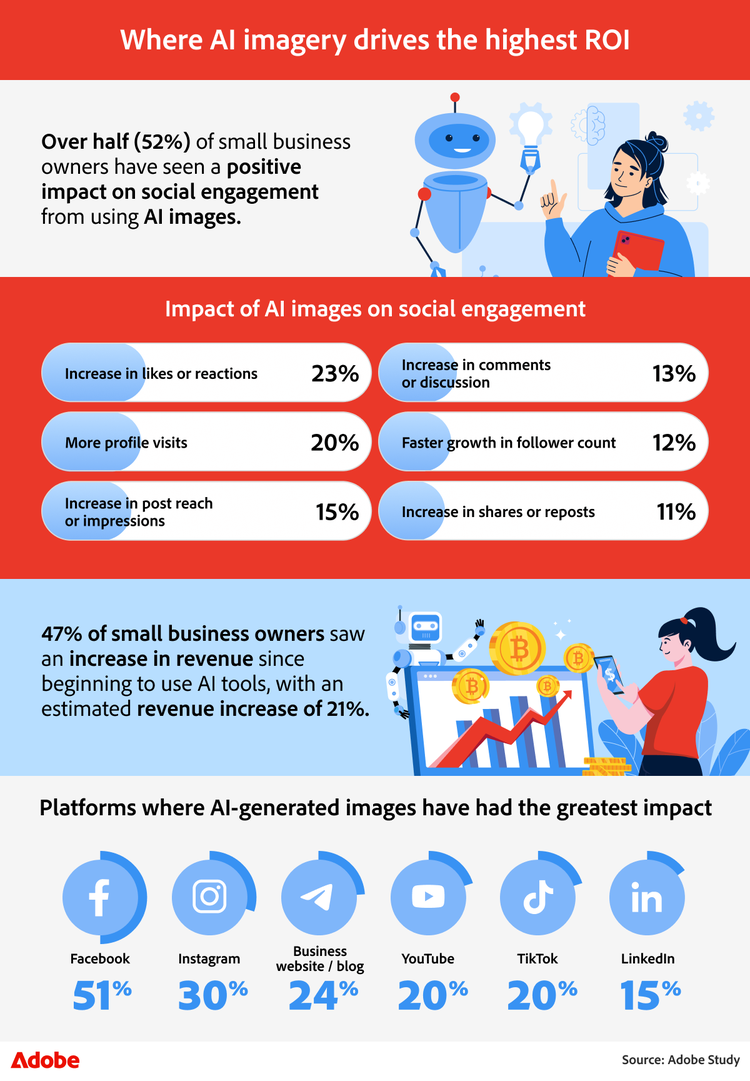
- AI-generated images are primarily driving top-tier engagement for small businesses surveyed, with increased likes (23%), more profile visits (20%), and expanded post reach (15%) emerging as the three most significant performance gains.
- To master visual design and data analysis (29% each), about one in seven small business owners surveyed are committing $1,000 or more to AI training this year.
Small business owners are increasingly turning to generative AI to support both their marketing and day-to-day operations. From assisting with the creation of branded visuals to reviewing complex documents, AI can help teams work more efficiently and focus their time on higher-value tasks.
The rise of generative AI in small business operations
As generative AI moves from experimentation to everyday infrastructure for small businesses, we surveyed 431 small business owners across industries to identify where AI is delivering meaningful time savings, operational efficiency, business growth, and increased confidence.
How small businesses are using AI today
For many small business owners, AI is helping with both content creation using an AI image generator and AI-assisted administrative tasks that keep the business running.
AI adoption rates among small business owners
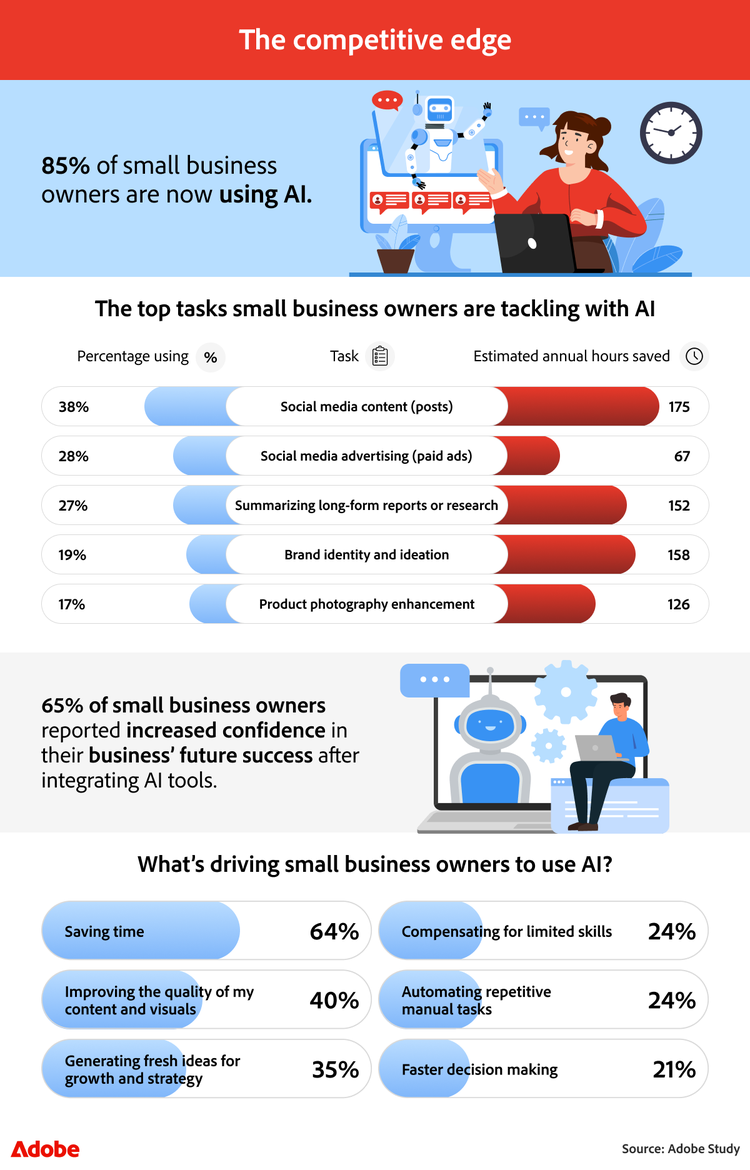
Eighty-five percent of small business owners surveyed are now using generative AI tools to help fuel their businesses. This AI integration has led 65% of respondents to feel more confident in their company’s future. This confidence varies by generation, with Baby Boomers surveyed reporting the highest levels of improved outlook due to AI use at 73%, compared to Gen Z respondents at 61%, the lowest amongst generations surveyed.
The most popular AI tools for small businesses
Among respondents, the most widely used AI tools include:
- Text generation tools (77%)
- Image generation tools (30%)
- Data analysis tools (29%)
- Document intelligence and AI assistants (18%)
- Code or website builders (11%)
This mix shows there’s a need for both creative expansion and operational efficiency. AI image generators such as Adobe Firefly are helping small businesses scale branded visuals and marketing content. Meanwhile, document-focused AI tools like Adobe Acrobat’s AI Assistant are streamlining complex tasks. With AI chat with PDF functionality, users can summarize reports, review contracts, and extract key insights from documents, reducing manual review time.
Time and cost savings from AI-powered workflows
Social media content is the leading AI-driven task, with 38% of respondents using AI to create posts, saving an estimated 175 hours annually. We determined how much small business owners could save based on the average income of a small business owner.
On average, owners stand to save:
- 175 hours and $5,816 annually from using AI for social media content
- 67 hours and $2,226 annually from using AI for social advertising
- 152 hours and $5,051 annually from using AI to summarize reports
While time savings are the primary motivator for adoption, cited by 64% of respondents, the financial impact adds up quickly. These hours saved can amount to thousands of dollars each year, and for many small business owners surveyed, AI adoption is about keeping costs down and staying competitive.
How AI is changing the small business workday
As AI becomes part of the workflow, many small business owners feel less pressure and find new ways to use the time they get back.
Improving work-life balance with AI automation
Among small business owners surveyed, the majority are using time saved by AI to improve work-life balance and reduce stress, while others are reinvesting it into skill-building, administrative tasks, and serving customers.
The type of AI tool used can shape how that time is experienced. Small business owners surveyed who use document intelligence tools are 110% as likely to cite automation as a top motivator, suggesting that streamlining paperwork and back-office tasks plays a major role in freeing up time. Tools that enable AI chat with PDF functionality, such as Acrobat’s AI Assistant and ChatPDF-style capabilities, let owners summarize reports, extract action items, and edit PDF documents without manually reviewing every page.
Reducing burnout through AI image and video generation
Meanwhile, respondents who use AI image generation tools are 32% more likely to say reducing burnout is a key motivator, highlighting the impact of speeding up creative workflows. Women surveyed are also 30% more likely than men to use AI specifically to reduce mental stress and decision fatigue. Whether using an AI image generator to test concepts, or experimenting with an AI video generator to expand content output, faster visual workflows can reduce pressure on small businesses.
AI can help small businesses operate more efficiently and reclaim time, directly affecting their focus, creativity, and day-to-day workload.
The impact of AI-generated content on social media engagement
Over half (52%) of small business owners surveyed say they’ve seen a positive impact on social engagement after using AI-generated images. The most noticeable improvements include increases in likes and reactions (23%), profile visits (20%), and post reach and impressions (15%). With an AI image generator(free options are available, business owners no longer need a marketing or design background to produce consistent, on-brand visuals that compete in crowded feeds.
Higher engagement can lead to increased revenue for these small businesses. Forty-seven percent of small business owners surveyed report an increase in revenue since beginning to use AI tools, with an estimated average increase of 21%. Facebook shows the greatest impact (51%), followed by Instagram (30%) and business websites or blogs (24%), with YouTube and TikTok also delivering measurable lift. The impact varies by industry: surveyed tech business owners are 56% more likely than those in business or management roles to report increased likes and reactions, and 10% more likely than retail owners to see revenue growth after adopting AI tools.
Turning increased engagement into revenue growth
Whether they’re using an AI image generator to create social posts or trying an AI video generator to test short-form content, small business owners are seeing stronger engagement turn into real revenue growth. Tools like Adobe Firefly make it easier for small teams to produce consistent, on-brand visuals without adding extra pressure.
Building confidence in AI
Even as AI becomes part of daily operations, business owners are still refining their skills, addressing concerns, and deciding how much to invest.
The top skills small business owners want to improve with AI
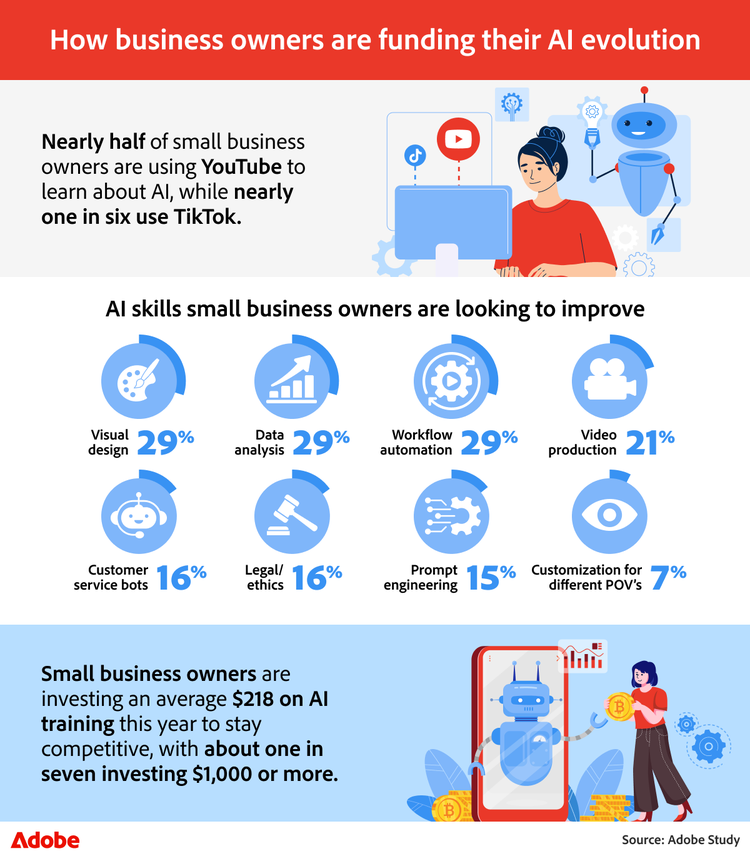
With AI now part of their day-to-day operations, many small business owners are focused on getting more out of the tools they use. Visual design, data analysis, and workflow automation are tied as the top skills respondents want to improve (29% each), followed by video production (21%). Others are looking to build expertise in customer service bots and legal or ethical considerations (16% each), while 15% want to strengthen their prompt engineering skills.
That commitment is showing up in spending: small business owners surveyed are investing an average of $218 in AI training this year, and about one in seven are committing $1,000 or more to stay competitive.
Common concerns about AI adoption
Despite high adoption, respondents say the biggest challenges preventing them from using AI more include:
- The output feels generic or lacks a human touch (42%)
- Ethical concerns, such as impact on artists or jobs (35%)
- Inconsistent quality or accuracy (31%)
- A preference for relying solely on human creativity (30%)
- Data privacy and security concerns (30%)
- Copyright or legal risks (28%)
- Concerns about accuracy when summarizing sensitive business documents (26%)
- Fear of damaging brand reputation (20%)
These concerns are shaping how business owners approach AI learning. Rather than abandoning the tools altogether, many are seeking out education and experimentation to use them more effectively.
Where small business owners are learning about AI:
- Trial and error / self-experimentation (46%)
- YouTube (46%)
- Online forums or communities (39%)
- AI tool provider websites (28%)
- Professional networks or peers (24%)
- Online courses or webinars (20%)
- News articles or media (19%)
- TikTok (16%)
Generational and gender differences in AI education
Learning habits vary by age; older small business owners surveyed are more likely to rely on trial and error, while millennials and Gen Z respondents tend to turn to YouTube. Nearly one in three Gen Z business owners surveyed use TikTok to learn about AI. That platform divide extends by gender as well, with men surveyed being 44% more likely to lean on YouTube for AI education, while women are 58% more likely to turn to TikTok.
The link between AI confidence and investment
Small business owners who report greater confidence in their company’s future as a result of AI use are investing 193% more in AI training than those who report no change in confidence. As confidence grows, so does the willingness to commit time and money to developing stronger AI skills.
How you can boost your business using Adobe’s AI tools
For many small businesses, AI is proving useful in two main ways: creating content and handling everyday tasks.
Strengthen your marketing with creative AI
An AI image generator, such as Adobe Firefly, can help you:
- Create on-brand social media graphics
- Develop product mockups and marketing visuals
- Test campaign ideas
- Expand into short-form content with an AI video generator
Faster visual production makes it easier to stay consistent online without increasing workload or outsourcing creative work.
Simplify complex tasks with document intelligence
Adobe Acrobat’s AI Assistant and AI chat with PDF functionality can help you:
- Summarize lengthy reports in seconds
- Extract key clauses from contracts
- Pull action items from briefs or proposals
- Chat with PDF documents to surface important insights
- Edit PDF files quickly without disrupting your workflow
Combining creative tools like Firefly with document tools in Acrobat gives small teams more control over both their marketing and their day-to-day operations.
Scaling small businesses with confidence using Adobe AI tools
For many small business owners surveyed, AI has moved beyond curiosity and into everyday use, especially as owners grow more comfortable with tools like Adobe Firefly to generate AI images and Adobe Acrobat’s AI assistant for AI chat with PDF functionality to manage documents. The value isn’t in the tools themselves, but in what they enable: clearer marketing, smoother operations, and greater confidence in the business's direction.
Methodology
To explore how business owners use AI, we surveyed 431 small business owners. The data has a 95% confidence level and a low 5% margin of error. Because this exploratory research relied on self-reported data, respondents may have biases, and discrepancies may exist between their answers and their actual experiences.
Keep exploring
title
How Small Businesses Maximize ROI With AI Tools
cardImageAltText
We surveyed over 400 small business owners to uncover how AI boosts revenue and saves time. Discover the AI tools driving growth and scale smarter today.
cardImage