#1E1E1E

ACROBAT | 7-MINUTE READ

Synthesis essay: What it is and how to write one.

Learn how to write an effective and well-structured synthesis essay.

Explore Acrobat Studio

A boy sits at a desk with a notebook and writes ideas for a synthesis essay.
#F5F5F5
Learn what a synthesis essay is and how it differs from other essays. Follow a step-by-step outline to write your essay. Learn how to organize sources, craft a thesis, and use Adobe Acrobat tools to edit, annotate, and finalize your work. You’ll have a polished, professional essay in no time

Whether you’re a high school student preparing for a college entrance exam, a university student in a composition class, or simply looking to brush up on your academic writing, knowing how to write a synthesis essay is a crucial skill. These essays require more than researching and summarizing multiple sources. Synthesis essays ask the writer to combine ideas, identify connections, and build a persuasive or informative argument for the reader.

A synthesis essay is different from other essays, like a persuasive essay or an analytical essay. This article will break down everything you need to know about how to write a synthesis essay successfully, including what it is, the structure to follow when writing, and what steps to take in the writing process.

#F5F5F5

What is a synthesis essay?

A synthesis essay is a type of academic essay that asks the writer to combine information from multiple sources into a cohesive, original argument or narrative. The goal of a synthesis essay is not just to report what each source says but to synthesize, or blend, together the various perspectives in each source into a new whole.

Think of it this way: Research papers are about analysis. Argumentative essays are about persuasion. A synthesis essay does both — analyzes different viewpoints and uses them to support a central claim.

You are most likely to encounter a prompt to write a synthesis essay as part of English Language and Composition exams, in college-level writing courses, for literature reviews or comparative studies, or as part of research-based essays and reports.

A synthesis essay has several key features:

  • Incorporates multiple sources, usually a minimum of three
  • Focuses on a central thesis
  • Demonstrates the relationship between ideas
  • May be argumentative, explanatory, or review-based

Synthesis essay outline.

Strong essays come from strong outlines. Outlining your synthesis essay helps you organize ideas, sort source material, and establish a logical flow before you begin writing.

While the overall structure of a synthesis essay is similar to most other academic essays, these essays also have unique planning requirements since they rely on multiple sources. As you craft your synthesis essay outline, take advantage of a free online PDF editor to annotate source PDFs and take notes directly in digital source documents.

Though taking time to complete a thorough outline may feel counterproductive, the outlining process is essential. Many synthesis essays fall flat not due to poor ideas but from poor structure and organization.

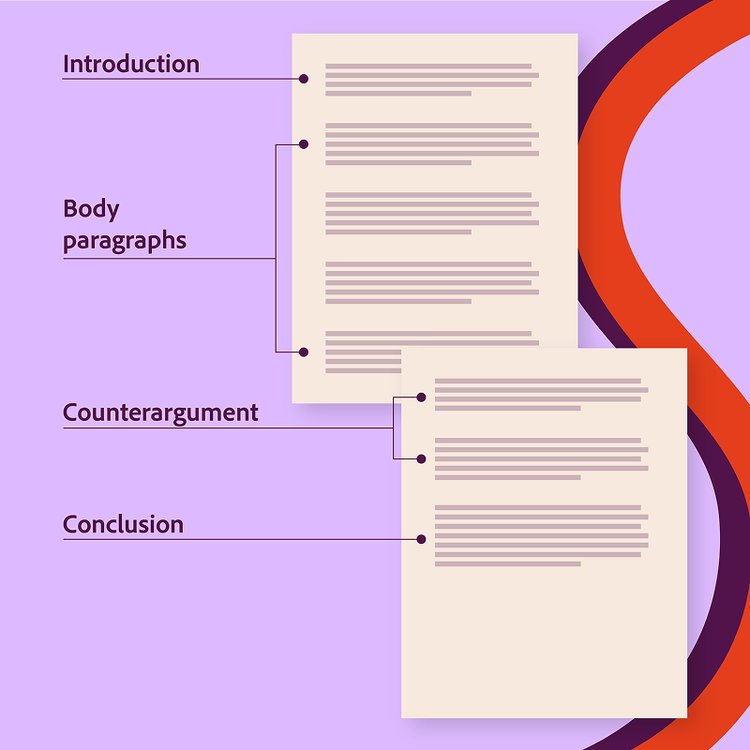
A two-page synthesis essay with callouts identifying the introduction, body paragraphs, counterargument, and conclusion.

Introduction

Your introduction starts with a hook that grabs the reader’s attention, such as an interesting fact, a question, or a quote. Then, share the context of your essay by giving a brief background on the topic. Close the introduction with your thesis statement, the central claim of your essay.

Body paragraphs

A standard synthesis essay typically contains three to four body paragraphs. Each paragraph should begin with a topic sentence. Next, integrate multiple sources to support that topic. Share explanation and analysis. Then, transition into the next point in the following paragraph.

Counterargument

Counterarguments are optional in synthesis essays but are recommended. Take a paragraph to present a view that opposes your thesis, and refute it using both evidence from the sources and your reasoning.

Conclusion

In the conclusion of your essay, restate the thesis in fresh words. Summarize your key points, and end with a strong, thought-provoking final statement.

#F5F5F5

How to write a synthesis essay.

Writing a synthesis essay can be broken down into five basic steps. Each stage of the writing process helps you progress from scattered sources to a well-crafted, cohesive essay.

#F5F5F5

1. Read and understand your sources.

Before you begin writing, read all the assigned texts or those you selected on your own. Annotate them. Highlight key arguments by the authors. Note the similarities and contradictions you see. Remember that you aren’t solely reading for understanding. You’re reading to find connections between the sources. You can also use a PDF to Word conversion tool to convert articles into editable files for easier annotation.

#F5F5F5

2. Develop your thesis statement.

Your thesis statement is the backbone of this (and any) essay. It must clearly state your position or the main insight drawn from synthesizing the sources. The goal of your thesis is to show that you can interpret complex material and arrive at your conclusion. That is what elevates a synthesis essay from a summary.

#F5F5F5

3. Organize your sources and main points.

Form your outline following the structure discussed earlier. As a reminder, your outline should include an introduction, several body paragraphs, a counterargument, and a conclusion. Organize your paragraphs by theme rather than source, and blend your sources throughout the piece. Avoid summarizing any source in isolation.

#F5F5F5

4. Draft your essay.

When you are happy with your outline, you can proceed to write with confidence because you have already done the hardest parts — identifying your thesis, finding evidence, and organizing your sources. Maintain a formal, objective tone as you craft your essay.

#F5F5F5

5. Revise and proofread.

Every great essay requires revision. Start by reviewing and revising yourself. You can use the following checklist as a starting point in your revision process:

  1. Are multiple sources cited in each paragraph?
  2. Does your thesis guide every part of the essay?
  3. Have you included transitions to help the essay flow smoothly?
  4. Did you address a counterargument?
  5. Are your citations accurate and in the requested format?

After completing your review, ask a peer or mentor for feedback to help point out areas for improved clarity or stronger arguments.

Before turning in your essay, be sure to conduct a final proofread to catch any grammatical errors or formatting mistakes. You may find it helpful to read your essay out loud as you review. Save your essay as a PDF to ensure your formatting stays the same across devices.s

Synthesis essay FAQs.

What is an example of synthesis writing?

Synthesis essays can be written on virtually any topic, as long as they bring together varied viewpoints into a unified argument. One example could be an essay comparing three articles on climate change to argue that government intervention is more effective than corporate sustainability initiatives. Another example could be an essay exploring the role of technology in the modern classroom, arguing that technology is only effective when integrated with other effective teaching strategies.

Is a synthesis essay like a DBQ?

DBQ stands for document-based question. These questions are common on Advanced Placement (AP) exams and other college entrance exams. A DBQ requires test takers to analyze multiple sources and form a clear argument. Answering these questions is essentially synthesis writing, just focusing exclusively on historical texts or data.

Are synthesis essays hard to write?

Synthesis essays can be challenging because they require critical thinking, organization, and integrating multiple points of view. However, with clear steps and a strong outline, synthesis essays can be very manageable. These skills are essential for achieving success in college, research, and professional communication.

What is synthesis in an LEQ?

In a long essay question (LEQ), synthesis refers to your ability to make connections between ideas, time, or different themes as part of a standardized test. It shows higher-level thinking and is often rewarded with extra points. When you answer an LEQ, you typically have a limited time frame and an assigned topic and sources.

Do synthesis essays require citations?

Yes, as part of a synthesis essay, you must cite all the sources you use. Accurate citations are required for academic credibility. The format for these citations varies depending on the citation style you are assigned. Common citation styles include:

  • MLA (Modern Language Association). This style is used in the humanities, particularly in literature and cultural studies. It features in-text citations with the author’s last name and page number as well as a Works Cited page.
  • APA (American Psychological Association). This style is used in the social sciences, like psychology and education. It uses author-date in-text citations and a References page.
  • Chicago (Chicago Manual of Style). This style is used in history and publishing. Chicago style is unique in that it offers two reference systems: notes and a bibliography with footnotes or author-date in-text citations like those used in APA.
  • AMA (American Medical Association). This style is used in medical and health sciences. It features superscript or numbered in-text citations with a corresponding numerical reference list.

Can you disagree with a source in a synthesis essay?

You can absolutely disagree with a source. Part of the critical thinking that a synthesis essay requires includes evaluating the strengths and weaknesses of each source you encounter. It is okay to challenge a viewpoint in your essay if you can back up your position with solid evidence.

What is the difference between a synthesis essay and an argumentative essay?

Both synthesis essays and argumentative essays involve the writer taking a position and supporting their claim. A synthesis essay requires the writer to connect multiple sources to support the claim, while an argumentative essay can support fewer or even a single source for your persuasion.

Can you use first person in a synthesis essay?

Whether you use first person or third person in a synthesis essay depends on the assignment and the tone. Most academic synthesis essays avoid first person, relying on third person to maintain a sense of objectivity. If your synthesis essay assignment is more reflective or personal, first person may be acceptable.

Keep Exploring

CaaS

https://main--dc--adobecom.aem.page/dc-shared/fragments/seo-articles/acrobat-color-blade