Common transition words for essays
Transition words for essays serve as essential bridges that connect ideas, paragraphs, and sections to create smooth, logical flow in academic writing.

What are transition words for essays?
Transition words for essays are words and phrases that establish connections between ideas, sentences, and paragraphs. They act as signposts that guide readers through your argument, signaling relationships between concepts and creating a seamless reading experience. Without these connectors, even well-researched essays can feel disjointed and difficult to follow.
These linguistic tools serve several critical functions in academic writing. They indicate how ideas relate to one another, whether through addition, contrast, cause and effect, or other logical relationships. Essay transition words also help maintain coherence by showing readers how each new point connects to what came before and what follows.
When you learn how to write a college essay, effective transitions demonstrate sophisticated thinking and organizational skills. Admissions committees and professors alike recognize that strong transitions reflect a writer's ability to construct logical arguments and communicate complex ideas clearly.
Modern AI tools can now assist writers in identifying weak transitions and suggesting improvements. These technologies analyze your writing for flow and coherence, flagging areas where additional connectors might strengthen your argument. However, understanding the fundamentals of transition words remains essential for any writer who wants to craft compelling essays.

Transition words for essays by function
Transition words serve different purposes depending on the relationship you want to establish between ideas. Understanding these categories helps you select the most appropriate connector for each situation in your writing.
Organizing your essay with proper structure makes choosing transitions easier. When you create an essay outline before writing, you can identify the logical relationships between sections and plan your transition words accordingly. This preparation ensures smooth flow throughout your final draft.
1. Addition transition words
Addition transitions introduce supplementary information that builds upon or reinforces your previous point. Use these connectors when you want to expand on an idea, add supporting evidence, or present another reason that strengthens your argument.
These words signal to readers that you're continuing in the same direction rather than changing course. They're particularly useful when building comprehensive arguments with multiple pieces of evidence. Addition transitions can also help you make an essay longer by encouraging you to develop ideas more fully.
Common addition transition words include:
- Furthermore
- Moreover
- Additionally
- In addition
- Also
- Besides
- Equally important
- Likewise
- Similarly
- Not only...but also
- As well as
- Coupled with
- Together with
- Along with
- What's more
- On top of that
- Further
- And
- Too
2. Contrast transition words
Contrast transitions highlight differences, present opposing viewpoints, or introduce unexpected information that challenges what came before. These connectors are essential for balanced academic writing that acknowledges multiple perspectives.
Use contrast words when shifting from one side of an argument to another, presenting counterarguments, or noting exceptions to general statements. They prepare readers for a change in direction and prevent confusion when you move from one perspective to its opposite.
Common contrast transition words include:
- However
- Nevertheless
- On the other hand
- In contrast
- Conversely
- Although
- Despite
- Whereas
- While
- Yet
- But
- Still
- Nonetheless
- On the contrary
- Even so
- Rather
- Instead
- Alternatively
- Notwithstanding
3. Cause and effect transition words
Cause and effect transitions establish relationships between events, actions, and outcomes. They show readers why something happened or what results from a particular circumstance, making your reasoning explicit and easy to follow.
These connectors are crucial for analytical writing where you need to demonstrate how one factor leads to another. Use them when explaining consequences, presenting results of research, or building logical arguments that depend on causal relationships.
Common cause and effect transition words include:
- Therefore
- Consequently
- As a result
- Thus
- Hence
- Accordingly
- Because
- Since
- Due to
- Owing to
- For this reason
- So
- Leads to
- Results in
- Causes
- Effects
- This means that
- It follows that
- As a consequence
4. Example and illustration transition words
Example transitions introduce specific instances, evidence, or illustrations that support your general claims. They signal to readers that you're about to provide concrete proof or clarification for an abstract point.
Use these connectors when moving from general statements to specific evidence, introducing quotations or data, or clarifying complex concepts with concrete examples. They help readers understand exactly what you mean and strengthen your credibility by showing evidence for your claims.
Common example and illustration transition words include:
- For instance
- Such as
- Specifically
- To illustrate
- Namely
- Including
- In particular
- As an illustration
- To demonstrate
- As shown by
- As seen in
- Consider
- Take the case of
- One example is
5. Emphasis and clarification transition words
Emphasis transitions highlight particularly important points or clarify meaning when precision matters. They draw readers' attention to key ideas and ensure your most significant arguments receive appropriate weight.
Use these connectors when you want to stress crucial information, restate something in clearer terms, or ensure readers understand the significance of a particular point. They're especially valuable in complex arguments where certain ideas deserve extra attention.
Common emphasis and clarification transition words include:
- Indeed
- In fact
- Certainly
- Undoubtedly
- Especially
- Particularly
- Significantly
- Importantly
- Above all
- Notably
- Clearly
- Without doubt
- To clarify
- In other words
- That is to say
- Put simply
- More importantly
6. Time and sequence transition words
Time and sequence transitions organize information chronologically or show the order of steps in a process. They help readers follow narratives, understand procedures, and track the progression of events or arguments.
Use these connectors when describing historical developments, explaining processes, or organizing information in a logical sequence. They're essential for any writing that depends on readers understanding when things happened or in what order steps should occur.
Common time and sequence transition words include:
- First
- Second
- Third
- Next
- Then
- Finally
- Subsequently
- Afterward
- Previously
- Meanwhile
- Simultaneously
- Before
- After
- During
- Initially
- Eventually
- At the same time
- In the meantime
- Following this
- Prior to
7. Conclusion and summary transition words
Conclusion transitions signal that you're wrapping up your argument or summarizing key points. They prepare readers for final thoughts and help create a sense of closure in your writing.
These connectors are essential when you learn how to write a conclusion for an essay as they clearly indicate the shift from body paragraphs to final synthesis. Use them to introduce your concluding paragraph, summarize main arguments, or present final thoughts on your topic.
Common conclusion and summary transition words include:
- In conclusion
- To summarize
- In summary
- Finally
- Ultimately
- Overall
- To conclude
- In brief
- All in all
- On the whole
- In the end
- As a final point
- To sum up
- In closing
- Taking everything into account
8. Concession transition words
Concession transitions acknowledge opposing viewpoints or limitations in your argument while maintaining your overall position. They demonstrate intellectual honesty and strengthen your credibility by showing you've considered alternative perspectives.
Use these connectors when addressing counterarguments, acknowledging weaknesses in your position, or showing nuance in complex debates. They help you appear fair-minded while still advancing your thesis.
Common concession transition words include:
- Admittedly
- Granted
- Although
- Even though
- While it is true
- Of course
- Naturally
- Certainly
- To be sure
- It may be that
- Despite this
- Regardless
9. Similarity transition words
Similarity transitions draw comparisons between ideas, events, or concepts. They show readers how different elements share common characteristics or parallel each other in meaningful ways.
Use these connectors when comparing two subjects, showing how examples relate to each other, or demonstrating patterns across different contexts. They're particularly useful in comparative essays and when building arguments through analogy.
Common similarity transition words include:
- Similarly
- Likewise
- In the same way
- By the same token
- Equally
- Correspondingly
- In like manner
- Just as
- Comparable to
- Along the same lines
- In a similar fashion
- Analogously
10. Condition transition words
Condition transitions present hypothetical situations, if/then relationships, or circumstances under which something applies. They help readers understand the parameters of your argument and any limitations on your claims.
Use these connectors when discussing possibilities, setting conditions for your conclusions, or exploring hypothetical scenarios. They're essential for nuanced academic writing that acknowledges complexity and avoids overgeneralization.
Common condition transition words include:
- If
- Unless
- Provided that
- In case
- Even if
- Only if
- Whether or not
- Assuming that
- On the condition that
- Given that
- In the event that
- Supposing that
Tips for using transition words for essays
Mastering transition words requires more than memorizing lists. Strategic implementation separates polished academic writing from amateur attempts at sophistication. These best practices will help you use essay transition words effectively.
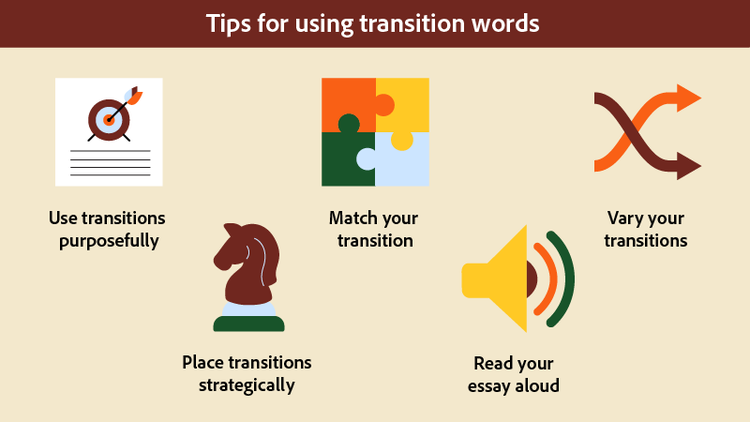
- Use transitions purposefully rather than excessively. Adding too many connectors clutters your prose and can actually impede readability. Each transition should serve a clear function in guiding readers through your argument. If removing a transition word doesn't change the meaning or flow, consider whether it's necessary.
- Match your transition to the actual logical relationship between ideas. Using "however" when you mean "furthermore" confuses readers and undermines your credibility. Before selecting a transition, identify the precise relationship you want to establish, then choose the connector that accurately reflects that relationship.
- Vary your transitions to avoid repetition. Starting every paragraph with "additionally" or "furthermore" becomes monotonous quickly. Draw from the full range of transition words available for each function to keep your writing fresh and engaging.
- Place transitions strategically for maximum clarity. While transitions often appear at the beginning of sentences or paragraphs, they can also work effectively mid-sentence. The key is ensuring readers immediately understand the connection you're establishing.
- Read your essay aloud to check flow. Your ear often catches awkward transitions that your eye misses. If a passage sounds choppy or disconnected when spoken, it likely needs stronger transitional language.
AI tools offer valuable assistance in reviewing your transitions. You can chat with a PDF to get feedback on essay flow and identify areas where transitions could be strengthened. These tools analyze your writing patterns and suggest specific improvements.
Generative AI for PDFs can help rewrite weak transitions or suggest alternatives when you've overused particular words. This technology serves as a helpful second reader, catching issues you might miss during self-editing.
When reviewing your overall essay structure, an AI summary generator can help you see whether your main points connect logically. If the summary feels disjointed, your transitions likely need attention.
Once you've polished your transitions and finalized your essay, you can convert your document to PDF for professional submission. PDF format preserves your formatting and ensures your carefully crafted transitions appear exactly as intended.
Here are ten examples of transitions used in sentences to illustrate how these words function in practice:
- "The study found significant improvements in test scores. Furthermore, attendance rates increased by 15%."
- "Many students prefer online learning. However, traditional classrooms offer valuable face-to-face interaction."
- "Increased screen time affects sleep quality. As a result, many students report fatigue during morning classes."
- "Several factors contribute to academic success. For example, consistent study habits and time management play crucial roles."
- "Critical thinking skills are essential. Indeed, they form the foundation of advanced academic work."
- "First, gather your research materials. Then, create an outline before drafting your essay."
- "In conclusion, transition words serve as vital tools for creating cohesive academic writing."
- "Admittedly, mastering transitions takes practice. Nevertheless, the effort yields significant improvements in writing quality."
- "Online resources provide convenience. Similarly, digital libraries offer accessible research materials."
- "If you practice using varied transitions, your writing will improve noticeably."
Frequently asked questions
How do I transition into a new paragraph in an essay?
Can I use the same transition word multiple times in an essay?
What are common mistakes when using transition words?
How many transition words should I use per paragraph?
Do transition words only go at the beginning of sentences?
What is the difference between transitions within paragraphs versus between paragraphs?
What are the best transition words for academic essays?
You may also like