

Purchase agreements appear across industries and deal sizes. Whether you are finalizing a business acquisition or purchasing high‑value equipment, the agreement documents the scope, price, responsibilities, conditions to close, and the steps each party must take. This article will cover definition and mechanics of a purchase agreement, key elements, and common contingencies, with practical steps and examples throughout.
What is a purchase agreement?
A purchase agreement is a formal contract that records the negotiated terms for selling and buying a defined asset or business. It typically follows earlier negotiations and due diligence, and precedes closing and final transfer. For many organizations, it serves as the single source of truth for who does what, when, and under what conditions the transaction will complete.
The agreement identifies the parties, describes the asset or business being transferred, states consideration and payment timing, sets out representations and warranties, and defines covenants and closing conditions. It also allocates risk between the parties, addressing remedies and procedures if something material changes before closing. In common use, the term is closely related to a purchase and sale agreement, which is why many teams use these interchangeably depending on the industry.
Purchase agreements exist in many forms, including those for business assets and those for recurring supply arrangements. Specialized versions such as a power purchase agreement address recurring delivery of energy across a defined term. Regardless of the variation, the central purpose remains the same: capture the negotiated deal in a clear, enforceable document that both parties can follow. It’s why having a strong foundation of how to write a contract is important.
Who prepares the purchase agreement depends on the organization and transaction. Many businesses rely on legal counsel to draft or review the agreement; others adapt approved templates with input from finance, operations, and procurement. When an organization drafts in‑house, it is critical to route the document for review by stakeholders who understand the asset, risks, and regulatory requirements. Templates accelerate the process, but they must be customized carefully to reflect the specific deal.
Clarity and version control matter throughout. Teams often circulate multiple drafts while negotiating definitions, schedules, and exhibits. Maintain a clear change history, consolidate feedback, and ensure that defined terms are used consistently across sections. Before signature, confirm that schedules and referenced documents are complete and attached.
Key elements of a purchase agreement.
Every deal is different, but most purchase agreements include a familiar core set of components. Use the list below as a reference during drafting and review.
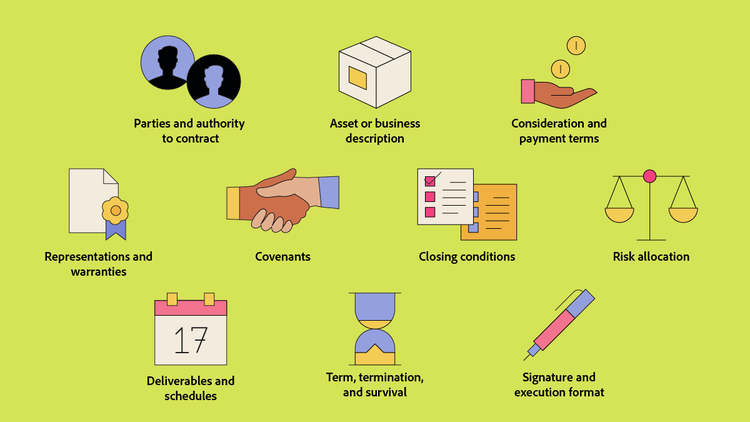
- Parties and authority to contract. Name each party precisely and confirm authority to enter into the agreement. Capture roles for signatories and any required approvals.
- Asset or business description. Define exactly what is being transferred, including inclusions, exclusions, and condition at transfer. Reference schedules where helpful.
- Consideration and payment terms. State price, deposits, timing, milestones, and method of payment. When price construction is relevant, reference a fixed‑price contract for context.
- Representations and warranties. Summarize what each party asserts as true at signing and, if applicable, at closing. Tie any updates to conditions or termination rights.
- Covenants. Specify actions parties must take between signing and closing, including required filings, third‑party notices, and access to information.
- Closing conditions. List what must be true or delivered at closing, such as approvals, consents, financing, deliverables, and absence of material adverse changes.
- Risk allocation. Define remedies and limits, including indemnification structure, caps, baskets, and dispute resolution mechanics. Clarify governing law and venue.
- Deliverables and schedules. Attach schedules and exhibits for assets, liabilities, transition services, or other details too lengthy for the main body.
- Term, termination, and survival. Explain when obligations begin and end, which provisions survive closing, and how the parties may end the agreement before closing.
- Signature and execution format. Capture signatories, execution mechanics, and whether the contracts may use electronic signatures.
Some agreements also clarify whether pre‑signing documents were intended to be binding vs non‑binding contracts. When parties compare structures, clarifying concepts like a unilateral contract can help align expectations for obligations.
Can you write up your own purchase agreement? Many small transactions begin with a company template assembled internally. Doing so can be effective when the scope is narrow and risks are well understood. For complex transactions or situations with regulatory or industry nuance, draft with counsel or route in‑house drafts to counsel for review. At minimum, ensure stakeholders in finance, operations, procurement, and security confirm accuracy and feasibility of the terms.
Purchase agreement contingencies.
Contingencies are provisions that must be satisfied or waived before the parties close. They protect buyers and sellers by clarifying what must happen between signing and closing and create structured exit ramps if critical assumptions change. The right mix depends on the asset, industry, and regulatory context.
Common contingencies include:
- Financing contingencies where the buyer's obligations depend on securing funding under defined terms and timelines.
- Inspections and appraisals that confirm condition, value, or compliance of the asset or business.
- Regulatory approvals including antitrust, industry licensing, or other government clearances.
- Third‑party consents from lenders, landlords, key customers, or suppliers when contracts require consent to assign or transfer.
- Title or ownership verification to ensure clean transfer of the asset or equity free of undisclosed encumbrances.
- Documentation delivery such as transition services agreements, bills of sale, or post‑closing support terms.
- Absence of material adverse change between signing and closing where the scope is defined and objectively measurable.
If contingencies are not satisfied or waived by their deadlines, either party may have a right to terminate under specified conditions. If a party fails to meet obligations without an applicable contingency or termination right, the other party's remedies will depend on the risk allocation and remedies section. Clear drafting of contingencies and termination procedures reduces disputes and speeds resolution.
When industry context matters, reference specialized practices to inform drafting. For example, a construction contract illustrates how industry‑specific schedules, inspections, and change procedures can be adapted to a purchase agreement's contingency structure.
Frequently asked questions.
A purchase order authorizes a vendor to supply goods or services under predefined pricing and terms, usually governed by standard terms and conditions. A purchase agreement documents a negotiated transaction for the transfer of a defined asset or business and includes detailed representations, covenants, and closing conditions that are not typical in purchase orders.
Common deliverables include signature pages, bills of sale, assignment and assumption agreements, lien releases, transition services agreements, certificates of authority, and third‑party consents. The specific checklist depends on the deal and should align with the schedules and closing conditions in the agreement.
Most organizations accept electronic signatures consistent with applicable law and internal policy. Confirm that signers have authority, that the signature process records intent, and that executed PDFs are preserved with a reliable audit trail.
Yes. The asset description and schedules should define the specific intellectual property being transferred, the scope of licenses or assignments, and any excluded IP. Confirm that chain of title, registrations, and security interests are addressed.
Retention periods vary by jurisdiction, industry, and internal policy. Many organizations retain executed agreements and supporting materials for multiple years to support audits, financial reporting, and dispute resolution. Align retention policies with regulatory requirements and risk tolerance.
Cross‑border deals often add complexity around tax, employment, data protection, and currency. Address governing law and dispute resolution carefully, and confirm whether local filings or approvals are required in each relevant jurisdiction.
You may also like
DISCLAIMER: This article is for informational purposes only. Adobe does not and cannot provide legal, financial, accounting or any other related professional advice. Laws and regulations frequently change. You should consult an attorney, accountant, or other appropriate professional advisor regarding questions specific to your situation. To the maximum extent permitted by law, Adobe provides this material on an "as is" basis. Adobe disclaims and makes no representation or warranty of any kind with respect to this material, express, implied, or statutory, including representations, guarantees, or warranties of merchantability, fitness for a particular purpose, or accuracy.
title
What is a purchase agreement and how to prepare one
cardImageAltText
Two hands shake with a purchase agreement in the background.
cardImage
Tags
caas:content-type/article,caas:topic/b2b,caas:topic/agreements-contracts

