


This article explains what a retainer agreement is, how it works, the core components you should expect to see in one, and when it makes sense to use this approach. It also answers common questions people search for when evaluating retainers and points to practical ways to draft, review, and execute agreements digitally.
What is a retainer agreement?
A retainer agreement is a contract that reserves a professional or firm's time and expertise for a defined period, commonly month-to-month or quarter-to-quarter. The client pays a recurring fee in exchange for access to services within a clearly defined scope. Retainers are common in legal, creative, consulting, IT, and other professional services where ongoing collaboration, faster turnaround, and subject-matter continuity are important.
How it works at a glance:
- The parties agree on scope, availability expectations, and a payment model.
- The client pays a fee (often upfront for each period) that retains access to the provider's services.
- Work is delivered against the scope and measured with agreed metrics, such as hours, deliverables, or outcomes.
- The retainer renews on a schedule unless either party terminates under the contract terms.
When evaluating mechanics and language, it helps to cross-reference a general guide on how to write a contract. You'll want to consider enforceability and expectations too, such as the distinctions between binding vs. non-binding contracts to ensure the agreement reflects the intended level of commitment without overreaching.
Why do organizations use retainers?
Most organizations adopt retainers for predictability and access. You can reserve specialized talent without negotiating a new project every time, and providers can plan capacity. Because the relationship is ongoing, knowledge compounds—providers understand your systems, brand voice, and preferences, allowing you to get faster, more consistent outcomes with less administrative friction.
What is the purpose of a retainer fee?
The retainer fee is the consideration that secures access to services during the period. Practically, it signals mutual commitment: the client commits budget; the provider commits availability. Depending on the model, the fee may cover a specific pool of hours ("pay for access"), a set of predefined deliverables ("pay for output"), or simply priority access for any needs that arise within defined boundaries.
Do you get a retainer fee back?
Whether a fee is refundable depends entirely on the contract's terms. Many agreements treat retainers as "earned upon receipt," meaning the fee is non-refundable because it guarantees the provider's availability for that period. Others treat it as a prepayment against future billable work, where unused funds might be credited or refunded. Your agreement should plainly state how unused hours or funds are handled (forfeited, rolled over, or credited) and what happens upon termination.
Key components of a retainer agreement.
A well-structured retainer agreement spells out what's included, how the fee works, and how the relationship is managed. While formats vary by industry, most comprehensive retainers cover the following components.
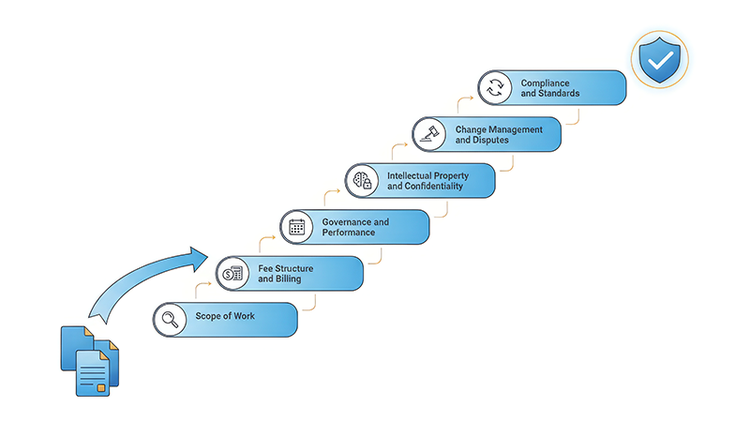
- Scope of work. A strong scope of work section acts as the guardrails for the relationship. It should not only list what services are included but also explicitly state what is excluded to prevent scope creep. For example, a marketing retainer might include content creation and social media management but exclude paid advertising campaign management. Deliverable definitions should be concrete (e.g., "four 1,000-word blog posts per month" or "one monthly performance report").
- Fee structure and billing. This section usually describes the pricing model, which can be an hourly drawdown, fixed deliverable, or hybrid. A fixed-price contract structure can be useful here to set clear expectations when deliverables are consistent. The section commonly includes:
- Payment cadence, due dates, and invoicing procedures.
- Overages: rates for work exceeding the allocation, pre-approval thresholds, and notification rules.
- Rollover rules for unused allocations (e.g., "up to 5 hours may roll over for one month").
- Term and renewal. Any retainer agreement needs to have a term and renewal section that usually covers:
- Initial term (e.g., 3, 6, or 12 months) and clear auto-renewal conditions.
- Termination for convenience (e.g., 30 days' notice) and for cause (e.g., breach of contract).
- Notice periods and procedures for final billing and hand-off.
- Intellectual property and confidentiality. Under this section, the agreement defines the ownership of the final work product and any underlying intellectual property. It also covers licensing rights for any tools or assets used. Another common item included in this section is the protocol around confidentiality and data handling, especially when it comes to sensitive information.
- Change management and disputes. In a retainer agreement, just like in any other type of contract, you’ll find a section on handling changes to the original contract and disputes. This usually covers:
- How new requests outside the initial scope are triaged, estimated, and approved.
- How scope changes might alter fees and timelines.
- Dispute resolution steps and venues. In some scenarios, understanding a unilateral contract concept is helpful, though most retainers are bilateral agreements that define mutual obligations.
What are the disadvantages of a retainer agreement?
Retainers are not the right fit for every situation. Potential drawbacks include:
- Misaligned scope: If needs are unpredictable or purely project-based, you may pay for capacity you don't use.
- Capacity constraints: A provider's other commitments may limit flexibility or turnaround times despite the retainer.
- Administrative overhead: Tracking allocations, reviewing reports, and managing change requests requires discipline from both parties.
- Perceived dependency: Teams may come to rely on the provider for tasks that should be owned in-house.
These risks are manageable with clear scope, measurable outcomes, strong governance, and regular communication.
When to use a retainer agreement.
A retainer is best when you need consistent, predictable access to specialized skills for a steady stream of work. Common fit signals include:
- An ongoing workload in a specific area (like marketing or IT) that benefits from continuity.
- Predictable monthly needs or a recurring set of deliverables.
- A strong preference for institutional knowledge and faster response times.
- A desire to align incentives around long-term outcomes rather than hourly bursts.
Common industry examples include:
- Marketing: An agency providing ongoing SEO, content marketing, and social media management.
- IT Services: A managed service provider (MSP) handling cybersecurity, network uptime, and helpdesk support.
- Creative Services: A design firm producing consistent brand assets, presentation decks, and marketing collateral each month.
- Construction: In construction and related trades, recurring maintenance, inspections, or advisory services are strong candidates for retainers. For context on project-based documents in that space, see a construction contract.
Modern tools can also simplify how you draft, review, and understand agreements. For example, you can use generative AI features to summarize lengthy sections, get plain-language explanations of complex clauses, or surface key terms to discuss with your advisors.

How to create a retainer agreement.
Use this process to move from an idea to a signed agreement that is clear, fair, and ready for execution.
- Define the business need and scope – Work with stakeholders to clearly articulate the goals you want to achieve. Create a detailed list of in-scope services and, just as importantly, a list of what is not included to prevent confusion.
- Choose a pricing model and allocation rules – Decide between an hourly drawdown, a fixed-deliverable fee, or a hybrid model. Define the overage rates, pre-approval thresholds, and rollover rules for any unused allocations.
- Draft terms and governance – Write clear sections for the agreement term, renewal process, and termination clauses. Establish success metrics, a meeting cadence, and escalation paths for issues. Specify service level agreement (SLA) expectations.
- Review obligations and risk – Confirm clauses for intellectual property ownership, confidentiality, and data handling align with your company's policies. Define the dispute resolution process and ensure it meets your procurement and compliance requirements.
- Route for stakeholder review and approvals – Use a digital workflow to share the draft with budget owners, legal, and operations. Track revisions centrally and capture all approvals in a single, auditable system of record.
- Execute and organize the final agreement – Once all parties are in agreement, use an e-signature tool to execute the document. Store the final, signed version in a secure, shared repository and establish a simple playbook to track allocations, changes, and renewals.
For ongoing document workflows—review, e-signature, sharing, and archiving—see what's possible with comprehensive PDF tools for business.
Frequently asked questions.
Many organizations start with a 3–6 month term to validate the relationship and results, then extend to 12 months or longer upon success. Shorter initial terms reduce switching risk while still enabling continuity.
This is a point of negotiation. Some retainers allow a limited rollover window (e.g., up to 25% of hours for 30 days), while others forfeit unused allocations to encourage a steady cadence and predictable capacity planning for the provider.
Yes, some agreements include limited exclusivity in a specific category or market, but this usually comes in exchange for higher fees or larger minimum commitments. If you require exclusivity, define its scope and remedies carefully.
A lightweight change order process is best. When a request falls outside the agreed scope, use a simple process: define the new requirement, estimate the effort, get approval, then schedule the work. Tying changes to scope and fee adjustments prevents silent scope creep.
Track outcomes that matter to your business. Go beyond simple utilization of hours to include metrics like project turnaround time, deliverable quality scores, stakeholder satisfaction, and, most importantly, impact on your strategic business goals.
While both are recurring fees, a retainer typically pays for access to customized professional services, whereas a subscription pays for access to a standardized product or service (like software).
You may also like
DISCLAIMER: This article is for informational purposes only. Adobe does not and cannot provide legal, financial, accounting or any other related professional advice. Laws and regulations frequently change. You should consult an attorney, accountant, or other appropriate professional advisor regarding questions specific to your situation. To the maximum extent permitted by law, Adobe provides this material on an “as is” basis. Adobe disclaims and makes no representation or warranty of any kind with respect to this material, express, implied, or statutory, including representations, guarantees, or warranties of merchantability, fitness for a particular purpose, or accuracy.
title
What is a retainer agreement and how does it work
cardImageAltText
Business professional reviewing contract documents
cardImage
Tags
caas:content-type/article,caas:topic/b2b,caas:topic/agreements-contracts

