
https://main--dc--adobecom.aem.live/dc-shared/fragments/seo-articles/seo-caas-collection
While many professionals largely know how to write a resume or how to write a cover letter, surprisingly very few business professionals have written a reference letter before and know where to start.
This guide includes professional, academic, and character reference letter templates, plus step‑by‑step instructions and examples to help you write a polished, credible reference every time.
A reference letter is a written endorsement that highlights a person’s strengths, qualifications, and character in relation to a specific opportunity. Employers, schools, and organizations use these letters to verify skills, assess cultural fit, and understand how a candidate performs in real‑world settings.
Modern reference letters are used for:
Because reference checks are now standard in hiring, a strong letter can significantly influence a candidate’s success.
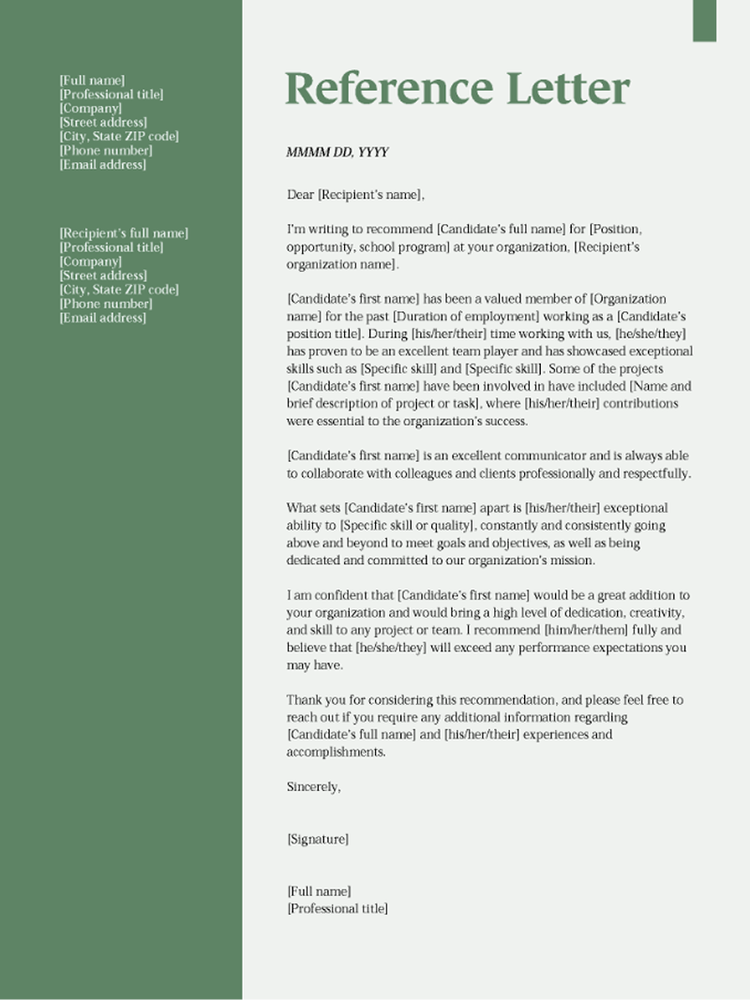
A professional reference letter focuses on workplace performance, achievements, and skills. Use this template when writing on behalf of a colleague, direct report, or former employee.
Advanced degree programs often require these letters to further evaluate an applicant’s character and scholarship skills. They tend to emphasize a candidate’s soft skills. For example, a master’s program candidate may be bolstered with a letter highlighting their organizational, problem-solving, and research skills.
[Your Name]
[Your Title/Position]
[Department Name] [University/Institution Name]
[Email Address]
[Phone Number]
[Date]
[Name of Recipient/Admissions Committee]
[Title/Program Name]
[University/Department]
[University Address]
Letter of Recommendation for [Student's Name]
Dear [Name of Recipient],
I am pleased to write this letter of recommendation for [Student’s Full Name], whom I have had the pleasure of working with as a [student/research assistant/colleague] in the [Department/Program Name] at [Institution Name].
During the time I have known [Name], they have consistently demonstrated exceptional [academic performance/intellectual curiosity/research ability] and a strong commitment to [field of study or discipline]. Their ability to [mention specific skills: e.g., analyze complex concepts, conduct independent research, contribute to group discussions] sets them apart from their peers.
One of the most impressive examples of their work was [briefly describe a project, paper, or achievement], which showcased their [qualities such as originality, analytical thinking, or attention to detail]. In addition to their academic strengths, [Name] is a thoughtful and collaborative individual who contributes positively to the learning environment.
I am confident that [Name] will thrive in [program, role, or opportunity] and make meaningful contributions to your institution. I strongly recommend them without reservation.
Please feel free to contact me if you require any further information.
Sincerely,
[Signature]
[Your Full Name]
These letters are typically more subjective and written by individuals close to the applicant but who may not have worked with them directly. These letters focus on personality, temperament, and other qualities that can provide a better understanding of the applicant’s general demeanor.
[Your Name]
[Your Address]
[Email Address]
[Phone Number]
[Date]
[Recipient’s Name or Title]
[Organization or Institution Name]
[Address]
Subject: Character Reference for [Full Name of the Person Being Recommended]
To whom it may concern,
I am writing to provide a character reference for [Full Name], whom I have known for [length of time] as a [relationship — e.g., friend, neighbor, colleague, mentor].
Throughout our time together, I have found [Name] to be a person of strong moral character, reliability, and kindness. They consistently demonstrate [positive traits — e.g., honesty, responsibility, empathy], and I have witnessed their ability to handle challenges with grace and integrity.
For example, [brief anecdote or situation that illustrates their character — e.g., how they supported someone in need, showed leadership, or acted ethically in a difficult situation].
I believe [Name] would be a valuable asset to any organization or community, and I wholeheartedly support their application for [purpose — e.g., employment, housing, volunteer role].
Please feel free to contact me if you need any additional information.
Sincerely,
[Your Signature]
[Your Full Name]
Notably, reference letters are different from letters of recommendation. While professional and personal connections, including friends and coworkers, can submit a letter of recommendation, a reference letter is typically only drafted by a current or previous employer.
Once you fill out your template, you can use Acrobat to sign your PDF.
A thorough letter includes a summary of the candidate's skills and excerpts showcasing their unique contributions. A strong reference letter is:
Saving time is one of the many benefits of using a reference letter template. With the reference letter examples above, you can quickly, easily, and accurately provide feedback on a particular individual with just a few changes to a tried-and-true letter of reference template without worrying that the content will be too general. Beyond efficiency, a template can help you with the following:
With these parameters in mind, let’s put the template into practice with a reference letter example.
March 13, 2024
John Doe
ABC Company
123 Main Street
Anywhere, NY 11111
Dear Mr. Doe,
It is my understanding that Jane Smith has applied for a project manager position with ABC Company. I am pleased to offer my insight into Jane’s qualifications and character related to the available position.
I have known Jane for over three years and had the pleasure of supervising her as a member of the software development department here at XYZ Company.
During that time, Jane proved to be a valuable team contributor, helping us achieve reduced scope creep on our development sprints while also increasing time to delivery across our agile development team. She also worked on a number of notable projects, including the rollout of our new project management software, helping to deploy the system with limited downtime and reducing departmental costs by 10%.
Throughout her employment, Jane demonstrated proficiency in determining and tracking success metrics and governing project timelines and schedules, making her a valuable asset to our company. Jane has always worked with integrity and diligence, exhibiting adaptability and collaborative skills throughout her tenure with us.
It is with great pleasure that I recommend Jane Smith for your consideration. If you have any questions, I would be happy to comment further on my experience with Jane. You can reach me via email at mmanager@xyzcompany.com or by calling (555) 555-5555.
Respectfully,
[Signature]
Matthew Manager
Software Development Lead
XYZ Company
987 Main Street
Anywhere, NY 11111

