
Content as a Service v2 - b2b - Wednesday, September 25, 2024 at 15:13
Conciseness in writing is the practice of communicating ideas completely using only the words necessary, without sacrificing clarity or meaning. A concise writer delivers information efficiently, choosing each word with purpose and eliminating anything that doesn't contribute to the message.
Understanding conciseness requires recognizing what it is not. Being concise doesn't mean being brief at the expense of important information. A thorough report can still be concise if every sentence serves a purpose. The goal is efficiency—removing unnecessary words while retaining full meaning and ensuring your reader grasps your point quickly.
This distinction matters because many writers confuse brevity with conciseness. A two-sentence email can still contain filler words and weak constructions, while a ten-page document can be perfectly concise if each paragraph advances the reader's understanding. The measure isn't length but intentionality.
Why does conciseness matter? Consider these benefits:
Writers who master concise writing find their work is more persuasive, more memorable, and more likely to achieve its intended purpose. Readers appreciate writing that gets to the point without wasting their time.
The techniques in the following sections will help you develop this skill, whether you're writing your first draft or polishing a final document.
Achieving conciseness requires deliberate practice and a willingness to edit ruthlessly. Several proven techniques can help you trim unnecessary words while keeping your message clear and complete. Each step below targets a specific type of wordiness, giving you practical strategies to apply immediately when learning how to write concisely.
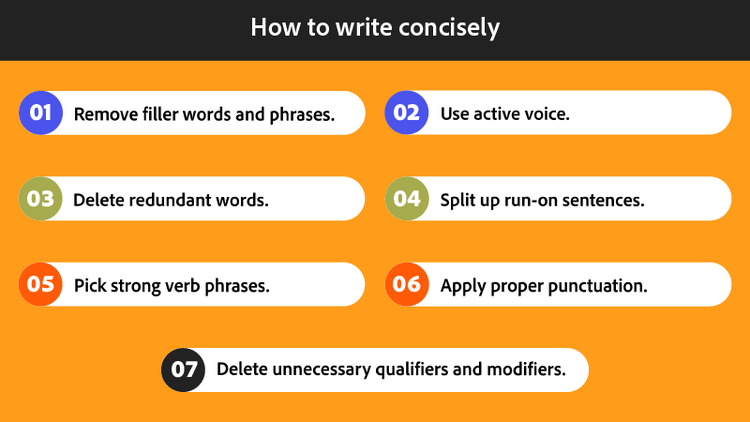
Filler words add bulk without adding meaning. Common culprits include "basically," "actually," "really," "just," "very," and "literally." These words often sneak into writing unconsciously, padding sentences without contributing information.
Wordy phrases present an even bigger opportunity for trimming. Replace "in order to" with "to." Swap "due to the fact that" for "because." Change "at this point in time" to "now." Each substitution saves words while maintaining—or even improving—clarity.
Review your drafts specifically for these fillers. Reading aloud helps you catch words that serve no purpose. When you spot a filler, ask yourself: Does removing this word change the meaning? If not, delete it.
Active voice structures sentences so the subject performs the action, creating more direct and energetic prose. Passive voice, by contrast, often requires more words and can obscure who is responsible for an action.
Compare these examples: "The report was written by the team" (passive, seven words) versus "The team wrote the report" (active, five words). The active version is shorter and clearer.
Passive voice isn't always wrong—sometimes it's appropriate for emphasis or when the actor is unknown. However, defaulting to active voice throughout your writing will naturally produce more concise sentences. Look for constructions using "was," "were," "is being," or "has been" as signals that you might be using passive voice unnecessarily.
Redundancy occurs when you repeat the same idea using different words. Phrases like "past history," "advance planning," "free gift," and "end result" contain built-in repetition—history is always past, planning is always in advance, gifts are always free, and results always come at the end.
These redundancies often feel natural because we hear them frequently in everyday speech. In writing, however, they waste space and can make your prose feel bloated. Train yourself to recognize common redundant pairs: "basic fundamentals," "close proximity," "completely finished," "each and every," "first and foremost."
Every word should earn its place in your sentence. If two words convey the same meaning, keep the stronger one and cut the other.
Long, complex sentences dilute your message by forcing readers to hold multiple ideas in mind simultaneously. When a sentence stretches beyond 25-30 words, consider whether it's trying to do too much.
Run-on sentences often occur when writers connect related ideas with conjunctions rather than separating them into distinct statements. While variety in sentence length keeps writing engaging, consistently long sentences exhaust readers and obscure key points.
Try this exercise: Find your longest sentences and split them at natural breaking points. Often, what seemed like one complex thought is actually two or three simpler ideas that communicate better as separate sentences. The result is usually shorter overall and significantly clearer.
Weak verb phrases use a general verb plus a noun where a single, specific verb would suffice. "Make a decision" becomes "decide." "Give consideration to" becomes "consider." "Conduct an investigation" becomes "investigate."
These substitutions typically save two to four words per instance while making your writing more dynamic. Strong verbs convey action directly, while weak verb phrases dilute that action by spreading it across multiple words.
Watch for phrases built around verbs like "make," "give," "take," "have," and "do" combined with nouns. Often, the noun in these phrases can become a verb on its own, instantly tightening your sentence.
Strategic punctuation helps you write concisely by clarifying meaning without requiring extra words. A well-placed comma, semicolon, or colon can replace transitional phrases, connecting ideas efficiently.
For example, instead of writing "The project succeeded, and this was because the team collaborated effectively," you can write "The project succeeded: the team collaborated effectively." The colon implies causation without spelling it out.
Understanding proper punctuation also helps you avoid the wordiness that comes from compensating for unclear sentence structures. When punctuation does its job, you don't need extra words to guide readers through your meaning.
Qualifiers like "very," "really," "quite," "somewhat," "rather," and "extremely" often weaken rather than strengthen your writing. These hedging words suggest uncertainty and add bulk without adding precision.
Instead of writing "very important," find a more specific word: "crucial," "essential," or "critical." Rather than "really fast," try "rapid" or "swift." The replacement is usually shorter and more impactful.
Modifiers become unnecessary when they state the obvious or when a stronger word choice makes them redundant. "Completely destroyed" can become "destroyed"—destruction is inherently complete. "Absolutely essential" can become "essential"—the qualifier adds nothing.
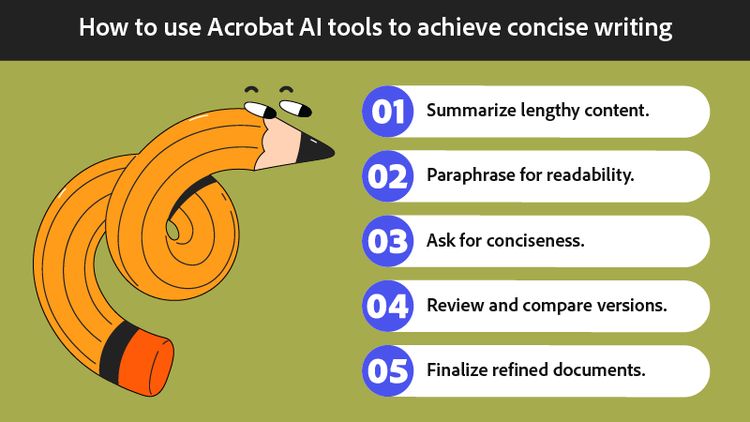
Artificial intelligence tools can accelerate the process of achieving conciseness by analyzing your text and suggesting improvements. Rather than manually hunting for every instance of wordiness, you can leverage these capabilities to identify problem areas quickly and generate cleaner alternatives. Here's how to use these features to streamline your writing.
To see these principles in action, consider these before-and-after examples using AI assistance:
Example 1:
Original (verbose): "Due to the fact that we are currently experiencing a high volume of customer inquiries, there may be some delays in our response times at this point in time."
AI Prompt: "Rewrite this sentence to be more concise while keeping the same meaning."
Output (concise): "High inquiry volume may delay our response times."
Original (verbose): "It is important to note that the meeting that was scheduled for Monday has been moved to a later date, specifically Wednesday of next week."
AI Prompt: "Make this more direct and concise."
Output (concise): "Monday's meeting has been rescheduled to next Wednesday."
This revision cuts the sentence from 27 words to 8 words while improving clarity. The AI removed the throat-clearing phrase "It is important to note that" and streamlined the date information. Notice how the concise version communicates identical information with greater impact.
These examples demonstrate how AI tools can quickly identify wordiness patterns and suggest tighter alternatives. The key is using specific prompts that direct the AI toward conciseness as your goal.
Understanding what to avoid is just as important as knowing what to do. Many writers fall into predictable traps that undermine their efforts toward conciseness. Recognizing these patterns helps you catch them in your own work before they reach your reader.
Common mistakes that sabotage concise writing:
Each of these mistakes shares a common thread: they add words without adding value. Catching them requires reading your work critically, asking of each phrase whether it earns its place.
Tips and best practices for concise writing:
These practices become habits with repetition. The more you apply them, the more naturally concise your first drafts become.
Seeing the transformation from wordy to concise helps cement these principles. Study these before-and-after examples:
Example 1:
Before: "At this point in time, we are not able to provide you with an answer to your question."
After: "We cannot answer your question now."
Before: "The reason why the project failed was because of the lack of proper planning."
After: "The project failed due to poor planning."
Before: "She made the decision to give consideration to the proposal that was submitted by the team."
After: "She decided to consider the team's proposal."
Before: "It is absolutely essential that all employees make an effort to arrive at work on time."
After: "All employees must arrive on time."
The throat-clearing "It is absolutely essential that" disappears, as does the weak verb phrase "make an effort to." The revision is direct and unambiguous in seven words rather than sixteen.

