


A well-crafted follow up email can mean the difference between a missed opportunity and a successful connection. Research suggests only 8.5% of cold emails receive a response, making strategic follow ups essential for professional success. Whether you're reaching out after a job interview, reconnecting with a prospect, or simply checking in on a pending request, knowing how to write a follow up email effectively is a critical skill. This guide covers best practices, key components, and practical examples you can customize. Plus, discover how artificial intelligence (AI) tools can help you craft compelling messages faster.
Best practices for a follow up email
The timing and approach of your follow up email can significantly impact whether you receive a response. A message sent too soon may come across as impatient, while waiting too long risks losing momentum or having your original communication forgotten entirely. Understanding how to write a follow up email that strikes the right balance requires attention to several key factors.
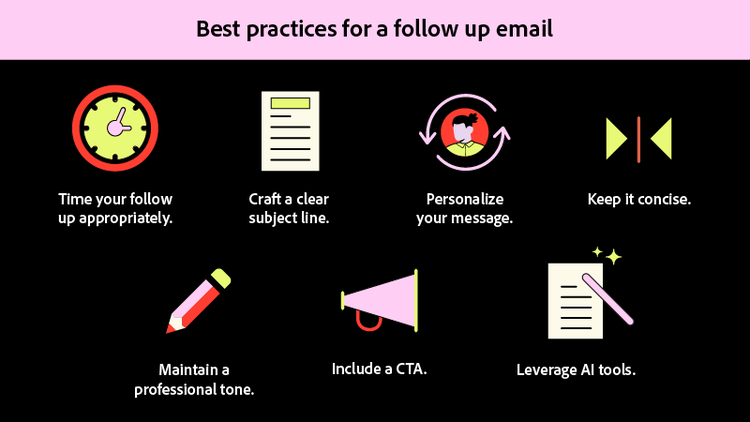
Time your follow up appropriately. For general business communications, waiting 24 to 48 hours gives recipients adequate time to respond while keeping your request fresh. Interview follow up email messages should be sent within 24 hours to express gratitude while you're still memorable. For sales outreach or proposals, allow 3 to 5 business days before your first follow up. You can set expectations in your first message, shifting the responsibility of follow up from the recipient to yourself. Adjust your timelines based on any deadlines mentioned in your original communication or the urgency of the matter.
Craft a clear, compelling subject line. Your subject line determines whether your email gets opened. Reference your previous interaction directly, such as "Following up on our Tuesday call" or "Re: Marketing proposal questions." Avoid vague subjects like "Checking in" or "Quick question" that don't provide context. Using AI prompts can help you generate subject line variations that capture attention while remaining professional.
Personalize your message thoughtfully. Generic follow ups rarely inspire action. Reference specific details from your previous conversation, mention something relevant to the recipient's business or interests, and demonstrate that you've done your homework. This personalization shows respect for the recipient's time and distinguishes your message from mass outreach.
Keep it concise and scannable. Busy professionals appreciate brevity. Aim for three to five short paragraphs maximum. Consider bullet points for multiple items. Your follow up should take no more than 30 seconds to read and understand. When you need to convey complex information, consider whether you should write a business letter as a formal attachment instead.
Maintain a professional yet warm tone. Strike a balance between being friendly and maintaining professionalism. Avoid being overly casual or too formal. Express understanding that the recipient is busy without being apologetic or self-deprecating. Phrases like "I understand you have a lot on your plate" acknowledge their time constraints respectfully.
Include a clear call to action. Every follow up email should have one specific, easy-to-complete next step. Whether you're requesting a meeting, asking for feedback, or seeking a decision, make the desired action unmistakable. Provide specific options when possible, such as "Would Tuesday at 2 PM or Wednesday at 10 AM work better for a call?"
Leverage AI tools to refine your message. Modern AI assistants can help you draft, edit, and improve your follow up emails quickly. You can use these tools to adjust tone, check for clarity, and ensure your message strikes the right balance between persistent and respectful. Learning to summarize documents with AI can also help you reference key points from previous communications efficiently.
Key components to include in a follow up email
Understanding the essential elements of a follow up email helps ensure your message is complete, professional, and action-oriented. Each component serves a specific purpose in moving your communication forward.
Your follow up email should include these key components:
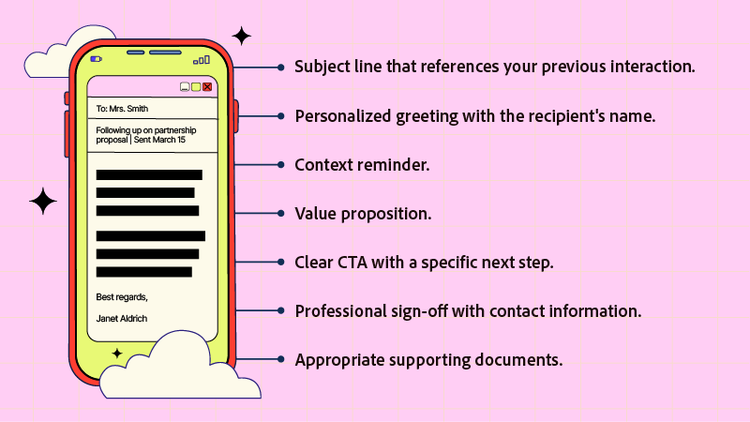
- Subject line that references your previous interaction. Connect directly to your earlier communication so recipients immediately understand the context without opening the email.
- Personalized greeting using the recipient's name. Address the person directly rather than using generic salutations. Double-check spelling to avoid undermining your professionalism.
- Context reminder. Briefly explain who you are and why you're following up. Don't assume the recipient remembers every detail of your previous exchange.
- Value proposition or reason for them to respond. Give the recipient a compelling reason to engage. What benefit do they receive from responding or taking action?
- Clear call to action with a specific next step. State exactly what you want them to do and make it as easy as possible for them to comply.
- Professional sign-off with contact information. Include your full name, title, company, and preferred contact methods so they can respond through their preferred channel.
- Appropriate attachments or supporting documents. If referencing materials, ensure they're attached and formatted professionally.
When sending important follow up emails with attachments, organizing your documents professionally makes a strong impression. Using a PDF editor to finalize your materials ensures consistent formatting across all devices. If you're working with draft documents, you can convert Word documents to PDF before attaching them to maintain your intended layout and content.
3 follow up email examples
While generic frameworks provide helpful starting points, the most effective follow up emails are customized to your specific situation and recipient. Consider the context, your relationship with the recipient, and what would genuinely be valuable to them. AI tools can help you personalize these frameworks quickly, adapting the tone and content to match your needs while maintaining professionalism.
General follow up email
A general follow up email works for most business situations where you need a response to a previous request, meeting inquiry, or information exchange. Use this approach when following up on proposals, meeting requests, or any professional communication that hasn't received a response.
The key is providing enough context that the recipient can immediately recall your previous interaction without searching through their inbox. Reference the date, topic, and any specific details that make your email identifiable. If your initial outreach was an email, you can even respond to that first communication directly and edit the subject line as needed.
Example:
Subject: Following up on partnership proposal | Sent March 15
Hi [Name],
I hope this message finds you well. I wanted to follow up on the partnership proposal I sent last week regarding our potential collaboration on the Q3 marketing initiative. I understand you're likely managing many priorities right now.
I'd welcome the opportunity to discuss any questions you might have or explore how we can adjust the proposal to better fit your needs. Would a brief 15-minute call this week be helpful?
Looking forward to hearing from you.
Best regards, [Your Name]
AI prompt to generate a personalized version: "Write a follow up email for a meeting request I sent last week to [name] about [topic]. Keep it professional and under 100 words. Include a specific reference to our previous conversation about [detail] and suggest two meeting times."
Time your general follow up 2 to 3 business days after your initial outreach. If you still don't receive a response, wait another 4 to 5 days before your second follow up. Keep the tone helpful rather than demanding, and consider whether you can add new value or information in each subsequent message.
Interview follow up email
Sending an interview follow up email within 24 hours of your conversation demonstrates professionalism and genuine interest in the position. This message serves multiple purposes: expressing gratitude, reinforcing your qualifications, and keeping you memorable among other candidates.
Reference something specific from your conversation to show you were engaged and listening. This could be a project the team is working on, a challenge they mentioned, or a shared professional interest. Briefly reaffirm why you're excited about the opportunity and how your skills align with their needs.
Example:
Subject: Thank you for the Marketing Manager interview
Dear [Interviewer's Name],
Thank you so much for taking the time to speak with me today about the Marketing Manager position. I truly enjoyed learning more about the team's upcoming rebrand initiative and the creative direction you're planning.
Our conversation reinforced my enthusiasm for this opportunity. My experience leading cross-functional campaigns at [Previous Company] aligns well with the collaborative approach you described, and I'm excited about the possibility of contributing to your team's success.
Please don't hesitate to reach out if you need any additional information. I look forward to hearing about the next steps.
Warm regards, [Your Name]
AI prompt to craft your message: "Help me write a thank-you email after my interview for [position] at [company]. I want to mention our discussion about [specific topic] and express my enthusiasm for the role. Keep the tone warm but professional and limit it to 150 words."
Avoid common mistakes like being too generic, writing excessively long messages, or following up too aggressively after sending your initial thank-you.
Sales follow up email
A sales follow up email requires a delicate balance between persistence and respect. After sending a proposal, delivering a pitch, or making initial contact with a prospect, your follow up should remind them of the value you offer without applying uncomfortable pressure.
Lead with value rather than simply asking if they've made a decision. Share a relevant case study, offer additional information that addresses potential concerns, or provide a new insight related to their business challenges. Make responding easy by suggesting a specific, low-commitment next step like a brief call.
Example:
Subject: Quick thought on streamlining your document workflow
Hi [Name],
I wanted to circle back on the proposal I shared last Tuesday regarding our document management solution. Since we spoke, I came across a case study from a company in your industry that reduced their contract processing time by 40% using similar strategies.
I thought it might be relevant to the workflow challenges you mentioned. Would you be open to a brief 15-minute call next week to discuss how these insights might apply to your team?
Happy to work around your schedule.
Best, [Your Name]
AI prompt: "Draft a follow up email for a prospect who hasn't responded to my sales proposal about [product/service]. Include a brief value reminder, mention a relevant benefit or case study, and suggest a 15-minute call next week. Keep it under 100 words."
Effective sales professionals know that persistence pays off, but timing matters. Space your follow ups appropriately and know when to move on. To streamline your sales workflow and manage follow ups more efficiently, consider how document automation can support your outreach efforts. Having polished sales pitch examples ready to share can also strengthen your follow up communications.
Mastering the follow up email is an investment in your professional success. By applying these best practices and adapting the examples to your specific situations, you'll increase your response rates and build stronger professional relationships. AI tools can accelerate your writing process, helping you craft personalized, effective messages in less time. When you need to refine your approach or analyze what's working, you can chat with your PDF documents to extract insights from your saved communications and resources.
Frequently asked questions
Start by acknowledging that the recipient is likely busy, which shows respect for their time. Reference your previous communication specifically so they don't have to search for context. Keep your tone warm but professional, avoiding language that sounds demanding or impatient. Make it easy for them to respond by asking a specific question or providing clear options for next steps. Adding value, such as new information or a helpful resource, gives them a reason to engage beyond obligation.
Avoid the overused phrase "just following up," which adds no value. Instead, try alternatives that provide context: "Checking in on our conversation about..." or "Wanted to reconnect regarding the proposal I sent on Tuesday." You might also use "Interested in the status of..." or "Returning to our discussion about..." The key is combining your follow up statement with specific context so the recipient immediately understands the purpose of your message.
The most effective follow up emails share several characteristics. They're concise, typically under 150 words. They're personalized with specific references to previous interactions. They include a clear subject line that connects to the original communication. They provide value to the recipient rather than simply asking for something. And they contain a single, specific call to action that makes responding easy. The best follow up email feels like a natural continuation of a conversation rather than a demand for attention.
For most professional situations, sending 2 to 3 follow ups is appropriate. Space them out, with increasing intervals between each message. A common cadence is following up after 3 days, then 7 days, then 14 days. After three unanswered follow ups, it's generally best to pause outreach for that particular request. However, you can maintain the relationship through other channels or reach out about different topics. For sales outreach, some professionals send up to 5 follow ups, but with new value added in each message.
Research consistently shows that mid-morning on weekdays, particularly Tuesday through Thursday, yields the highest open and response rates. Aim for between 9 AM and 11 AM in the recipient's time zone. Avoid Monday mornings when inboxes are typically flooded and Friday afternoons when people are wrapping up for the week. If you're reaching out internationally, be mindful of time zones and local business customs. Many email tools allow you to schedule sends for optimal timing regardless of when you compose the message.
Avoid excessive apologizing in your follow up emails, as it can undermine your professionalism and make your request seem less important. Instead of saying "Sorry to bother you again," try confident alternatives like "I wanted to reconnect on this" or "Bringing this back to the top of your inbox." A brief acknowledgment that they're busy is appropriate, but constant apologizing diminishes the value of your communication and can make recipients less likely to prioritize your message.
The key to following up without being annoying is adding value with each message rather than simply repeating your request. Space your follow ups appropriately, typically waiting longer between each subsequent message. Vary your approach by sharing new information, reframing the importance of the request, offering alternative solutions, or adjusting your ask. Keep messages brief and make responding easy. If you've sent multiple follow ups without response, consider whether the timing is wrong or if you need to try a different channel.
You may also like
title
Follow up emails: best practices and 3 key examples
cardImageAltText
Professional reviewing follow up email on laptop
cardImage
primaryTag
caas:content-type/article
Tags
caas:content-type/article,caas:products/acrobat,caas:topic/students,caas:topic/job-search

