How to Restate a Thesis Using AI
Restating a thesis can feel like solving a puzzle—you need to express the same idea without repeating yourself word for word. Artificial intelligence (AI) tools now offer writers a faster, more effective way to generate fresh variations of their thesis statements.

What is a restated thesis?
A restated thesis is a rephrased version of your original thesis statement that appears in your essay's conclusion. Rather than copying your opening thesis verbatim, you express the same core argument using different words, sentence structures, or perspectives. Understanding how to restate a thesis effectively is essential for creating polished academic work.
The distinction between restating and repeating matters significantly. Repeating your thesis means copying it exactly as it appeared in your introduction—a practice that signals lazy writing and fails to demonstrate intellectual growth. Restating, on the other hand, shows readers that your argument has developed through the evidence and analysis presented in your essay. When you write a thesis statement for your introduction, you're making a promise to your reader. Your restated thesis in the conclusion fulfills that promise while reflecting the journey your essay has taken.
Restating your thesis matters because conclusions serve as your final opportunity to leave a lasting impression. A well-crafted restatement reminds readers of your central argument and reinforces why it matters. It creates a sense of closure by connecting your conclusion back to your introduction without sounding redundant. When you write a conclusion for an essay, your restated thesis anchors the entire closing section.
You should place your restated thesis at the beginning of your essay conclusion, typically within the first one to two sentences. This positioning immediately signals to readers that you're wrapping up your argument. From there, your conclusion can expand on the broader implications of your work.
A strong restated thesis maintains the original meaning while using fresh language. It reflects any evolution in your argument throughout the essay and fits naturally within the tone and style of your conclusion.
How to restate a thesis
Restating your thesis requires intentional effort to preserve your argument's essence while presenting it in a new way. Whether you're learning how to write a research paper or crafting a persuasive essay, follow these steps to create an effective restatement.
- Review your original thesis statement carefully, noting its key components and the specific claim you made
- Identify the core argument or central idea that everything else supports
- Choose where to place the restatement within your conclusion's opening sentences
- Capitalize on supporting evidence from your work by letting your body paragraphs inform how you frame the restatement
- Rephrase using different words, synonyms, and alternative sentence structures
- Ensure the restatement reinforces your conclusion and creates a satisfying sense of closure
When restating your thesis, keep these best practices in mind:
- Avoid word-for-word repetition, which undermines your credibility as a writer
- Don't introduce new information or arguments not addressed in your essay
- Steer clear of clichés like "In conclusion" or "To sum up" immediately before your restatement
- Maintain the original meaning—your restated thesis should make the same fundamental claim
- Match your essay's evolved tone, reflecting any shifts in perspective that occurred through your analysis
Methods of restating a thesis
Multiple approaches exist for transforming your original thesis into a fresh restatement. Each method offers different advantages depending on your writing style and the nature of your argument. Consider these proven techniques:
- Reworking sentence structure
- Rephrasing and paraphrasing
- Condensing or expanding length
- Substituting synonyms
- Changing verb tense
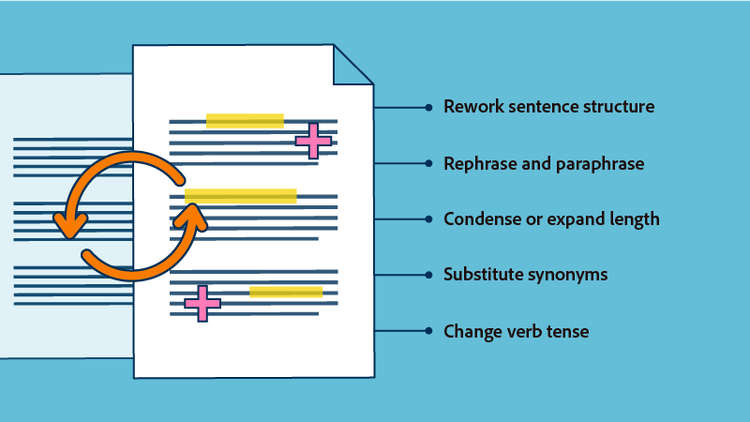
Reworking sentence structure
Restructuring your thesis involves changing the grammatical arrangement while keeping the meaning intact. This might mean converting an active sentence to passive voice, moving clauses around, or breaking a complex sentence into simpler components.
Original: "Social media platforms negatively impact teenagers' mental health by promoting unrealistic beauty standards and fostering constant comparison."
Restated: "By fostering constant comparison and promoting unrealistic beauty standards, teenagers' mental health suffers significant negative effects from social media platforms."
Rephrasing and paraphrasing
This technique involves expressing your thesis using entirely different words while preserving the core message. Understanding what paraphrasing means and mastering effective paraphrasing techniques requires knowing your argument deeply enough to explain it in multiple ways.
Original: "Remote work increases employee productivity by eliminating commute time and reducing workplace distractions."
Restated: "Workers accomplish more when operating from home, freed from daily travel and the interruptions common in traditional office environments."
Condensing or expanding length
Sometimes your restated thesis benefits from being shorter or longer than the original. Condensing works well when your conclusion needs to be punchy and direct. Expanding helps when you want to incorporate insights gained through your essay. An AI summary generator can help you identify the essential elements worth keeping when condensing.
Original: "Climate change poses an existential threat to coastal communities worldwide, requiring immediate governmental action, corporate responsibility, and individual behavioral changes."
Condensed: "Coastal communities face existential climate threats demanding action at every level of society."
Substituting synonyms
Replacing key words with synonyms offers a straightforward way to restate your thesis. This method works best when combined with other techniques to avoid creating awkward or unnatural phrasing.
Original: "Standardized testing fails to accurately measure student intelligence or predict academic success."
Restated: "Standardized assessments inadequately gauge learner aptitude or forecast scholastic achievement."
Changing verb tense
Shifting tense can refresh your thesis while subtly changing its emphasis. Moving from present to past tense, for example, can make your argument feel more established or conclusive.
Original: "Universal basic income provides a viable solution to automation-driven unemployment."
Restated: "Universal basic income has proven itself a viable answer to job losses caused by automation."
How to restate a thesis with AI
AI tools offer significant advantages for thesis restatement, including speed, variety, and the ability to overcome writer's block. AI tools can analyze your original statement and generate multiple variations in seconds, giving you options you might never have considered independently. Here's how to use AI effectively for this task.
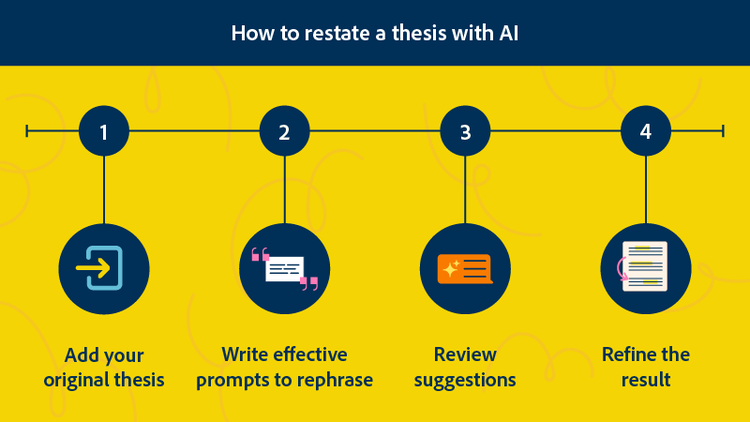
Step 1: Input your original thesis
Start by preparing your thesis statement for AI input. Copy your exact thesis and provide relevant context about your essay's topic, tone, and academic level. The more information you give the AI, the better its suggestions will be.
Consider formatting your input like this:
Input example: "My thesis statement is: [your thesis]. This is for a [type of essay] about [topic] at the [academic level] level. Please help me restate this for my conclusion."
Sample input: "My thesis statement is: 'Social media platforms negatively impact teenagers' mental health by promoting unrealistic beauty standards and fostering constant comparison.' This is for a persuasive essay about social media's effects on youth at the undergraduate level. Please help me restate this for my conclusion."
Including context about your essay's argument and the evidence you've presented helps AI generate more relevant variations.
Step 2: Craft effective prompts to rephrase
The quality of AI output depends heavily on your prompts. Vague requests produce generic results, while specific instructions yield targeted suggestions. When you chat with your documents or use AI writing assistants, precision matters.
Effective prompt example: "Rephrase this thesis using different sentence structure while maintaining the core argument about social media's impact on mental health. Use a more conclusive tone appropriate for an essay conclusion."
Sample output: "The evidence demonstrates that social media platforms undermine teenage mental health through the promotion of unrealistic beauty standards and an environment of perpetual comparison."
Experiment with prompts requesting specific methods—ask for synonym substitution, structural changes, or condensed versions to see different approaches.
Mistakes to avoid when prompting:
- Being too vague (e.g., "Make this better")
- Failing to specify the academic context or tone
- Not indicating that you need a conclusion-appropriate restatement
Step 3: Review AI suggestions
Not every AI-generated restatement will work for your essay. Evaluate each suggestion against these criteria:
- Does it preserve your original argument's meaning completely?
- Does the tone match your essay's voice and academic level?
- Is the language original enough to avoid sounding repetitive?
- Does it flow naturally within a conclusion context?
Sample AI output to evaluate: "Teenagers experience detrimental mental health outcomes as a result of social media's cultivation of impossible beauty ideals and environments encouraging relentless self-comparison."
Watch for common AI issues like overly formal language, subtle meaning shifts, or awkward phrasing. AI sometimes prioritizes variety over clarity, so verify that each suggestion actually says what you intend.
Mistakes to avoid when reviewing:
- Accepting suggestions that subtly change your argument's meaning
- Overlooking awkward phrasing that sounds unnatural
- Ignoring tone mismatches with your essay's voice
Step 4: Refine the restatement for your conclusion
AI suggestions serve as starting points, not final products. Take the best elements from AI-generated options and refine them to fit your specific needs. Your research paper conclusion should feel like a natural extension of your writing voice.
Sample refinement process:
AI suggestion: "Teenagers experience detrimental mental health outcomes as a result of social media's cultivation of impossible beauty ideals and environments encouraging relentless self-comparison."
Refined version: "As the evidence reveals, social media's promotion of impossible beauty standards and culture of constant comparison creates measurable harm to teenage mental health."
Edit for flow by reading your restatement aloud within the context of your full conclusion. Adjust word choices that feel unnatural or overly mechanical. Ensure transitions from your restated thesis to the rest of your conclusion feel smooth.
Mistakes to avoid when finalizing:
- Accepting AI output without any personalization
- Using vocabulary that doesn't match your essay's tone
- Creating a restatement that sounds disconnected from your body paragraphs
- Forgetting to verify that the meaning remains identical to your original thesis
Before submitting, confirm your restated thesis answers the same question as your original, supports the same position, and reflects the evidence presented throughout your essay.
Frequently asked questions
What is an example of a restated thesis?
Original thesis: "Online education offers greater flexibility than traditional classroom learning, enabling students to balance work, family, and academic responsibilities more effectively."
Restated thesis: "Students juggling careers and family obligations find online learning provides the scheduling flexibility that traditional classrooms cannot match."
This restatement works because it maintains the core comparison while restructuring the sentence and using fresh vocabulary. The meaning remains identical, but the expression feels new and conclusive.
What is an example of a restate?
How do you rephrase a thesis?
How do I connect back to the thesis?
You may also like