How to create a TEAS test study guide using AI
Preparing for the TEAS exam can feel overwhelming, but AI tools make it easier to build a personalized study guide.

What is TEAS?
The Test of Essential Academic Skills (TEAS) is a standardized examination used by nursing schools and allied health programs across the United States to evaluate prospective students. Developed by Assessment Technologies Institute (ATI), this comprehensive test measures your readiness for the academic demands of healthcare education programs. Creating a solid TEAS test study guide is essential for anyone preparing to take this important admissions exam.
The TEAS assesses competency across four distinct subject areas. Reading comprehension evaluates your ability to understand and analyze written passages, identify main ideas, and draw logical conclusions from text. Mathematics tests your proficiency with numbers, algebra, data interpretation, and measurement concepts commonly encountered in healthcare settings. Science covers anatomy and physiology, life sciences, chemistry, and scientific reasoning skills fundamental to nursing practice. English and language usage examines grammar, vocabulary, sentence structure, and writing conventions.
Nursing students, licensed practical nurse (LPN) candidates, and applicants to various healthcare programs typically take the TEAS as part of their admissions process. Many programs set minimum score requirements, making thorough preparation crucial for acceptance. Understanding how to study for a test of this magnitude requires a strategic approach tailored to standardized exam formats.
The current version of the TEAS contains 170 questions, though only 150 are scored. Test-takers receive approximately 209 minutes to complete all sections. Questions appear in various formats, including multiple choice, supply answer, ordered response, and hot spot questions. Scores are reported as both composite and individual section scores, giving programs insight into your academic strengths across different domains.
TEAS study guide: how to use AI to study
Creating an effective TEAS study guide requires organization, focus, and the right tools. AI-powered study assistants can transform how you prepare for this challenging exam by helping you process large amounts of information efficiently and create customized study materials. Follow these steps to build your comprehensive TEAS exam study guide using artificial intelligence.
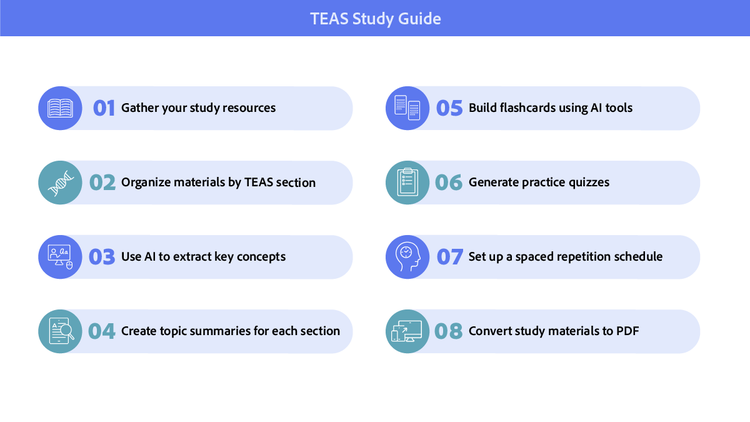
1. Gather your study resources. Start by collecting all available materials, including textbooks, class notes, official ATI preparation guides, and any practice tests you have access to. Download digital versions when possible, as these work best with AI tools. Having everything in one place gives you a complete picture of what you need to master before test day.
2. Organize materials by TEAS section. Create separate folders or document sections for Reading, Mathematics, Science, and English. This organization helps you track progress in each area and ensures balanced preparation across all test components. Label materials clearly so AI tools can help you locate specific information quickly.
3. Use AI to extract key concepts from existing notes and prep materials. Upload your study documents to AI platforms that can analyze and summarize content. The best AI tools for students can identify important themes, highlight frequently tested concepts, and create condensed versions of lengthy chapters. This saves hours of manual review while ensuring you capture essential information.
4. Create topic summaries for each test section. Ask AI to generate comprehensive summaries covering major topics within each TEAS section. When you make a study guide, include definitions, formulas, key facts, and relationships between concepts. These summaries become your quick-reference materials during intensive review sessions.
5. Build section-specific flashcards using AI tools. Transform your summaries into flashcard sets for active recall practice. An AI flashcard maker can generate question-and-answer pairs from your uploaded materials, and AI study tools help you focus on the most important concepts. Create separate decks for anatomy terms, math formulas, grammar rules, and reading strategies.
6. Generate practice quizzes for self-assessment. Use an AI quiz generator to create custom practice tests based on your study materials. Request questions in formats that mirror actual TEAS questions, including multiple choice and scenario-based problems. Regular self-testing reveals knowledge gaps and builds test-taking confidence.
7. Set up a spaced repetition schedule for review. AI can help you create a study calendar that revisits material at optimal intervals for long-term retention. Schedule more frequent reviews for challenging topics and less frequent sessions for material you have mastered. This approach maximizes learning efficiency and prevents last-minute cramming.
Best practices for TEAS study guide
Understanding the different question types you will encounter is one of the most valuable TEAS test study guide strategies you can adopt. The test presents information in various formats, and familiarity with each type reduces test-day anxiety while improving your response accuracy.
Practicing with different question formats trains your brain to recognize what each question asks and how to approach it efficiently. Many test-takers lose points not because they lack knowledge but because they misunderstand question requirements. Incorporating effective study methods that address all four question types ensures comprehensive preparation.
Your TEAS study guide should include practice with multiple choice questions, supply answer questions, ordered response questions, and hot spot questions. Each format requires slightly different strategies, and mastering all four gives you a significant advantage on test day.

Multiple choice questions
Multiple choice questions represent the most common format on the TEAS exam. You select one correct answer from four or five options, with only one choice being completely accurate. These questions appear across all four test sections.
When approaching multiple choice questions on your TEAS exam study guide practice tests, read the entire question stem carefully before looking at answer choices. Eliminate obviously incorrect options first to narrow your selection. Watch for absolute words like "always" or "never," which often indicate incorrect answers. Consider each remaining option against the question requirements before making your final selection.
Example: Which of the following best describes the function of red blood cells?
A) Producing antibodies to fight infection
B) Transporting oxygen throughout the body
C) Regulating body temperature
D) Breaking down nutrients for absorption
The correct answer is B. Red blood cells contain hemoglobin, which binds to oxygen in the lungs and delivers it to tissues throughout the body.
Supply answer questions
Supply answer questions require you to type a response rather than select from options. These questions typically appear in the Mathematics section and ask for numerical answers to calculations. No answer choices are provided, so you must solve problems independently.
Accuracy matters greatly with supply answer questions. Double-check your calculations before entering responses, paying attention to decimal placement and unit requirements. Some questions specify how answers should be formatted, such as rounding to the nearest tenth or expressing results as fractions.
Example: A patient receives 250 milliliters of intravenous fluid every 2 hours. How many milliliters will the patient receive over an 8-hour period?
To solve this, divide 8 hours by 2 hours to get 4 intervals, then multiply 250 milliliters by 4. The answer is 1,000 milliliters.
Ordered response questions
Ordered response questions ask you to arrange items in a specific sequence. You might order steps in a process, rank items by importance, or arrange events chronologically. These questions test your understanding of relationships and logical progression.
Read all items before attempting to order them. Identify clear first and last items when possible, then work on middle positions. Consider cause-and-effect relationships and temporal sequences. Double-check that your final order makes logical sense from beginning to end.
Example: Arrange the following steps of the scientific method in the correct order.
- Analyze data and draw conclusions
- Form a hypothesis
- Conduct the experiment
- Make observations and ask questions
- Report results
Correct sequence: Make observations and ask questions, Form a hypothesis, Conduct the experiment, Analyze data and draw conclusions, Report results.
Hot spot questions
Hot spot questions display an image, diagram, or graphic and ask you to click on a specific area that answers the question. These questions commonly appear in Science sections featuring anatomy diagrams or Reading sections with charts and graphs.
Take time to carefully examine the entire image before clicking. Read the question multiple times to ensure you understand exactly what location is being requested. For anatomy questions, recall spatial relationships between structures. For graph questions, trace data points carefully before identifying your answer location.
Example: On the diagram of the human heart, click on the chamber that receives deoxygenated blood from the body.
You would click on the right atrium, which receives blood returning from the body through the superior and inferior vena cava before sending it to the right ventricle for pumping to the lungs.
Frequently asked questions
How should I study for my TEAS test?
Is the TEAS test very hard?
Is 2 weeks enough to study for TEAS?
Is there a free TEAS practice test?
You may also like