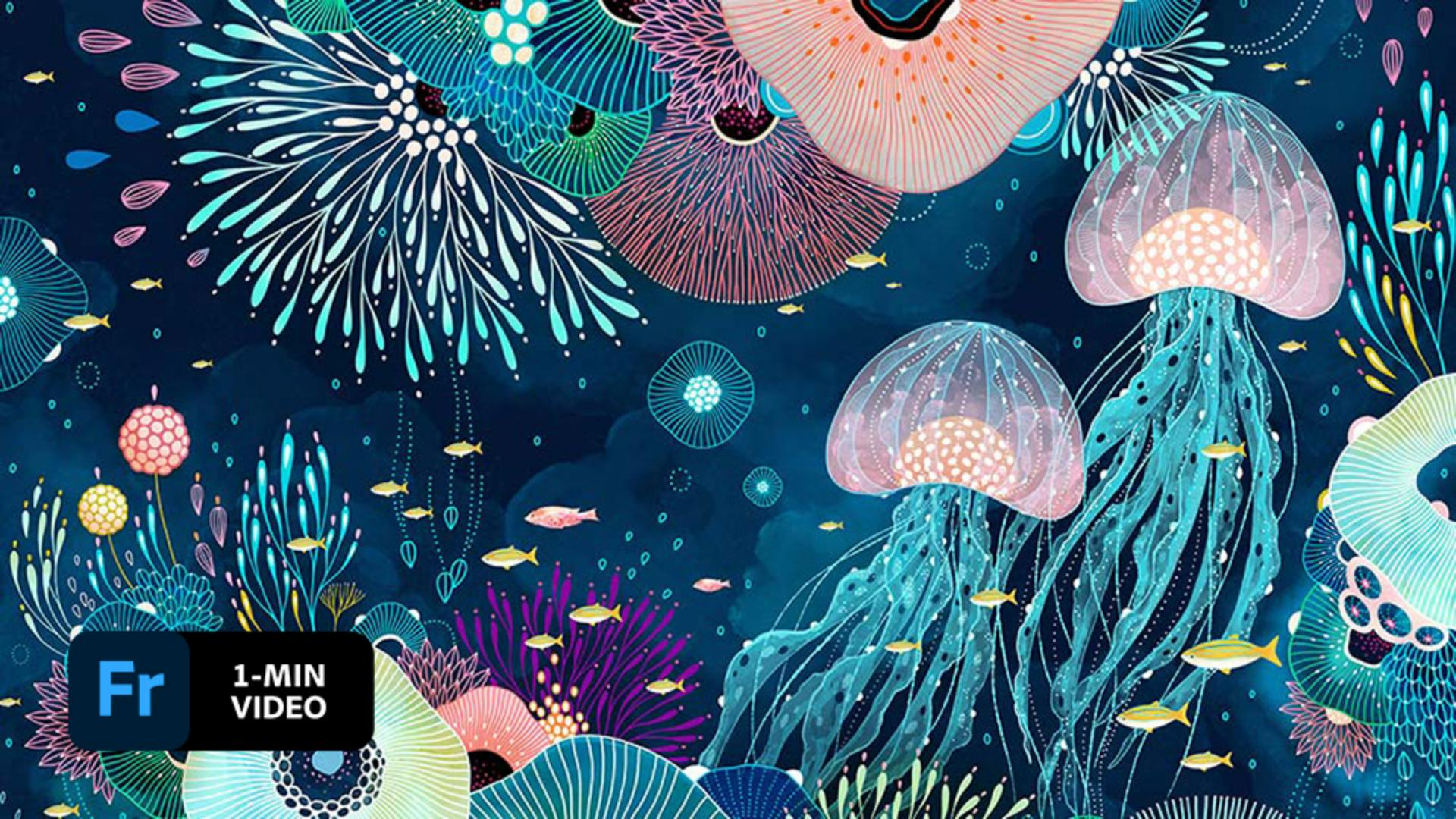
Adobe Fresco has Live brushes that behave as if you had real paint on your brush. See how Yellena James paints with watercolor while keeping her creative space dry.
Yellena James is a graphic designer and painter who explores the intricate and delicate forms of an imaginary ecosystem and twists and floats them together into alluring environments.
Transcript not available
1 Discover Live Brushes
James sampled the available watercolor Live Brushes before she started painting the second jellyfish in her composition. She thought the Watercolor Wash Soft brush could get her the look she wanted, so she chose that one.
2 Start to paint
Next, James tapped the + icon to add a new layer, tapped the color circle, and used the color stops to choose the color. Then she set her brush size to 180 and started painting the head of the jellyfish. She pinched, expanded, and dragged with two fingers to zoom in and out and pan the image as she worked.
3 Blend and dry
James chose a second color to blend with the blue she just painted. She wanted the colors to spread as she mixed them, so she increased the Water Flow to 60. The colors blended as if she had more water on her brush. When she was finished, she tapped the Layer Options icon and chose Dry Layer to stop any further blending of the watercolors.
4
Brush with texture
As she experimented with the available watercolor brushes and their settings, James discovered that she could add a wide range of textures to her art. As you practice, select the tentacles layer for the second jellyfish and choose a brush to enhance with additional detail. For the finer lines, the Blotty Ink brush under the Ink brushes worked well for James – Size: 150; Hardness: 100%; Blend Mode: Normal; All other settings: default.
5 Erase and show
James had drawn the head and body of the jellyfish in a previous session. Once she was ready to finish her work, she tapped the layer thumbnail with the head and clicked the eye icon to display it. She did this for each of the hidden layers. She then selected the blue and pink layer and used the Eraser to clean up the paint that flowed outside of the lines. Finally, she tapped and held the head layer and dragged it above the pink and blue layer.
Create new worlds
Combine texture and color to blend elements from the world you know and create colorful, imaginary ecosystems.
Note: Project files included with this tutorial are for practice purposes only.
You can control how Adobe websites use cookies and similar technologies by making choices below. But note that if you disable cookies and similar technologies entirely, Adobe websites may not function properly.
Cookies are small text files stored by your web browser when you use websites. There are also other technologies that can be used for similar purposes like HTML5 Local Storage and local shared objects, web beacons, and embedded scripts. These technologies help us do things like remembering you and your preferences when you return to our sites, measure how you use the website, conduct market research, and gather information about the ads you see and interact with.
You can make choices in the menu below about what cookies and other technologies you want us to use on Adobe sites when you visit them from this browser. You can always change those choices later by clicking on the Cookie Preferences link at the bottom of the page.
If enabled:
We can improve your experience by tailoring the site and the content to things we think might be of interest
We can better keep track of your preferences — like what language you prefer to use
We will better understand your likely interests so we can provide you more relevant Adobe ads and content on non-Adobe websites and in non-Adobe apps
It will help us improve the performance of our website and those of our partners who use the Adobe Experience Cloud
If disabled:
We won’t be able to remember you from session to session so the experience may not be tailored to your interests
You’ll still have access to the content of the site but certain features that depend on cookies may not function
You’ll still see ads, they just may not be as relevant to you
General information
You can control how Adobe websites use cookies and similar technologies by making choices below. But note that if you disable cookies and similar technologies entirely, Adobe websites may not function properly.
Cookies are small text files stored by your web browser when you use websites. There are also other technologies that can be used for similar purposes like HTML5 Local Storage, web beacons, and embedded scripts. These technologies help us do things like remembering you and your preferences when you return to our sites, measure how you use the website, conduct market research, and gather information about the ads you see and interact with.
You can make choices in the menu below about what cookies and other technologies you want us to use on Adobe sites when you visit them from this browser. You can always change those choices later by clicking on the Cookie Preferences link at the bottom of the page.
If enabled:
We can improve your experience by tailoring the site and the content to things we think might be of interest
We can better keep track of your preferences — like what language you prefer to use
We will better understand your likely interests so we can provide you more relevant Adobe ads and content on non-Adobe websites and in non-Adobe apps
It will help us improve the performance of our website and those of our partners who use the Adobe Experience Cloud
If disabled:
We won’t be able to remember you from session to session so the experience may not be tailored to your interests
We’ll still count your use of our site and services
You’ll still have access to the content of the site but certain features that depend on cookies may not function
You’ll still see ads, they just may not be as relevant to you
Operate the site and core servicesOperate site and measure engagement
Always active
These cookies are required, and they are used to enable the site and related services core functionality. Without them the site could not operate, so they cannot be disabled.
These cookies enable the site and related services’ core functionality and collect statistics about user engagement, such as counting active use to help us understand trends. These cookies cannot be disabled.
Measure performance
These cookies are used to analyze site usage to measure and improve performance. Without them Adobe cannot know what content is most valued and how often unique visitors return to the site, making it hard to improve information we offer to you.
These cookies are used to analyze site usage to measure and improve performance. Without them Adobe cannot know what content is most valued, making it hard to improve information we offer to you.
Extend functionality
These cookies are used to enhance the functionality of Adobe sites such as remembering your settings and preferences to deliver a personalized experience; for example, your username, your repeated visits, preferred language, your country, or any other saved preference.
Personalize advertising
These cookies are used to enable Adobe and our partners to serve ads more relevant to your interests. Without them you will still see ads, but they might not be as relevant to you.
Personalize advertising
These cookies are used to enable Adobe and our partners to serve ads more relevant to your interests. Without them you will still see ads, but they might not be as relevant to you.