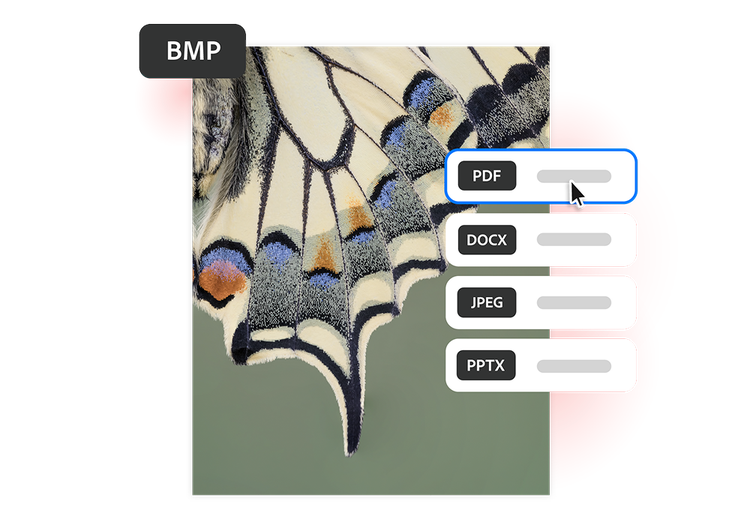
Drag and drop a bitmap image file to use our BMP to PDF converter. Free to use, no sign-up to try.
How to convert BMP to PDF online
Turn BMP images into polished PDF documents in just a few clicks with Acrobat online tools. Whether you’re preserving image quality, preparing files for sharing, or organizing graphics into documents, converting BMP files to PDF is fast and convenient.
Follow these steps to convert BMP to PDF:
Upload a source: Upload or drag and drop your BMP file into the converter tool above.
Convert the file: Your file is processed and converted into a PDF in moments.
Download your file: Download your newly converted file, then save, print, or share your PDF.
More ways to work with PDFs
Try our online tools to convert, compress, and merge PDF files — Acrobat can do it all.
Questions about the BMP to PDF converter? We have answers.
A BMP (Bitmap) file is a raster image format commonly used for storing high-quality digital images. BMP files often contain uncompressed image data, which helps preserve detail but can result in larger file sizes.
Converting BMP to PDF can make image files easier to share, print, store, and present. PDFs also provide better compatibility across devices and help organize visual content into a more professional format.
Yes. Acrobat online tools let you convert BMP files to PDF directly in your browser without downloading or installing additional software.
The online converter is designed for quick, individual conversions. Larger files or high-volume conversions may be subject to limits. Acrobat online tools provide additional options for more advanced workflows.
Your privacy and file security are a priority. Files are processed and deleted from Adobe servers unless you choose to sign in and save them.
The BMP to PDF converter supports BMP as well as JPEG, JPG, PNG, HEIC, TIFF, GIF, PSD, INDD, and AI files.
style
l spacing
Try our free BMP to PDF converter
Discover how converting BMP files into PDFs can make your images easier to share, store, and present.
background
#F8F8F8
Make large image files easier to share
BMP files can be significantly larger than other image formats. Converting them to PDF can help simplify file sharing through email, cloud storage, and collaboration platforms.
Create print-ready image documents
PDFs are optimized for reliable printing across devices and printers. Turn BMP images into professional-looking PDFs for presentations, flyers, diagrams, scanned documents, and visual references.
Improve compatibility across devices
BMP files may not always open consistently on every device or platform. PDFs offer a more universally supported format that’s easy to view on desktops, tablets, and smartphones.
Organize graphics into a document workflow
Convert standalone BMP images into structured PDF documents that are easier to archive, manage, and combine with other files for work, school, or personal projects.
Preserve image appearance
BMP files are known for storing detailed image data with minimal compression. Converting BMP to PDF helps maintain image clarity, color, and visual quality while creating a more shareable file format.
Do more with your PDFs
Edit, organize, and protect your PDFs with Acrobat online tools. You can combine files into a single PDF, rearrange pages, compress document sizes, and add password protection for sensitive content.
background
#F8F8F8
style
xl spacing top, xxl spacing bottom, three-up
Use Acrobat tools for free
Sign in to try 25+ tools, like convert or compress
Add comments, fill in forms, and sign PDFs for free
You can control how Adobe websites use cookies and similar technologies by making choices below. But note that if you disable cookies and similar technologies entirely, Adobe websites may not function properly.
Cookies are small text files stored by your web browser when you use websites. There are also other technologies that can be used for similar purposes like HTML5 Local Storage and local shared objects, web beacons, and embedded scripts. These technologies help us do things like remembering you and your preferences when you return to our sites, measure how you use the website, conduct market research, and gather information about the ads you see and interact with.
You can make choices in the menu below about what cookies and other technologies you want us to use on Adobe sites when you visit them from this browser. You can always change those choices later by clicking on the Cookie Preferences link at the bottom of the page.
If enabled:
We can improve your experience by tailoring the site and the content to things we think might be of interest
We can better keep track of your preferences — like what language you prefer to use
We will better understand your likely interests so we can provide you more relevant Adobe ads and content on non-Adobe websites and in non-Adobe apps
It will help us improve the performance of our website and those of our partners who use the Adobe Experience Cloud
If disabled:
We won’t be able to remember you from session to session so the experience may not be tailored to your interests
You’ll still have access to the content of the site but certain features that depend on cookies may not function
You’ll still see ads, they just may not be as relevant to you
General information
You can control how Adobe websites use cookies and similar technologies by making choices below. But note that if you disable cookies and similar technologies entirely, Adobe websites may not function properly.
Cookies are small text files stored by your web browser when you use websites. There are also other technologies that can be used for similar purposes like HTML5 Local Storage, web beacons, and embedded scripts. These technologies help us do things like remembering you and your preferences when you return to our sites, measure how you use the website, conduct market research, and gather information about the ads you see and interact with.
You can make choices in the menu below about what cookies and other technologies you want us to use on Adobe sites when you visit them from this browser. You can always change those choices later by clicking on the Cookie Preferences link at the bottom of the page.
If enabled:
We can improve your experience by tailoring the site and the content to things we think might be of interest
We can better keep track of your preferences — like what language you prefer to use
We will better understand your likely interests so we can provide you more relevant Adobe ads and content on non-Adobe websites and in non-Adobe apps
It will help us improve the performance of our website and those of our partners who use the Adobe Experience Cloud
If disabled:
We won’t be able to remember you from session to session so the experience may not be tailored to your interests
We’ll still count your use of our site and services
You’ll still have access to the content of the site but certain features that depend on cookies may not function
You’ll still see ads, they just may not be as relevant to you
Operate the site and core servicesOperate site and measure engagement
Always active
These cookies are required, and they are used to enable the site and related services core functionality. Without them the site could not operate, so they cannot be disabled.
These cookies enable the site and related services’ core functionality and collect statistics about user engagement, such as counting active use to help us understand trends. These cookies cannot be disabled.
Measure performance
These cookies are used to analyze site usage to measure and improve performance. Without them Adobe cannot know what content is most valued and how often unique visitors return to the site, making it hard to improve information we offer to you.
These cookies are used to analyze site usage to measure and improve performance. Without them Adobe cannot know what content is most valued, making it hard to improve information we offer to you.
Extend functionality
These cookies are used to enhance the functionality of Adobe sites such as remembering your settings and preferences to deliver a personalized experience; for example, your username, your repeated visits, preferred language, your country, or any other saved preference.
Personalize advertising
These cookies are used to enable Adobe and our partners to serve ads more relevant to your interests. Without them you will still see ads, but they might not be as relevant to you.