Chicago style citation: What it is and how to use it
Chicago style citation is one of the most widely used academic citation formats. This comprehensive guide covers the two main systems and walks you through how to properly credit sources in research papers, theses, and professional publications.

What are Chicago style citations?
Chicago style citation is a documentation system developed by the University of Chicago Press in 1906. It is used to credit sources in academic and professional writing. This citation method provides standardized guidelines for acknowledging the work of others, helping writers avoid plagiarism while giving readers the information they need to locate original sources.
The Chicago Manual of Style (CMOS), now in its 18th edition, serves as the authoritative reference for this citation format. For over a century, scholars, publishers, and students have relied on CMOS as the definitive guide for matters of style, grammar, and citation. Its longevity and widespread adoption across academic institutions make it one of the most trusted resources for professional writing standards.
Chicago style offers two distinct citation systems to accommodate different disciplines and writing contexts. The Notes-Bibliography system uses superscript numbers in the text that correspond to footnotes or endnotes, accompanied by a comprehensive bibliography. The Author-Date system places parenthetical citations within the text, followed by a reference list. Understanding which system to use depends on your field of study and specific assignment requirements.
Chicago style is commonly used in the following contexts:
- Humanities disciplines such as history, writing, and creative arts
- Social sciences research and publications
- Academic publishing and scholarly journals
- Professional publishing contexts and trade books
- Graduate theses and dissertations
Types of Chicago in-text citations
Chicago style offers two primary citation systems, each designed to serve different academic disciplines and writing purposes. Understanding the distinctions between these systems helps you choose the appropriate format for your work and ensures your citations meet scholarly standards.
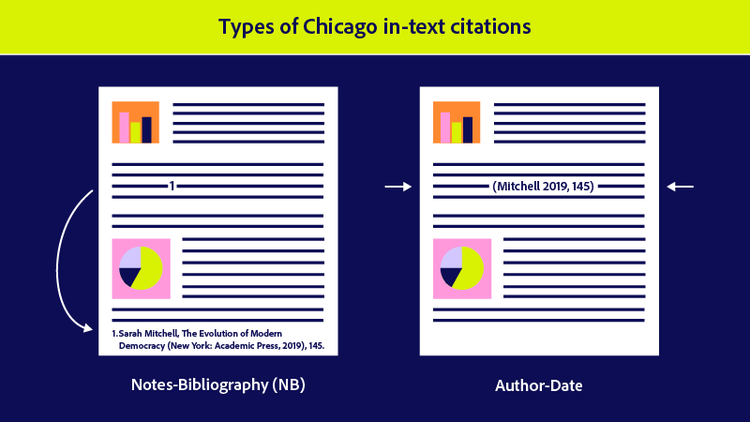
1. Notes-Bibliography (NB)
The Notes-Bibliography system is favored in humanities fields where extensive commentary and source discussion enhance the reader's understanding. This system uses superscript numbers placed at the end of sentences or clauses to direct readers to corresponding footnotes at the bottom of the page or endnotes at the end of the document. This system allows for detailed source commentary without interrupting the flow of the main text.
Each note contains full bibliographic information for the source, including author name, title, publication details, and page numbers. At the end of the document, a comprehensive bibliography lists all sources in alphabetical order by author's last name. This system works particularly well for history, literature, philosophy, and arts papers where source discussion often adds valuable context to the argument.
2. Author-Date
The Author-Date system provides a streamlined approach preferred in scientific and social science writing where efficiency and quick source identification matter most. Brief parenthetical citations are placed directly within the text, typically including the author's last name and the year of publication. When quoting or referencing specific passages, page numbers follow the year. This format allows readers to quickly identify sources without leaving the main text.
A reference list at the end of the document provides complete bibliographic information for each source, arranged alphabetically by author's last name. This system is particularly efficient for scientific and social science writing, where multiple sources may be cited in rapid succession and readers often need to verify claims quickly.
Turabian style, based on Kate L. Turabian's manual for students, represents a simplified version of Chicago style designed specifically for academic papers and theses. It follows the same fundamental principles as CMOS but offers streamlined rules that make citation formatting more accessible for students new to academic writing.
When choosing between systems, consider your discipline and assignment requirements. As research methods evolve, students should also familiarize themselves with guidelines for citing AI-generated content to maintain academic integrity in their work.
When working on research papers, digital tools can significantly streamline the citation process. Creating dedicated study spaces for organizing your research materials helps you keep track of sources and maintain consistent citation formatting throughout your project.
Additionally, being able to chat with PDF documents can help you quickly locate specific information within lengthy academic sources, making it easier to gather the details you need for accurate citations.
Examples of Chicago style citations
Proper citation formatting varies depending on the type of source you're referencing. Each source type has specific required elements and formatting conventions that differ between the Notes-Bibliography and Author-Date systems. The following examples demonstrate correct formatting for common source types using hypothetical references.
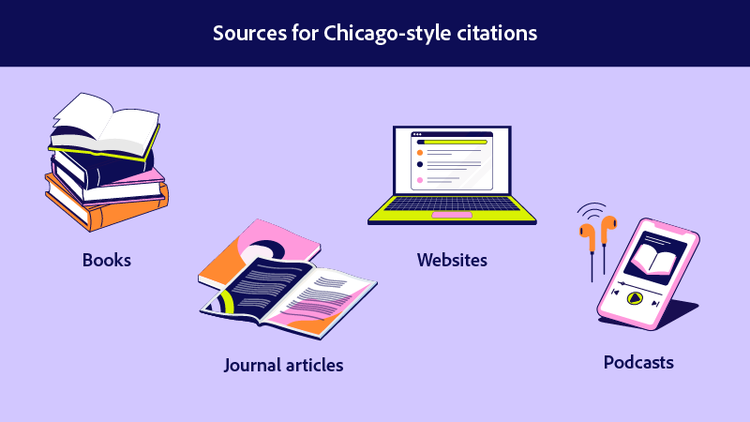
1. Books
Books remain one of the most frequently cited sources in academic writing. The citation format captures essential publication information while following specific punctuation and formatting conventions.
Notes-Bibliography format (footnote or endnote):
- Sarah Mitchell, The Evolution of Modern Democracy (New York: Academic Press, 2019), 145.
Notes-Bibliography format (bibliography entry): Mitchell, Sarah. The Evolution of Modern Democracy. New York: Academic Press, 2019.
Author-Date format (in-text): (Mitchell 2019, 145)
Author-Date format (reference list): Mitchell, Sarah. 2019. The Evolution of Modern Democracy. New York: Academic Press.
Key elements include the author's name, book title in italics, place of publication, publisher name, and publication year. Note the different punctuation patterns between footnote entries and bibliography entries.
2. Journal articles
Journal articles require additional elements including the article title in quotation marks, journal name in italics, volume and issue numbers, and page ranges. Understanding proper formatting for citing articles properly ensures your academic work meets scholarly standards.
Notes-Bibliography format (footnote or endnote): 2. James Chen, "Climate Policy and Economic Growth," Environmental Studies Quarterly 45, no. 3 (2021): 234–256.
Notes-Bibliography format (bibliography entry): Chen, James. "Climate Policy and Economic Growth." Environmental Studies Quarterly 45, no. 3 (2021): 234–256.
Author-Date format (in-text): (Chen 2021, 240)
Author-Date format (reference list): Chen, James. 2021. "Climate Policy and Economic Growth." Environmental Studies Quarterly 45 (3): 234–256.
3. Websites
Website citations present unique challenges because they may lack traditional publication information. Include as much identifying information as available, and always note the access date for content that may change.
Notes-Bibliography format (footnote or endnote): 3. National Archives, "Founding Documents," National Archives website, accessed March 15, 2024, https://www.archives.gov/founding-docs.
Notes-Bibliography format (bibliography entry): National Archives. "Founding Documents." National Archives website. Accessed March 15, 2024. https://www.archives.gov/founding-docs.
Author-Date format (in-text): (National Archives 2024)
Author-Date format (reference list): National Archives. 2024. "Founding Documents." Accessed March 15, 2024. https://www.archives.gov/founding-docs.
4. Podcasts
Podcasts and other multimedia sources require information about hosts, episode titles, series names, producers, and access details.
Notes-Bibliography format (footnote or endnote): 4. Maria Rodriguez, host, "The Future of Renewable Energy," Science Today Podcast, produced by Digital Media Labs, January 10, 2023, https://sciencetodaypodcast.com/episode-45.
Notes-Bibliography format (bibliography entry): Rodriguez, Maria, host. "The Future of Renewable Energy." Science Today Podcast. Produced by Digital Media Labs. January 10, 2023. https://sciencetodaypodcast.com/episode-45.
Author-Date format (in-text): (Rodriguez 2023)
Author-Date format (reference list): Rodriguez, Maria. 2023. "The Future of Renewable Energy." Science Today Podcast. Produced by Digital Media Labs. January 10, 2023. https://sciencetodaypodcast.com/episode-45.
When working with digital documents, understanding the conventions for citing PDF sources helps ensure accurate attribution regardless of the original format.
Chicago style citations in footnotes and endnotes
The Notes-Bibliography system relies on footnotes or endnotes to provide source information. Footnotes appear at the bottom of the page where the citation occurs, while endnotes are collected at the end of a chapter or document. Both serve the same purpose but offer different reading experiences.
Footnotes provide immediate access to source information, making them ideal for readers who want to verify claims without flipping pages. Endnotes keep the main text cleaner and less visually cluttered, which some publishers and instructors prefer. Your choice between footnotes and endnotes often depends on assignment guidelines, publication requirements, or personal preference.
Chicago style distinguishes between full notes and shortened notes. Full notes, also called long notes, are used for the first citation of any source and contain complete bibliographic information.
Full note example:
- Elizabeth Warren, Financial Markets and Consumer Protection (Boston: Harbor Publishing, 2020), 89.
Managing multiple sources across a lengthy research paper can become complex. Digital tools that help you summarize lengthy sources make it easier to extract key information and maintain accurate notes throughout your research process. This approach helps prevent citation errors that often occur when juggling numerous sources simultaneously.
Chicago style: common formatting mistakes
Even experienced writers make citation errors when working with Chicago style. Recognizing common mistakes helps you avoid them in your own work and ensures your citations meet academic standards.
Common Chicago style formatting mistakes include:
- Capitalizing all words in titles instead of using sentence-style capitalization where appropriate (headline-style capitalizes major words, while sentence-style capitalizes only the first word and proper nouns)
- Adding extra spaces between words or before and after punctuation marks
- Using italics and quotation marks inconsistently (book titles and journal names are italicized, while article and chapter titles use quotation marks)
- Missing or incorrect punctuation in citations, particularly commas and periods
- Forgetting to include access dates for online sources that may change over time
- Mixing Notes-Bibliography and Author-Date systems within the same paper
- Using incorrect indentation in bibliographies (hanging indents are required, with the first line flush left and subsequent lines indented)
- Applying incorrect date formats that don't match Chicago style conventions
Consistency throughout your document is essential for professional presentation. Before submitting academic work, review all citations to ensure they follow the same system and formatting conventions. Small inconsistencies can undermine the credibility of otherwise excellent research.
When preparing final submissions, you can convert documents to PDF to preserve your careful formatting. PDF format ensures that fonts, spacing, indentation, and special characters appear exactly as intended, regardless of what software your instructor or publisher uses to view the document.
Frequently asked questions
What is the Chicago style citation format?
Is Chicago style MLA or APA?
What are the 4 citation styles?
Is Chicago citing the same as Harvard?
How do you do Chicago style in-text citations?
You may also like