



The abbreviation "et al." comes from a Latin phrase meaning "and others." Academic writers use et al. citation formats to shorten references when a source has multiple authors. Read on to learn how to apply this basic rule for APA, MLA, and Chicago citation style.
When to use "et al." citations?
Whether you need to cite an article with four contributors or a research paper with a dozen authors, et al. streamlines your references while keeping them accurate and style-compliant.
Academic citation styles use the Latin abbreviation to shorten in-text citations when a source has multiple authors, making the writing cleaner and easier to read.

Each major citation style has specific rules for when et al. applies:
- APA and MLA style: Use et al. from the first citation when a source has three or more authors
- Chicago style: Use et al. from the first citation when a source has four or more authors
When writing a research paper, consistency matters more than memorizing every rule. Choose your citation style based on your discipline or instructor requirements, then apply its et al. rules uniformly throughout your document.
Citation Style
APA 7th Edition
MLA 9th Edition
Chicago Author-Date
Chicago Notes-Bibliography
Authors to List Individually
1-2 authors
1-2 authors
1-3 authors
1-3 authors
When to Use Et al.
3+ authors
3+ authors
4+ authors
4+ authors
First Citation Rule
First author et al.
First author et al.
First author et al.
First author et al.
Subsequent Citations
Same as first citation
Same as first citation
Same as first citation
Same as first citation
1. Et al. citation in APA style
APA 7th edition provides the most straightforward et al. citation rules. For any source with three or more authors, use the first author's surname followed by "et al." from the very first citation. This consistent approach makes in text citation et al. formatting simple to remember.
2. Et al. citations in MLA
MLA 9th edition follows a similar three-author threshold for et al. citations. When a source has three or more authors, use the first author's surname followed by "et al." in both in-text citations and your Works Cited page.
3. Et al. citation in Chicago style
Chicago style offers two citation systems, each with distinct et al. citation rules. The notes-bibliography system uses footnotes or endnotes, while the author-date system resembles APA formatting. Understanding these differences helps you create accurate et al. in text citation formats.
Notes-bibliography system: For sources with four or more authors, use the first author's name followed by "et al." in footnotes. In the bibliography, you may list all authors or use et al. after the first author.
Author-date system: For sources with four or more authors, use et al. from the first citation.
Reference list and bibliography rules for “et al.”
Your reference list or bibliography follows different rules than your in-text citations. Understanding these distinctions helps you create accurate, style-compliant lists that readers can use to locate your sources. The way you handle et al. citation formatting differs significantly between your paper's body and its final pages.
In APA style, your reference list entry includes all authors up to 20, regardless of how many times you used et al. in the text. This means a source you cited as "Johnson et al." throughout your paper might list eight full author names in your References section.
APA reference list example (5 authors): Johnson, A. B., Williams, C. D., Brown, E. F., Davis, G. H., & Miller, I. J. (2024). Understanding citation practices. Journal of Academic Writing, 15(3), 234-256.
MLA takes a different approach to et al. citations in the Works Cited. Use et al. after the first author for sources with three or more contributors. This keeps your Works Cited entries concise and consistent with your in-text citations.
MLA Works Cited example: Johnson, Amanda, et al. "Understanding Citation Practices." Journal of Academic Writing, vol. 15, no. 3, 2024, pp. 234-56.
Chicago style varies by system. In notes-bibliography format, your bibliography may list all authors or use et al. for works with four or more contributors. In author-date format, list all authors for sources with up to ten contributors.
The et al. abbreviation in your text helps readers connect your citations to the correct reference list entry. This connection between your in-text citations and your reference list is fundamental to academic integrity and reader usability.
Creating an "et al." in-text citation
In-text citations serve two purposes: they give credit to your sources and help readers locate the full reference information. Proper et al. citation formatting makes your citations concise while maintaining this essential connection between your text and your sources.
When you write a report or academic paper, you will encounter various citation scenarios. Mastering the et al. in text citation format for each major style ensures your work meets academic standards. Here are formatted examples for each major style:
APA parenthetical citations: First and all subsequent: (Anderson et al., 2024) With page number: (Anderson et al., 2024, p. 45) Multiple sources: (Anderson et al., 2024; Baker et al., 2023)
APA narrative citations: Anderson et al. (2024) demonstrated... According to Anderson et al. (2024)...
MLA parenthetical citations: First and all subsequent: (Rodriguez et al. 112) Multiple sources: (Rodriguez et al. 112; Patel et al. 78)
MLA narrative citations: Rodriguez et al. argue that... As Rodriguez et al. note...
Chicago author-date citations: First and all subsequent: (Thompson et al. 2024) With page number: (Thompson et al. 2024, 89)
Chicago footnote format: First note: Thompson et al., Research Methods, 89. Subsequent notes: Thompson et al., Research Methods, 92.
When citing the same author group for works published in different years, include the year to distinguish between sources. For example, you might cite "(Martinez et al., 2022)" and "(Martinez et al., 2024)" in the same paragraph, with readers understanding these represent different publications.
For multiple sources within the same parentheses, separate each citation with a semicolon and arrange them alphabetically by first author surname or chronologically, depending on your style guide's requirements. Understanding these nuances of in-text citation formatting helps your academic writing appear polished and professional.
How to format “et al.” citation
Correct formatting of an et al. citation involves several specific rules that are easy to overlook. Review these rules to perfect multi-author citations in any style.
Punctuation rules:
The period after "al." is essential because it marks an abbreviation. The word "al." is short for "alia" (or "alii" or "aliae" depending on gender in Latin). Never omit this period when writing any et al. citation.
In APA style, no comma appears between the author name and "et al." Write "Smith et al." not "Smith, et al." However, a comma does appear before the year: "(Smith et al., 2024)."
Chicago style uses a comma before "et al." in bibliography entries, depending on the specific format. Consult the Chicago Manual of Style for detailed guidance on your citation scenario.
Common formatting mistakes to avoid:
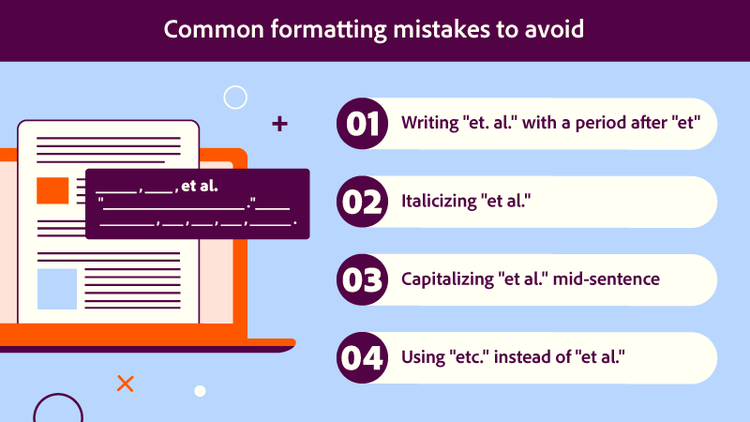
- Writing "et. al." with a period after "et" (incorrect—"et" is a complete Latin word meaning "and")
- Italicizing "et al." (incorrect in APA, MLA, and Chicago)
- Capitalizing "et al." mid-sentence (only capitalize at the start of a sentence)
- Using "etc." instead of "et al." (these abbreviations have different meanings)
Verb agreement:
When "et al." is the subject of a sentence, use a plural verb because the phrase refers to multiple people. Write "Martinez et al. demonstrate" not "Martinez et al. demonstrates." This grammatical consideration applies to all et al. in-text citation contexts.
When finalizing your document, use a PDF editor to review your citations for consistent formatting. Before submission, many students convert Word to PDF to preserve their formatting across different devices and platforms. You can also convert Google Docs to PDF if you prefer working in cloud-based applications.
Additionally, learning how to compare two documents can help you identify formatting inconsistencies between draft versions. This skill proves especially valuable when revising papers with numerous et al. citations that need to follow identical formatting patterns throughout.
How to use AI for “et al.” in-text citation
Artificial intelligence tools are transforming how students and researchers manage citations. These technologies can help you format et al. citations correctly while saving time on repetitive tasks. Understanding how to leverage AI tools for students enhances your academic productivity.
Before uploading documents, review the tool's privacy and data-handling policies. File retention, storage, and AI training practices vary by provider. Avoid uploading confidential, unpublished, or sensitive materials unless you understand how they will be processed.
Modern AI capabilities offer several citation-related features. AI can identify the number of authors in a source automatically, suggest the correct et al. citation format based on your chosen style, and check for consistency across your document. These capabilities make managing complex multi-author sources significantly easier.
AI research tools excel at processing large volumes of sources quickly. When you are reviewing dozens of articles for a literature review, AI can help you organize author information and flag sources that require et al. formatting. This automated assistance reduces the tedious manual work of checking each citation individually.
Several AI-powered features support citation workflows:
Document summarization. An AI summary generator can help you quickly review sources with multiple authors, identifying key arguments without reading entire documents. This speeds up the research process while ensuring you understand what you are citing.
Interactive document analysis. When you chat with PDF documents, you can ask specific questions about authorship, publication details, and content. This helps verify that your citation information is accurate before you format it with proper et al. usage.
Research organization. A student workspace with AI capabilities can help you track sources, organize notes, and maintain consistent et al. citation formatting throughout your project.
Best practices when using AI for citations:
Always verify AI-generated citations against official style guides. Double-check author names, publication years, and page numbers. Review the AI's suggested et al. formatting for accuracy. Use AI as an assistant rather than a replacement for understanding citation rules.
AI tools work best when you understand the underlying rules. If you know that APA requires et al. for three or more authors, you can quickly spot when an AI tool makes an error. Treat AI as a helpful collaborator that speeds up your workflow while you maintain quality control.
Remember that citation styles update periodically. AI tools may not always reflect the most recent edition of a style guide, so cross-reference their suggestions with current guidelines from the APA, MLA, or Chicago Manual of Style. When reviewing lengthy PDF documents with multiple citations, you might also find it helpful to print a large PDF so you can markup physical copies during your revision process.
The combination of AI assistance and human oversight creates an effective system for managing et al. in text citation requirements.
Frequently asked questions
No, et al. is only used when there are three or more authors in most citation styles. For two authors, list both names in every citation. In APA, use an ampersand in parenthetical citations "(Smith & Jones, 2024)" and "and" in narrative citations "Smith and Jones (2024)." MLA and Chicago follow similar patterns for two-author sources. This rule applies consistently regardless of how many times you cite the same two-author source throughout your paper.
Yes, when using an et al. citation, you always include the first author's surname followed by "et al." The abbreviation replaces only the remaining co-authors, not all authors. For example, a paper by Smith, Johnson, Williams, and Brown would be cited as "Smith et al." in most styles. The first author always receives explicit credit, while "et al." acknowledges the contributions of the remaining team members.
The rules depend on citation style rather than academic discipline. APA, commonly used in sciences and social sciences, and MLA and Chicago, common in humanities, each have specific et al. rules. A psychology paper using APA follows the same et al. citation rules as an education paper using APA, regardless of subject matter. Choose your style based on your instructor's requirements or your field's conventions.
When no individual author is identified, use the organization or company responsible for the content. If the organization name is the same as the website name, MLA style begins the citation with the page title instead. APA style uses the organization name as author even when it matches the site name. For in-text citations without an author, use a shortened version of the page title in MLA or the organization name and year in APA.
In all major styles, place a period after "al." but not after "et." APA uses a comma before the year but not between the author name and "et al.": (Smith et al., 2024). MLA omits commas entirely: (Smith et al. 45). Chicago author-date format follows APA conventions, while notes-bibliography style may vary. Never italicize "et al." in any citation style, and only capitalize it when it begins a sentence.
You may also like
title
Et al. citation guide: MLA, APA, and Chicago rules
cardImageAltText
Guide to using et al. in academic citations
cardImage
Tags
caas:content-type/article,caas:products/acrobat,caas:topic/students

