



AI detection has become a critical consideration for writers across industries. This article explains how to avoid AI detection, what AI detection is, how these tools analyze content, and eight practical tips to avoid AI detection in writing while maintaining authentic, high-quality work.
What is AI detection?
AI detection refers to the automated analysis of text to determine whether content was generated by a machine rather than a human. These systems use sophisticated algorithms to scan writing for telltale patterns that distinguish computers from human authors.
The technology has evolved rapidly over the past few years, driven largely by the explosion of AI writing tools like ChatGPT, Claude, and other large language models. As these tools are increasingly capable of producing polished content, institutions and organizations scramble to develop countermeasures.
The stakes vary across industries, but the concerns remain consistent. In academic settings, AI detection serves as a frontline defense for maintaining academic integrity. Professors and administrators worry that students might submit AI-generated essays as their own work, undermining the educational process and devaluing legitimate learning. Many universities now require submissions to pass through academic detection tools before receiving grades.
Journalism faces similar challenges. News organizations rely on authenticity and credibility as their core currency. Readers trust that articles reflect genuine reporting and human analysis, not machine-generated summaries. When AI-written content slips through editorial processes undetected, it can damage public trust in media institutions.
Marketing and advertising teams also grapple with AI detection. Search engines and social platforms have begun penalizing content they identify as AI-generated, potentially hurting organic reach and engagement. Professional communications, business proposals, and other documents all face scrutiny as well.
The bottom line? Understanding AI detection matters whether you're writing a term paper, a news article, or a quarterly report. These tools are here to stay, and learning to work alongside them—rather than against them—will serve you well.
How AI detectors work
AI detection tools rely on several analytical approaches to identify machine-generated text. Understanding these mechanisms helps explain why certain writing patterns trigger flags and how you can adjust your approach accordingly.
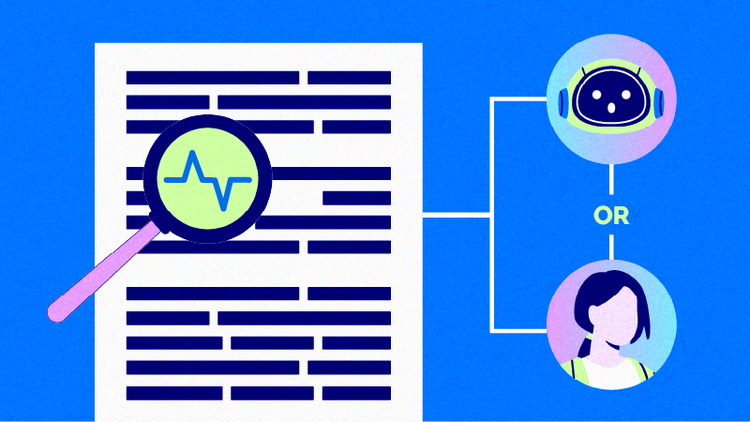
Most detectors analyze text using pattern recognition and statistical analysis. They examine factors like perplexity—essentially, how predictable the next word in a sentence is—and burstiness, which measures variation in sentence length and complexity throughout a piece. Human writing tends to be less predictable and more variable than AI-generated content.
These tools compare submitted text against massive databases of both human and AI-generated writing. They look for uniformity in sentence structure, repetitive phrasing patterns, and the kind of smooth, generic prose that large language models tend to produce. When text feels too polished, too consistent, or too devoid of personality, detection algorithms raise red flags. For a deeper understanding of how detection tools analyze text, exploring the technical foundations can provide valuable context.
The key insight? Detection tools look for patterns that suggest uniformity and predictability. Your goal isn't to trick these systems but to write in ways that naturally exhibit the variation, personality, and specificity that denote authentic human voice.
8 ways to avoid AI detection
Before diving into specific techniques, a word about intent matters here. These tips to avoid AI detection in writing aren't about gaming detection systems or passing off AI-generated work as your own. Instead, they focus on using AI responsibly—as a tool that augments your creativity and research rather than replacing your unique knowledge and expertise.
The goal is authenticity. When you contribute genuine personal insight, draw from real experience, and express ideas in your distinctive voice, you create content that naturally passes detection because it genuinely reflects human thought. These eight strategies help you achieve that authenticity while leveraging AI tools appropriately.
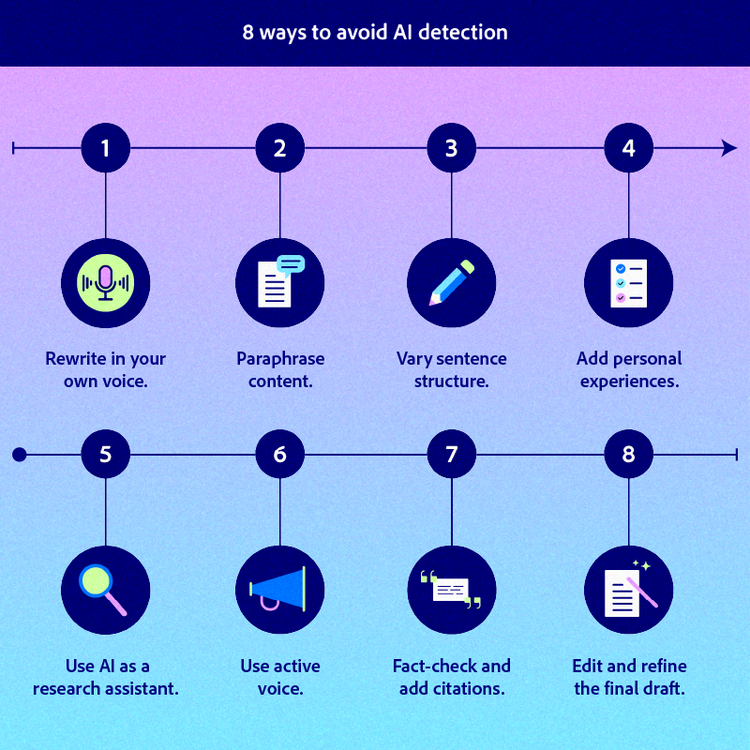
1. Rewrite in your own voice.
AI tends to produce generic, neutral prose that could have been written by anyone—or no one in particular. Detection tools pick up on this blandness. Your voice, by contrast, carries personality, quirks, and perspectives that machines simply cannot replicate.
Think about how you actually talk about topics that interest you. Do you use particular phrases? Do you tend toward humor or sarcasm? Do you have strong opinions you're not afraid to express? Bring those elements into your writing.
Consider adding personal observations, expressing genuine enthusiasm or skepticism, and using vocabulary that feels natural to you rather than academically neutral. If you'd never use the word "utilize" in conversation, don't use it in your writing just because it sounds more formal.
One effective technique: read your work aloud. Does it sound like you? Could a friend or colleague identify it as your writing? If the prose feels stilted or generic when spoken, it probably needs a human touch.
2. Paraphrase strategically.
Understanding what paraphrasing means goes beyond simply subbing in synonyms. Effective paraphrasing involves restructuring ideas entirely, approaching concepts from different angles, and filtering information through your own understanding. Learning how to rewrite text to avoid AI detection starts with this foundational skill.
When you encounter useful information—whether from AI tools, research papers, or other sources—don't just swap out a few words. Instead, close the source, think about what you learned, and explain it in your own words as if you were teaching someone else. This process naturally produces original phrasing.
A paraphrasing tool can help restructure AI-generated content as a starting point, but the real work happens when you take that restructured text and make it genuinely your own. Add context, connect ideas to related concepts, and express why the information matters.
Avoid over-reliance on any single source or phrasing pattern. When you synthesize multiple sources and add your own analysis, the resulting text naturally takes on the variation that detection tools read as human writing.
3. Vary your sentence structure.
AI writing models often produce remarkably uniform sentence lengths and structures. They favor certain constructions—particularly compound sentences connected by commas and conjunctions—and tend to maintain consistent rhythm throughout a piece.
Human writing, by contrast, has natural variation. We write short sentences. Then we might elaborate with something longer, more complex, perhaps even a bit meandering as we work through a complicated idea. Sometimes we start with questions. Other times we lead with strong declarative statements.
Mix it up intentionally. Follow a long, detailed sentence with something brief and punchy. Start some paragraphs with transitions, others with questions, and still others with bold claims. Use fragments sparingly for emphasis. Let your writing breathe.
This variation isn't just about avoiding detection—it makes your writing more engaging and readable. Monotonous prose puts readers to sleep regardless of whether a human or machine wrote it. Rhythm keeps people reading.
4. Add personal experiences and examples.
There is something AI fundamentally cannot do: draw from experiences it has never had. When you reference a specific conversation with a colleague, describe a project you worked on, or share an anecdote from your professional life, you're adding content that no language model could generate.
Think about concrete examples from your own experience that illustrate the points you want to make. Maybe you learned something about project management from a failed initiative at work. Perhaps a particular client interaction taught you something about communication. These specific, personal details signal authenticity.
Even if you're writing about topics outside of your direct experience, you can reference how you first encountered the subject, what surprised you during your research, or how the information connects to something you already knew. These personal touchpoints ground your writing in lived experience.
Specificity matters here. Vague references to "many people" or "some experts" feel generic. Naming specific sources, describing particular scenarios, and including concrete details all demonstrate the kind of deep engagement that characterizes human expertise.
5. Use AI as a research assistant, not a writer.
Reframing AI's role in your workflow makes a significant difference. Instead of asking AI to write your content, use it to accelerate your research, brainstorm ideas, and understand complex topics more quickly.
An AI summary generator can help you quickly digest lengthy research materials, extracting key points so you can focus your reading time on the most relevant sections. This saves hours while keeping you in the driver's seat for actual content creation.
Similarly, generative AI for documents can help you understand complex topics before you write about them. Ask questions, explore angles, and build your understanding—then close the AI tool and write from your own informed perspective.
The distinction matters both ethically and practically. When you write content yourself, informed by AI-assisted research, you naturally produce work that reflects your understanding. The AI helped you learn; you did the writing.
6. Use active voice and strong verbs.
AI models frequently default to passive voice constructions and weak verbs. Phrases like "it was determined that" or "the decision was made to" appear constantly in machine-generated text. These constructions feel impersonal and bureaucratic—exactly the kind of generic prose that triggers detection algorithms.
Active voice creates more direct, engaging prose. Instead of "the report was written by the team," write "the team wrote the report." Instead of "it can be seen that results improved," write "results improved dramatically."
Strong verbs add energy and precision. Rather than "made a decision," write "decided." Instead of "gave consideration to," write "considered." These substitutions tighten your prose while adding the kind of directness that characterizes confident human writing.
Review your drafts specifically for passive constructions and weak verb phrases. Each time you spot one, ask yourself: who is doing what? Then restructure the sentence to put that actor front and center with a strong, specific verb.
7. Fact-check and add citations.
AI can generate plausible-sounding information that turns out to be completely false. These "hallucinations" represent one of the technology's most significant limitations—and one of the clearest signals that content may be machine-generated.
When you verify facts and add citations to credible sources, you demonstrate the kind of research depth that AI-generated content typically lacks. You also protect yourself from the embarrassment of publishing inaccurate information.
Tools that let you chat with your documents can help verify claims against source material. Upload your research documents and ask questions to confirm that your assertions align with your sources.
Citations serve double duty: they establish credibility with readers and signal to detection tools that you've studied the actual source material. A well-researched piece with proper attribution looks fundamentally different from AI-generated content that makes unsupported claims.
8. Edit and refine your final draft.
Multiple revision passes help humanize any content, whether you started with AI assistance or wrote everything from scratch. Each editing round gives you opportunities to inject more personality, catch awkward phrasing, and sharpen your arguments.
Read for flow first. Does each paragraph connect logically to the next? Do your ideas build toward a coherent conclusion? Then focus on eliminating redundancy—AI tends to repeat itself, and even human writers often say the same thing multiple ways.
Using a PDF editor to review and annotate your work can help you approach editing systematically. Export your draft, mark it up with comments and corrections, then implement those changes in your final version.
Consider getting fresh eyes on your work. A colleague or peer can catch patterns you might miss after staring at the same text for hours. They can also tell you whether the writing sounds like you—an invaluable check on authenticity.
Frequently asked questions
Preventing AI detection comes down to authentic human input. Use the techniques outlined above: write in your own voice, vary your sentence structure, add personal experiences and examples, paraphrase strategically, and edit thoroughly. Focus on contributing genuine expertise rather than trying to trick detection systems. When your writing reflects real human thought and personality, it naturally passes detection.
Yes, when done thoughtfully. Effective paraphrasing goes beyond swapping synonyms—it involves restructuring ideas entirely, approaching concepts from new angles, and filtering information through your own understanding. Simply running text through a paraphrasing tool won't suffice. You need to genuinely engage with the material and express it in your own words, adding your perspective and connecting ideas in original ways.
Context matters significantly. A 40% AI detection score might trigger serious concerns in academic settings where any AI use could result in disciplinary action. In other contexts—like drafting internal business communications or brainstorming marketing copy—such a score might be perfectly acceptable. Focus on understanding your specific requirements and reducing that score through personal input, varied structure, and thorough content revision.
AI detectors perform differently across various content types. They tend to be more accurate with longer texts and may struggle with highly technical or specialized writing. Creative writing with unique stylistic choices often passes detection more easily than straightforward expository prose. The tools also have difficulty with non-English languages and may produce inconsistent results with translated content.
False positives can occur with AI detection tools. If your genuinely human-written content is flagged, document your writing process—drafts, research notes, and revision history can all serve as evidence. Many institutions allow appeals, and demonstrating your process often resolves the issue. Consider keeping records of your writing workflow, especially for high-stakes submissions.
You may also like
title
How to avoid AI detection when writing
cardImageAltText
Tips for avoiding AI detection in writing
cardImage
Tags
caas:content-type/article,caas:products/acrobat,caas:topic/ai-chat-pdf,caas:topic/students

