How to simplify complex sentences
Transform confusing, lengthy sentences into clear, easy-to-read writing. Learn proven techniques and AI-powered tools to simplify sentences.

What makes a sentence complex?
Understanding what makes a sentence difficult to read is the first step toward writing clearly. Complex sentences aren’t inherently bad—they serve important purposes in academic writing and technical documentation. However, when complexity obscures meaning or creates confusion, it’s time to simplify sentences and make your writing more accessible.
Several factors contribute to sentence complexity:
- Excessive use of jargon and technical terminology. Industry-specific language can alienate readers unfamiliar with your field. While sometimes necessary, jargon often creates barriers between you and your audience. A sentence packed with technical terms requires readers to pause and decode meaning, disrupting their reading flow and reducing overall comprehension.
- Multiple dependent or subordinate clauses. When sentences contain several clauses that rely on each other, readers must hold multiple ideas in mind simultaneously. This cognitive load increases as clauses stack up, making the main point harder to identify and requiring readers to work harder to extract meaning.
- Passive voice constructions. Passive voice obscures who is performing an action. “The report was written by the team” requires more mental processing than “The team wrote the report.” Passive constructions add words and reduce directness, forcing readers to reorganize information mentally.
- Unnecessary words and redundant phrases. Phrases like “in the event that” instead of “if” or “at this point in time” instead of “now” pad sentences without adding meaning. These verbal fillers slow readers down and dilute your message, creating unnecessary friction in the reading experience.
- Long compound sentences with multiple ideas. Joining too many independent clauses with conjunctions creates sentences that seem to go on forever. Readers lose track of the initial point by the time they reach the period, often needing to re-read to understand the full meaning.
- Abstract language instead of concrete terms. Vague words like “facilitate,” “utilize,” or “implement” sound impressive but often confuse readers. Concrete language paints clearer pictures and communicates more directly, helping readers visualize exactly what you mean.
Why is it important to simplify complex sentences?
Clear writing isn’t just a stylistic preference—it directly impacts how effectively you communicate. When you simplify complex sentences, you remove obstacles between your ideas and your readers’ understanding. This skill benefits everyone involved in the communication process.
The benefits of simplified writing extend across every type of communication:
- Improves clarity and comprehension. Readers grasp your meaning on the first pass instead of re-reading sentences multiple times. This saves time for everyone involved and reduces the chance of misunderstandings that could lead to costly errors.
- Makes content accessible to wider audiences. Not everyone shares your educational background or familiarity with your subject matter. Simplified sentences welcome readers from diverse backgrounds and experience levels, expanding your potential audience significantly.
- Reduces reader fatigue and increases engagement. Dense, complicated prose exhausts readers. When every sentence requires intense concentration, people stop reading. Simpler sentences keep readers moving through your content and maintain their attention.
- Enhances professional credibility. Contrary to what some believe, simple writing demonstrates mastery of your subject. When you can explain complex ideas clearly, you show genuine understanding rather than hiding behind complicated language.
- Supports readers with varying literacy levels. Plain language serves readers who speak English as a second language, those with learning differences, and anyone reading quickly on a mobile device. Accessibility benefits everyone.
- Improves document usability across platforms. Shorter sentences display better on small screens and translate more accurately when readers use translation tools. They also work better with screen readers and other accessibility technologies, ensuring your message reaches all readers.
How to simplify complex sentences
Multiple techniques exist for transforming dense, complicated writing into clear prose. Mastering these methods will help you communicate more effectively in any context. Practice each technique individually, then combine them for maximum impact when you need to simplify sentences in your own work.
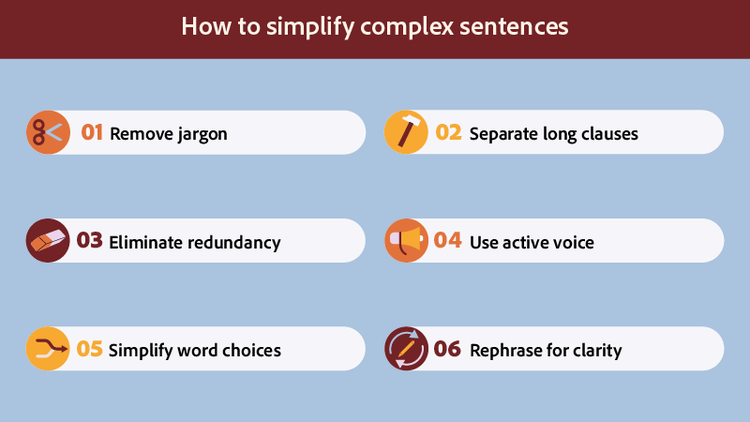
1. Remove jargon and technical terms
Specialized vocabulary serves a purpose within professional communities, but it creates barriers for general audiences. When possible, replace technical terms with plain language equivalents that convey the same meaning without requiring specialized knowledge.
Consider this transformation:
- Before: “The paradigm shift necessitates stakeholder alignment across all organizational verticals.”
- After: “The new approach requires everyone in the company to agree on the direction.”
Ask yourself whether a reader outside your field would understand each word. If not, find a simpler alternative. This practice helps you simplify complex sentences while ensuring your message reaches the widest possible audience.
2. Break up long clauses
Compound-complex sentences often contain multiple ideas that deserve their own sentences. Look for conjunctions like “and,” “but,” “while,” and “although” as potential breaking points where you can divide one long sentence into two or more shorter ones.
Identify independent clauses—groups of words that could stand alone as complete sentences. Separate them with periods instead of connecting them with commas and conjunctions. Your readers will thank you for the breathing room, and your writing will become much easier to follow.
3. Eliminate redundant words
Many phrases contain hidden redundancies that add length without adding meaning. Train yourself to spot and cut these verbal fillers to simplify sentences effectively.
Common culprits include:
- “In order to” becomes “to”
- “Due to the fact that” becomes “because”
- “At this point in time” becomes “now”
- “In the event that” becomes “if”
- “Has the ability to” becomes “can”
- “For the purpose of” becomes “for”
- “In spite of the fact that” becomes “although”
Every unnecessary word dilutes your message and tests your reader’s patience. Cutting redundancies is one of the fastest ways to simplify complex sentences.
4. Use active voice
Passive voice constructions obscure the actor and add unnecessary words. Active voice puts the subject front and center, creating more direct and engaging sentences that readers can process quickly.
- Passive: “The proposal was reviewed by the committee and approved by management.”
- Active: “The committee reviewed the proposal, and management approved it.”
Active voice typically uses fewer words and creates stronger, more confident prose. While passive voice has legitimate uses, defaulting to active voice will simplify most sentences and make your writing more engaging.
5. Simplify word choices
Longer words don’t make you sound smarter—they make you harder to understand. When a shorter, more common word conveys the same meaning, choose it every time.
- “Utilize” becomes “use”
- “Commence” becomes “start”
- “Terminate” becomes “end”
- “Facilitate” becomes “help”
- “Subsequent” becomes “next”
- “Endeavor” becomes “try”
- “Ascertain” becomes “find out”
Your goal is communication, not impression. Simple words communicate faster and more reliably, helping you simplify sentences while maintaining your intended meaning.
6. Rephrase for directness
Many sentences bury their main point under qualifiers, hedging language, and throat-clearing phrases. Lead with your key message instead of making readers wait for the important information.
- Indirect: “It should be noted that, based on our analysis, the deadline has been moved to Friday.”
- Direct: “The deadline is now Friday.”
Cut phrases like “it is important to note that,” “it goes without saying,” and “as a matter of fact.” Get to the point immediately. This directness helps you simplify complex sentences while making your writing more powerful.
How to simplify sentences using AI tools
AI-powered writing assistants have transformed how we approach sentence simplification. These tools analyze your text and suggest clearer alternatives in seconds, making the revision process faster and more consistent. Using generative AI for documents can streamline your workflow significantly and help you simplify sentences with unprecedented speed.
Follow these steps to simplify sentences using AI tools effectively:
- Input your complex sentence or paragraph into the AI tool. Copy the text you want to simplify and paste it into your chosen AI assistant. You can work with individual sentences or entire paragraphs depending on your needs.
- Specify your simplification goals. Tell the AI what you need. Include details about your target reading level, intended audience, and desired tone. Learning about writing effective prompts will help you get better results and more useful suggestions.
- Generate the simplified version. Let the AI process your request and produce alternative versions. Most tools offer multiple options, giving you choices to consider and compare against your original text.
- Review the AI output for accuracy and meaning retention. Check that the simplified version says what you intended. AI sometimes removes important nuances or changes meaning slightly. You can chat with your document to review content and verify that AI suggestions maintain accuracy throughout your work.
- Fine-tune the results to match your voice and intent. Edit the AI suggestions to sound like you. Adjust word choices and phrasing until the text feels natural and authentic to your writing style while still maintaining the simplified structure.
- Apply the simplified text to your document. Replace the original complex sentences with your refined, simplified versions. Review the surrounding context to ensure everything flows smoothly and maintains consistent tone.
Here are examples showing how prompts and AI work together to simplify complex sentences:
Example 1:
- Before: “The implementation of the new organizational restructuring initiative necessitates the immediate cessation of all previously approved expenditure allocations pending further review.”
- Prompt: “Simplify this sentence for a general audience while keeping the core meaning intact.”
- After: “The new company restructure requires stopping all approved spending until we complete a review.”
- Before: “Due to the fact that the weather conditions were unfavorable and the forecast indicated continued precipitation, the outdoor event was postponed until such time as conditions improve sufficiently.”
- Prompt: “Rewrite this sentence using simpler words and fewer clauses.”
- After: “Bad weather postponed the outdoor event. We’ll reschedule when conditions improve.”
- Before: “It is incumbent upon all team members to familiarize themselves with the new protocols prior to the commencement of the next quarter.”
- Prompt: “Make this sentence more direct and easier to understand.”
- After: “All team members must learn the new protocols before next quarter begins.”
Best practices for simplifying sentences
Applying simplification techniques strategically ensures you improve clarity without sacrificing necessary detail. These best practices will help you simplify sentences effectively across different writing contexts while maintaining the precision your documents require.

- Know your audience and their reading level. A document for medical professionals can include more technical language than one for patients. Research your readers’ familiarity with your subject and adjust your simplification accordingly. Understanding who will read your work helps you make better decisions about how to simplify complex sentences.
- Understand the document’s purpose before simplifying. Legal contracts may require precise language that sounds complex but serves important functions. Identify which complexity serves a purpose and which merely obscures meaning. Not every sentence needs simplification—sometimes specific terminology protects both writer and reader.
- Pay attention to punctuation for clarity. Proper full stop punctuation creates natural pauses that help readers process information. Understanding ellipsis usage and other punctuation marks supports clear communication. Good punctuation can simplify sentences by creating logical breaks in your text.
- Read sentences aloud to catch awkward phrasing. Your ear often catches problems your eye misses. If you stumble while reading, your readers will too. Revise until the text flows naturally when spoken. This simple technique reveals complexity that might otherwise go unnoticed.
- Maintain the original meaning when simplifying. Simplification should clarify, not change what you’re saying. After revising, compare your new version to the original to ensure you’ve preserved essential information and intent. Oversimplification can be just as problematic as overcomplicated writing.
- Use tools to check readability scores. Many writing applications calculate readability metrics like Flesch-Kincaid grade level. These scores provide objective feedback on your writing’s accessibility and help you track improvement over time.
- Create a personal checklist of common issues. Track the complexity problems that appear most frequently in your writing. Whether you tend toward passive voice, jargon, or run-on sentences, knowing your habits helps you simplify sentences more efficiently during revision.
- Simplify in stages rather than all at once. Focus on one type of complexity at a time. First eliminate redundant words, then address passive voice, then break up long sentences. This methodical approach ensures thorough revision without overwhelming yourself.
Frequently asked questions
What is a complex sentence simplified?
How do I convert complex sentences into simple ones?
What is the best sentence simplifier?
Can simplifying sentences change the meaning?
How simple should my sentences be?
What’s the difference between simple and simplified sentences?
How long does it take to learn how to simplify sentences?
Should I simplify all my writing?
You may also like