ACS citation style: definition and examples
Master the American Chemical Society (ACS) citation style. Learn the three in-text formats and how to create a complete ACS reference list.

What is ACS citation?
American Chemical Society citation style (ACS) is the standard citation system used by many chemistry journals, chemistry courses, and chemical research publications. It is a comprehensive system developed and maintained by the American Chemical Society. In chemistry and related disciplines, the ACS citation style serves as the standard framework for citing an article, website, textbook, patents, chemical data bases, and other sources.
You'll encounter ACS citation requirements across many contexts. Chemistry students use this format when writing a research paper for coursework, while professionals rely on it for peer-reviewed publications in major chemistry journals. Lab instructors often require ACS style when writing a report on experimental findings, and graduate students must master it for theses and dissertations.
ACS style offers three distinct citation systems: superscript numbers, italic numbers in parentheses, and author-date format. Each system has specific rules for both in-text citations and reference list entries. The format you use depends on the requirements of your target journal, your instructor's preferences, or the conventions of your institution.
Whether you're documenting a groundbreaking discovery or building on decades of established research, accurate citations allow readers to trace your sources, verify your claims, and explore related work.
In-text ACS citation format
ACS style provides three options for citing sources within your text. Each system connects your in-text citations to corresponding entries in your reference list, but they differ in appearance and application. Journals and academic institutions often specify which format they require, so always check submission guidelines or assignment instructions before you begin writing.
Regardless of which system you choose, maintaining consistency throughout your document is critical. Switching between formats mid-paper violates ACS guidelines and creates confusion for readers trying to locate your sources. When conducting research for a literature review or comprehensive paper, establish your citation format from the start and apply it uniformly.
Superscript Numbers
The superscript number system is the most widely used ACS citation format, particularly in major chemistry journals. In this system, you assign each source a number based on the order it first appears in your text. These numbers appear as small, raised figures immediately after the relevant information, typically following any punctuation marks.
For example, a sentence using superscript citation might read: "Recent advances in catalysis have enabled more sustainable chemical synthesis.¹" The superscript "1" directs readers to the first entry in your reference list. If you cite the same source again later, you use the same number regardless of where it appears.
This format offers a clean, unobtrusive way to acknowledge sources without interrupting the flow of your writing. Most chemistry journals, including those published by the American Chemical Society itself, prefer superscript citations for their streamlined appearance.
Italic Numbers
The italic number system presents citations as italicized numbers enclosed in parentheses. The italicized number in parentheses serves the same function as a superscript citation, linking to the corresponding reference list entry.
Using this format, a citation appears as: "Computational methods have transformed molecular modeling (1)."
While less common than superscript citations, some journals and instructors prefer this format for its visibility. The parenthetical presentation makes citations easier to spot when scanning a document, which can be helpful for reviewers and editors evaluating your sources.
Author-Date
The author-date system will feel familiar if you've used styles like APA. Instead of numbers, you cite sources by including the author's surname and the publication year in parentheses. This format provides immediate context about who conducted the research and when.
An author-date citation appears as: "Recent studies have demonstrated improved yield under these conditions (Martinez, 2023)." For works with two authors, include both surnames: "(Martinez and Chen, 2023)." When a source has three or more authors, use the first author's name followed by "et al.": "(Martinez et al., 2023)."
This format is particularly useful when the identity of researchers matters to your argument or when you're discussing the historical development of ideas. For instance, some journals in biochemistry and related fields prefer author-date citations.
How to create an ACS reference list
Your references list provides complete bibliographic information for every source cited in your paper. This section appears at the end of your document, allowing readers to locate and verify each source you've referenced. Proper formatting ensures clarity and demonstrates attention to scholarly standards.

ACS style requires specific formatting conventions for your references list. Use a consistent font throughout, typically the same typeface as your main text. Single-space individual entries, with a blank line between each reference. Apply a hanging indent to entries longer than one line, where the first line is flush left and subsequent lines are indented.
The ordering of your references depends on which citation system you've used. If you employed superscript or italic numbers, arrange references in numerical order matching your in-text citations. The first source you cited becomes reference 1, the second becomes reference 2, and so on. If you used the author-date system, alphabetize your references by the first author's surname.
Each reference entry must include specific elements depending on the source type. At minimum, you'll need author names, article or chapter title, publication title, year, and location information such as page numbers or URLs. Author names appear with surname first, followed by initials without periods or spaces between them.
Pay careful attention to punctuation and italicization. Journal names and book titles appear in italics, while article and chapter titles use standard formatting. Semicolons, commas, and periods have specific placements that vary by source type.
Before submitting your work, review your references list carefully for accuracy and consistency. Verify that every in-text citation has a corresponding reference entry and that no orphan references appear in your list. When your document is complete, you can convert your document to PDF to preserve your formatting across different devices and platforms. If you need to make final adjustments, a PDF editor allows you to refine your references without reformatting issues.
Common sources in ACS style citation
Different source types require different formatting approaches in ACS citation. Below are the most common sources you'll cite in chemistry and related fields, along with their formatting requirements.
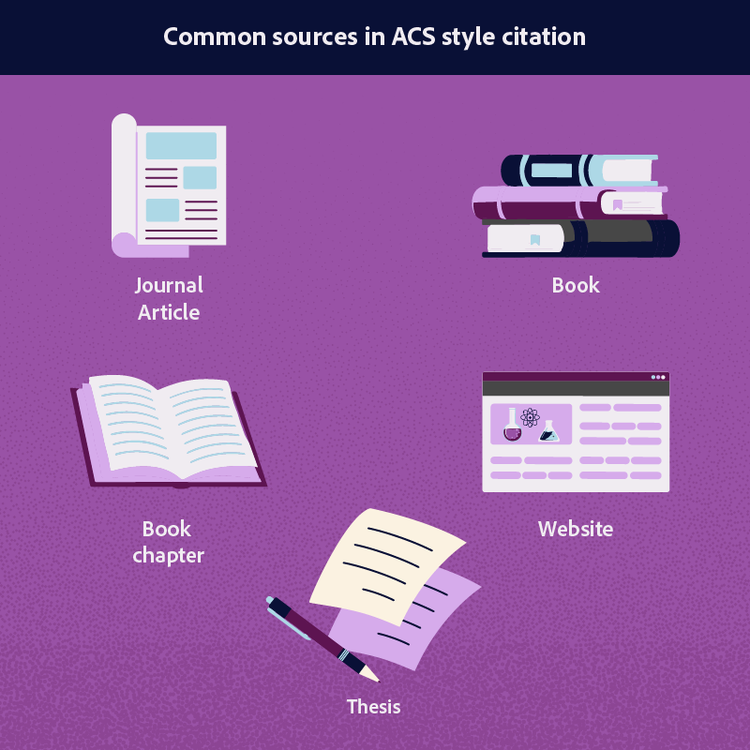
Journal articles are the most frequently cited sources in chemistry writing. The standard format includes: Author(s). Article Title. Journal Abbreviation Year, Volume, Pages.
Example: Martinez, JL; Chen, R. Advances in Catalytic Efficiency for Green Chemistry Applications. J. Am. Chem. Soc. 2023, 145, 1234–1245.
Note that journal names are abbreviated according to Chemical Abstracts Service conventions. The year appears in bold, followed by the italicized volume number and page range.
Books follow this format: Author(s). Book Title; Publisher: Location, Year.
Example: Thompson, KM. Fundamentals of Organic Synthesis; Academic Press: New York, 2022.
The book title appears in italics, and a semicolon separates it from the publisher information. Include the city of publication before the year.
When citing a specific chapter from an edited volume, use: Chapter Author(s). Chapter Title. In Book Title; Editor(s), Ed.; Publisher: Location, Year; pp Pages.
Example: Rodriguez, AM. Spectroscopic Methods in Analysis. In Modern Analytical Chemistry; Williams, PT, Ed.; Wiley: Hoboken, NJ, 2021; pp 145–178.
The chapter title appears in standard formatting, while the book title is italicized. Include the page range for the specific chapter.
Online sources require: Author/Organization. Title. URL (accessed Date).
Example: National Institute of Standards and Technology. NIST Chemistry WebBook. https://webbook.nist.gov/ chemistry/ (accessed March 15, 2024).
Always include the access date for online sources, as web content can change or become unavailable. When citing a PDF obtained online, include the URL where you accessed the document.
Theses and dissertations use: Author. Title. Degree Type, Institution, Location, Year.
Example: Patel, S. Novel Approaches to Polymer Degradation. Ph.D. Dissertation, Massachusetts Institute of Technology, Cambridge, MA, 2023.
Specify whether the work is a master's thesis or doctoral dissertation and include the full institution name and location.
For chemistry-specific sources like patents, conference proceedings, or technical reports, consult the ACS Style Guide for detailed formatting requirements. Each source type has specific conventions that ensure readers can locate the original material.
How to generate ACS citations with AI
Creating accurate citations manually can be time-consuming, especially when working with numerous sources. AI tools for students and researchers now offer efficient ways to generate properly formatted citations, reducing errors and saving valuable time. Here's how to use AI assistance for ACS citation creation.
Step 1: Upload or input your source information
Begin by gathering the bibliographic details for your source. You can upload a PDF directly to AI research tools, paste a URL, or manually enter information like author names, publication title, year, and page numbers. The more complete your input, the more accurate your generated citation will be. When working with PDF documents, you can chat with your PDF to extract key details efficiently. (Before uploading documents, review your AI tool's privacy policy to understand how files are processed, stored, and used. Avoid uploading confidential, proprietary, or sensitive information unless your organization's policies permit it.)
Step 2: Select ACS citation format
Specify that you need ACS format and indicate which of the three systems you're using—superscript, italic numbers, or author-date. Some AI tools have preset options for ACS style, while others require you to describe the format in your prompt. Be explicit about your requirements to ensure the output matches your needs.
Step 3: Review and verify the generated citation
AI-generated citations require careful review. Check that author names are formatted correctly with surnames first and initials without periods. Verify that journal names use proper abbreviations and that italicization and punctuation follow ACS conventions. An AI summary generator can help you quickly extract and verify source information when checking citations.
Step 4: Copy the citation to your document
Once you've verified accuracy, transfer the citation to your references list. Maintain consistent formatting as you add entries, ensuring proper spacing and indentation. Organize your research materials in a student workspace to keep sources and citations organized throughout your project.
Step 5: Double-check formatting against ACS guidelines
Before finalizing your paper, compare your citations against official ACS Style Guide examples. Pay particular attention to punctuation placement, abbreviation conventions, and the ordering of elements within each entry. Even AI-generated citations may require minor adjustments to meet exact ACS specifications.
Using AI for citation generation offers significant advantages. These tools can quickly generate journal abbreviations, format numbered references, and maintain consistency across your references list. However, they work best as assistants rather than replacements for your own careful review. Always verify AI output against authoritative ACS guidelines to ensure your citations meet professional standards.
Frequently asked questions
Does ACS use APA format?
Does computer science use MLA or APA?
Does ACS style referencing use et al.?
What citation format does the medical field use?
You may also like