


Interviews provide valuable primary source material for academic papers, research projects, and class assignments. To cite an interview, include the interviewer's name, interviewee's name, interview title, publication or broadcast details, and date. The specific format varies by citation style: APA, MLA, and Chicago each have distinct requirements for different interview types, including published, broadcast, personal, and online sources.
Best practices to cite an interview
Whether you're referencing a magazine interview with a public figure, a podcast conversation, or an interview you conducted yourself, proper citation ensures your academic work maintains credibility and allows readers to locate your sources.
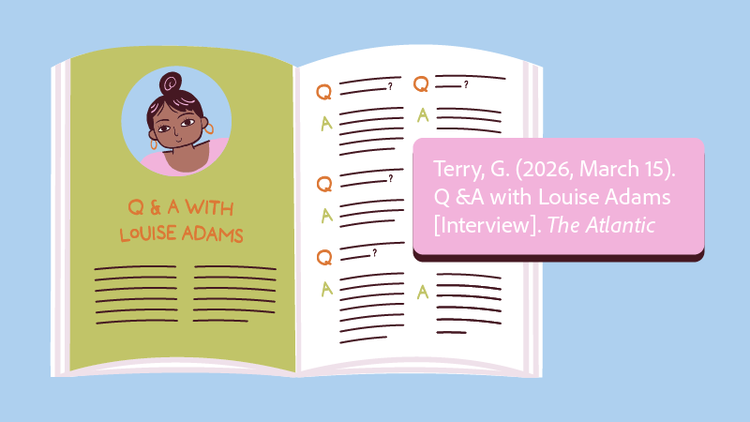
The three major citation styles—American Psychological Association (APA), Modern Language Association (MLA), and Chicago—each handle interview citations differently. Understanding these distinctions is essential for anyone writing a report or academic paper that incorporates interview material. Much like citing an article, interview citations require attention to specific formatting details that vary by source type.
Published interviews appear in magazines, newspapers, books, and online publications with editorial oversight. These sources receive full reference list entries in all citation styles. Personal interviews, conducted by the researcher, receive different treatment depending on the style—APA excludes them from reference lists entirely, while MLA and Chicago include them with specific formatting.
Here's a quick comparison of how each style handles the key citation elements:
Citation Element
Author Position
Personal Interviews
In-Text Format
Date Format
APA Style
Interviewer listed as author
In-text only (personal communication)
Parenthetical (Author, Year)
Year, Month Day
MLA Style
Interviewee listed first
Included in Works Cited
Parenthetical (Interviewee)
Day Month Year
Chicago Style
Interviewee listed first
Included in bibliography
Footnote/endnote numbers
Month Day, Year
Best practices for working with interviews in your report writing:
When working with interview material, consider these strategies for accurate citations:
- Always verify the exact date of publication or broadcast before finalizing your citation
- When paraphrasing interview content, ensure you accurately represent the speaker's meaning while using your own words
- Practice paraphrasing a quote from interviews to avoid over-relying on direct quotations
- Double-check that interviewee names are spelled correctly—this is a common error
- For interviews without clear titles, create a descriptive bracketed title that identifies the interviewee
Common interview citation mistakes:
- Using the interviewer instead of interviewee in MLA
- Including APA personal interviews in reference lists
- Omitting upload dates for YouTube interviews
- Not including contextual information for personal communications
How to cite an interview in APA style
The APA interview citation format follows the Publication Manual of the American Psychological Association, 7th edition guidelines. APA distinguishes between recoverable sources (published or broadcast interviews that readers can access) and non-recoverable sources (personal interviews that only you have access to).
Published interview in APA
For interviews published in magazines, newspapers, or books, treat the interviewer as the author and include the interviewee's name in the title.
Reference list format:
Interviewer Last Name, First Initial. (Year, Month Day). Title of interview: Subtitle including interviewee name [Interview]. Publication Name. URL
Example:
Terry, G. (2024, March 15). A conversation with Maya Chen on climate policy [Interview]. The Atlantic. https://www.theatlantic.com/example
Include the word "Interview" in brackets after the title to identify the source type. If the interview has no formal title, create a descriptive title in brackets.
Broadcast interview in APA
For interviews aired on television, radio, or podcasts, include the network or platform and relevant episode information.
Reference list format:
Host Last Name, First Initial. (Host). (Year, Month Day). Episode title (Season #, Episode #) [Audio podcast episode or TV series episode]. In Producer Last Name, First Initial. (Executive Producer), Program Name. Production Company. URL
Example:
Chen, Maya, M. (Host). (2024, March 15). Interview with Dr. James Patel: The future of urban sustainability (No. 127) [Audio podcast episode]. In Ideas in Action. Insight Media. https://www.example.com/podcast/127
Personal interview in APA
APA treats personal interviews as personal communications because readers cannot retrieve them. This distinction is critical: Personal communications are cited only in the text of your paper and never appear in your reference list. Because these sources cannot be recovered by your readers, APA style requires you to provide enough context within your text for readers to understand the nature and relevance of the information. Always include the interviewee's initials, last name, the phrase "personal communication," and the specific date of the interview.
In-text citation format:
(First Initial. Last Name, personal communication, Month Day, Year)
Example:
According to the project manager, the timeline shifted due to budget constraints (J. Williams, personal communication, January 12, 2024).
You can also integrate the citation into your sentence: J. Williams noted in a personal interview on January 12, 2024, that budget constraints affected the project timeline.
Online or video interview in APA
For interviews hosted on YouTube, websites, or other online platforms, include the platform name and URL.
Reference list format:
Interviewee Last Name, First Initial. (Year, Month Day). Title of video [Video]. Platform Name. URL
Example:
Gates, B. (2024, April 3). Bill Gates discusses AI and education [Video]. YouTube. https://www.youtube.com/example
When the interviewer is more prominent or the focus of the content, list them as the author instead.
How to cite an interview in MLA format
MLA format, governed by the Modern Language Association Handbook, 9th edition, takes a different approach than APA. MLA typically lists the interviewee first, treating them as the primary source of the content, and includes personal interviews in the Works Cited list.
Published interview in MLA
For interviews in print or online publications, begin with the interviewee's name.
Works Cited format:
Interviewee Last Name, First Name. "Title of Interview." Interview by Interviewer First Name Last Name. Publication Name, Day Month Year, pages or URL.
Example:
Williams, Angela. "The Future of Public Health." Interview by Marcus Lee. National Geographic, 10 Jan. 2024, www.nationalgeographic.com/example
If the interview has no title, use "Interview" as a descriptor after the interviewee's name.
Broadcast interview in MLA
For radio, television, or podcast interviews, include the program name and network or platform.
Works Cited format:
Interviewee Last Name, First Name. "Episode Title." Interview by Host First Name Last Name. Program Name, Network or Platform, Day Month Year.
Example:
Martinez, Sarah. "The Future of Medicine." Interview by Joe Rogan. The Joe Rogan Experience, Spotify, 8 Feb. 2024.
For podcast episodes, you may include the episode number if available.
Personal interview in MLA
Unlike APA, MLA includes personal interviews in the Works Cited list. Format them simply with the interviewee's name and the interview type.
Works Cited format:
Interviewee Last Name, First Name. Personal interview. Day Month Year.
Example:
Collett, Jesse. Personal interview. 12 Jan. 2024.
For phone or video interviews, specify the format: "Telephone interview" or "Zoom interview."
Online or video interview in MLA
For interviews on YouTube or other video platforms, include the website name and URL. When citing a PDF transcript of an online interview, follow the format for online sources while noting the PDF format.
Works Cited format:
Interviewee Last Name, First Name. "Title of Video." Interview by Interviewer First Name Last Name. Website Name, uploaded by Username, Day Month Year, URL.
Example:
Rodriguez, Elena. "Exploring Modern Architecture." Interview by Michael Chen. YouTube, uploaded by Design Insights, 18 Jan. 2024, www.youtube.com/watch?v=example456
How to cite an interview in Chicago style
Chicago style, detailed in the Chicago Manual of Style, 17th edition, uses a notes-bibliography system with footnotes or endnotes for in-text citations and a bibliography for the full reference list. This style offers flexibility for various interview formats.
Published interview in Chicago
For published interviews, Chicago provides both footnote and bibliography formats.
Footnote format:
First Name Last Name (interviewee), interview by First Name Last Name, "Title of Interview," Publication Name, Month Day, Year, URL.
Example footnote:
Maya Chen, interview by Grace Terry, "Climate Policy in the Next Decade," The Atlantic, March 15, 2024, https://www.theatlantic.com/example.
Bibliography format:
Interviewee Last Name, First Name. Interview by Interviewer First Name Last Name. "Title of Interview." Publication Name, Month Day, Year. URL.
Example bibliography:
Chen, Maya. Interview by Grace Terry. "Climate Policy in the Next Decade." The Atlantic, March 15, 2024. https://www.theatlantic.com/example.
Broadcast interview in Chicago
For television, radio, or podcast interviews, include the program title and network.
Footnote format:
First Name Last Name (interviewee), interview by First Name Last Name, Program Name, Network, Month Day, Year.
Bibliography format:
Interviewee Last Name, First Name. Interview by Interviewer First Name Last Name. Program Name. Network. Month Day, Year.
Example bibliography:
Martinez, Sarah. Interview by Joe Rogan. The Joe Rogan Experience. Spotify. February 8, 2024.
Personal interview in Chicago
Chicago includes personal interviews in the bibliography with clear identification of the interview type.
Footnote format:
First Name Last Name (interviewee), interview by author, Location, Month Day, Year.
Bibliography format:
Interviewee Last Name, First Name. Interview by author. Location. Month Day, Year.
Example bibliography:
Williams, James. Interview by author. New York, NY. January 12, 2024.
The phrase "interview by author" indicates that you conducted the interview yourself.
Online or video interview in Chicago
For online interviews, include the platform and access information.
Footnote format:
First Name Last Name (interviewee), "Title of Video," interview, Platform Name, Month Day, Year, URL.
Bibliography format:
Interviewee Last Name, First Name. "Title of Video." Interview. Platform Name. Month Day, Year. URL.
Example bibliography:
Gates, Bill. "AI and Education: A Conversation." Interview. YouTube. April 3, 2024. https://www.youtube.com/example.
How to generate an interview citation with AI
Modern AI tools for students can streamline the citation process, helping you format interview references accurately and efficiently. Here's how to leverage AI assistance for your citation needs:
- Upload your interview transcript or notes. Start by gathering your interview materials. You can chat with your PDF transcript to extract key details like names, dates, and publication information needed for citations. The AI Assistant makes it easy to query your documents and pull out essential citation elements quickly.
- Use AI to identify citation elements. AI tools can help parse interview content to identify the interviewer, interviewee, date, title, and source information. The AI summary generator can help condense lengthy interviews into manageable summaries while preserving citation-relevant details.
- Generate formatted citations in your required style. Specify whether you need APA, MLA, or Chicago format, and AI can structure your citation accordingly. The citation feature helps ensure your references follow the correct formatting conventions for your chosen style. When citing AI-generated content, remember to follow the specific guidelines for AI-assisted work.
- Process and refine interview content. Use an AI paraphrasing tool to help rephrase interview quotes while maintaining their original meaning, ensuring you avoid unintentional plagiarism.
- Review and verify accuracy. Always double-check AI-generated citations against official style guides. Edit your documents to correct any formatting inconsistencies before final submission.
- Create audio summaries for study purposes. The Generate Podcast feature lets you turn interview notes into audio summaries, making it easier to review material while commuting or exercising. Learn more about creating podcasts from your documents for effective study sessions.
- Access additional citation support. Explore student resources for comprehensive citation tools and templates that integrate with your document workflow, providing dedicated spaces for managing your academic projects.
While AI tools significantly reduce the time spent on formatting citations, always verify the output against current style guide requirements, as citation standards occasionally update.
Frequently asked questions
For in-text citations, APA uses parenthetical citations with the author's last name and year, while personal interviews include the full date and are formatted as personal communications. MLA uses parenthetical citations with the interviewee's last name and page number if available. Chicago uses superscript numbers that correspond to footnotes or endnotes containing the full citation information. Each style requires you to clearly attribute the information to the interviewee while following the specific punctuation and formatting conventions of that style.
You should obtain consent from the interviewee before publishing or submitting work that includes their statements. For academic papers, inform the interviewee that their responses may be quoted or paraphrased. Some institutions require documented consent, especially for research involving human subjects. When in doubt, consult your instructor or institution's research ethics guidelines.
If you cannot determine the precise date, use the most specific information available. For APA, use "n.d." (no date) if completely unknown, or provide the year alone if the month and day are unavailable. For MLA and Chicago, describe the approximate timeframe if possible, such as "ca. 2024" for an approximate year. Always make reasonable efforts to determine the date before resorting to these alternatives.
Yes, you can cite interviews you conducted. In APA, use personal communication format in-text only—do not include it in the reference list. In MLA, include it in Works Cited as "Personal interview" with the date. In Chicago, list it in the bibliography with "Interview by author" and the location and date. Keep detailed notes of your interviews to ensure accurate citations.
Unpublished archival interviews require additional information about the collection and repository. Include the interviewee's name, interview date, collection name, box and folder numbers if applicable, and the repository name and location. Each citation style has specific conventions for archival materials, so consult the relevant style guide for precise formatting requirements.
Gather the interviewee's full name, interviewer's name (if applicable), interview title or topic, date of the interview, and source information (publication name, URL, network, or platform). For personal interviews, note the location and method of communication (in person, phone, video call). Having all this information ready before formatting your citation will save time and ensure accuracy.
You may also like
title
How to cite an interview: APA, MLA, and Chicago styles
cardImageAltText
Student reviewing interview citation formats on computer screen
cardImage
Tags
caas:content-type/article,caas:products/acrobat,caas:topic/students

