



Adobe is focused on providing the world with the tools, resources, and solutions that empower and enable creative endeavors.
Generative AI is a new technology with a lot of promise, but one that has also caused a lot of uncertainty and concern around the impact it may have on the creative industry. Our view is that AI is a tool for, not a replacement of, human creativity. We believe that generative AI can be developed responsibly, starting with respect for creators’ rights. Our approach to our commercially safe, family of Adobe Firefly generative AI models, is driven by our roots in the creative community and our respect for creators.
The vision for Adobe Firefly is to help people expand upon their natural creativity. As both a standalone website and a family of models that powers features inside Adobe apps, Firefly offers generative AI models and tools made specifically for creative needs, use cases, and workflows.
We believe Adobe Firefly is the most creator-friendly generative AI solution in the industry. This page lays out our approach on how we develop the generative AI models behind Adobe Firefly. Our aim is to be clear about what we do and do not do, to differentiate our approach from much of the broader industry, and to provide an example that can hopefully guide the industry to a more responsible place.
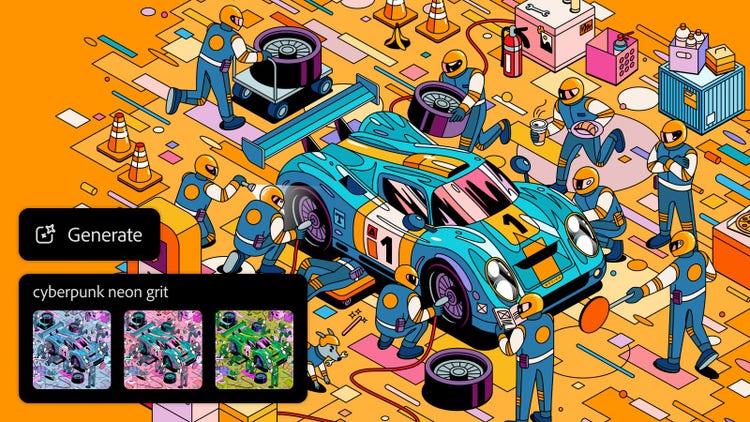
Generative Recolor in Illustrator
Our Approach.
Adobe Firefly models are trained on a dataset of licensed content, such as Adobe Stock, and public domain content where copyright has expired. Adobe Stock content is covered under a separate license agreement, and Adobe compensates contributors for the use of that content.
We do not train and have never trained Adobe Firefly on user content.
We recently updated our General Terms of Use to explicitly spell out this commitment (Sections 2.2F and 4.3C2).
Adobe Firefly models are trained on a dataset of licensed content, such as Adobe Stock, and public domain content where copyright has expired. Adobe Stock content is covered under a separate license agreement, and Adobe compensates contributors for the use of that content.
We do not mine the web or video hosting sites for content. We only train on content where we have rights or permission to do so.
Adobe Firefly models are trained on a dataset of licensed content, such as Adobe Stock, and public domain content where copyright has expired. Adobe Stock content is covered under a separate license agreement, and Adobe compensates contributors for the use of the content.
You can find more information here.
Many other companies train their generative AI models on content that is collected from the web without permission (often referred to as “publicly available online data”). We do not believe this is fair toward creators, and this is not our approach.
We only train Adobe Firefly models on a dataset of public domain content where copyright has expired and licensed content, such as Adobe Stock, where Adobe compensates contributors for the use of that content.
Adobe focuses on training its models in a way that is responsible and respects the rights of creators. We deploy safeguards at each step (prior to training, during generation, at prompt, and during output) to ensure Adobe Firefly models do not create content that infringes copyright or intellectual property rights and that it is safe to use for commercial and educational work.
In addition, Adobe provides intellectual property indemnification for enterprise customers for content generated with Adobe Firefly.
You own your content. Adobe makes no claims, and never has, to owning your content, regardless of how it was created.
While this has always been our policy, we recently updated our General Terms of Use to make this clearer (Section 4.2).
Adobe makes no claims of copyright or ownership over content you create with Adobe Firefly.
Adobe is a founding member of the Content Authenticity Initiative, which currently has over 5000 members signed on and aims to provide transparency on how content was generated and on who created it.
Platform providers can display credentials showcasing provenance. Meta and LinkedIn are the two most recent sites to display Content Credentials.
You can find more information on the Content Authenticity Initiative here.
Adobe has taken and continues to pursue avenues for defending and protecting creator rights, including through proposing the FAIR (Federal Anti- Impersonation Right) Act, which aims to help protect artists from the harmful and unfair use of generative AI that replicates their style and work.
Adobe has prohibitions in its terms of use and has taken steps for its sites, such as Behance, that publicly host creators’ content, to restrict and prevent third parties from scraping customer content to train generative AI models.
We have reinforced these approaches through a number of policy changes and updates:
Our terms of use reflect the approaches above and make it clear that we do not train Adobe Firefly on your content and make no claims of ownership to your content.
We have overhauled our moderation policies on Adobe Stock, and made it easier to report content that violates the Adobe Stock contributor guidelines, particularly content that references and/or replicates other artists’ names and styles without their permission.
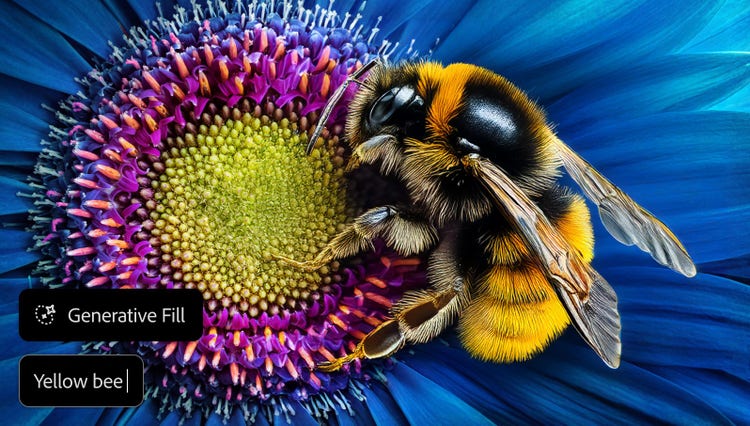
Generative AI within our Creative Applications.
For our creative applications, our primary focus is to provide unparalleled creative control to empower the creativity of our customers. We prioritize improving quality and performance, adding the most requested features from the community, and incorporating generative AI when it can complement and improve workflows (with features like Generative Fill in Photoshop, Generative Remove in Lightroom, and Generative Recolor in Illustrator).
We also understand that the community has a wide range of opinions and needs around generative AI, may choose not to use generative AI features, or may want to use models other than Adobe Firefly. Our approach to generative AI within our applications is to let the individual choose how and whether they use it within our applications.
Partner Models
We often receive community requests for greater flexibility and more options for models in our applications, particularly for idea generation. We may offer the choice to use features that leverage generative AI models from partners within our apps. When we do, our implementations will be guided by the following principles:
We will provide information so you can know when partner models may be used. This may include UI elements and other indicators, information on our website, and Content Credentials that indicate content is created with partner models.
User data and content within our applications are not, and will not be, used to train generative AI models—whether those models are from Adobe or its partners. This is explicitly stated in our agreements with partner companies providing access to partner models, as well as in our Terms of Use:
We will provide access to information about the partner models that may be enabled in Adobe apps. However, it is the creator’s responsibility to determine whether a partner model is suitable for their specific projects.
