




JUMP TO SECTION
Most Creatives are undecided about AI
Creatives are optimistic about their futures, even as AI evolves
There is an age-based AI enthusiasm gap
AI adoption is concentrated in specific parts of the creative process
Excitement about AI peaks among those with 6-9 years' experience
Creatives are concerned about IP and consent
Key findings at a glance
- The nearly 2,000 Creative Professionals and other Creatives surveyed across the US, UK, and Japan cluster into four groups with distinct AI adoption profiles — these range from enthusiastic adopters to experienced pros who remain skeptical.
- Creatives are still optimistic about their careers, even while feeling uncertain about AI’s role within them, with 18- to 24-year-olds being the least excited compared to Monetizing Creatives who monetize their work and mid-career professionals who show the most excitement.
- Brainstorming and ideation are where creatives are integrating AI most — but they are also the areas where creatives believe the technology is expanding access and enabling people without traditional training to participate more easily.
- Altogether, the data reveals concerns around trust and ethics, and a creative community that is engaging with AI, but still sorting through questions about its place in their lives.
Most Creatives are undecided about AI
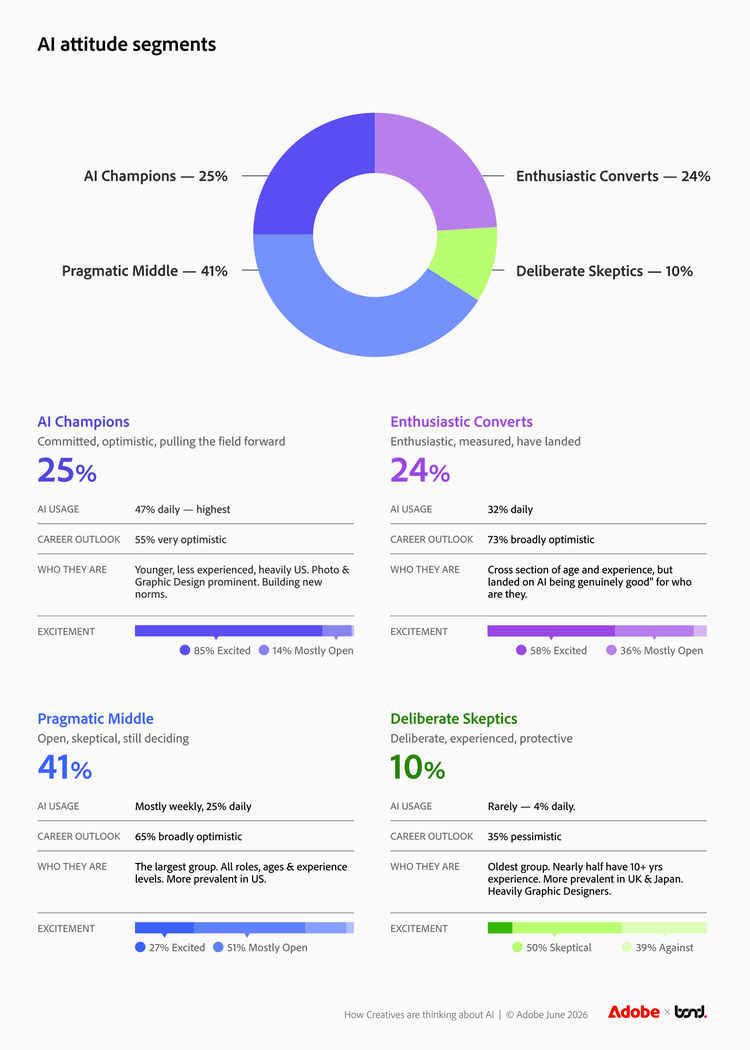
One of the clearest themes in the data is that there is no single creative response to AI. Some people are already using it every day and seeing real value in it. Others remain skeptical. The largest group sits somewhere in between.
Overall, 86% of creatives say AI has been positive for their work, and 38% already use it daily. But those numbers don't tell the full story. When we segmented creatives by their attitudes toward AI, the largest group (41%) landed in what we call the "Pragmatic Middle" — open to AI but not fully convinced. Positive sentiment and full conviction aren't the same thing. Much of the creative world is still working out exactly where AI fits in their process.
Creatives are optimistic about their future, even as AI evolves
Creative Professionals maintain a positive outlook when it comes to their careers, even as they continue to assess how AI fits into the creative process. Across the study, confidence in creative work consistently outpaced excitement about AI itself — suggesting that many creatives are approaching the technology with curiosity, caution, and active evaluation rather than outright resistance.
The gap is especially visible among Creative Professionals. While 84% say they feel optimistic about their careers, only 50% say they feel excited about AI. Another 30% describe themselves as open to AI, but not yet fully convinced. At the same time, many creatives also believe AI creates new opportunities within the industry, reflecting a community that is actively weighing both the potential and the tradeoffs of the technology.
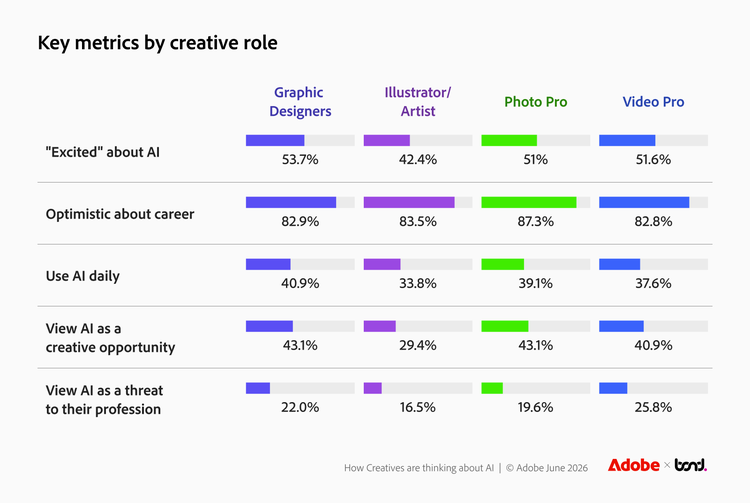
Rather than signalling fear of AI itself, the data points to a more nuanced dynamic: creatives are determining how these tools fit into workflows, standards, and forms of creative expression that already carry deep professional and personal meaning.
There is an age-based AI enthusiasm gap
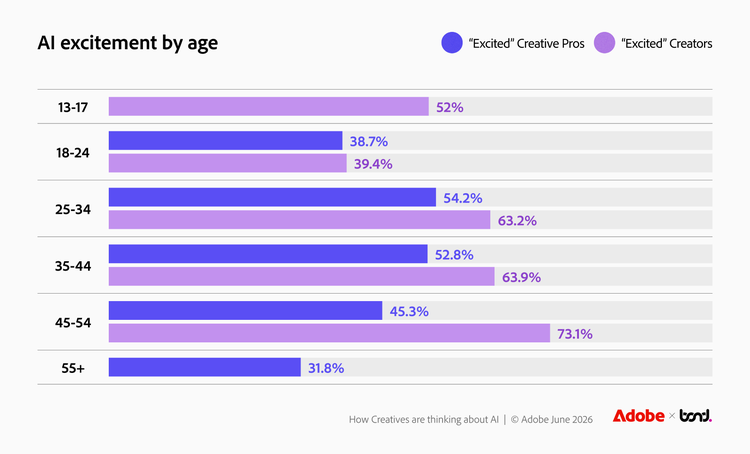
Contrary to traditional beliefs about digital-native workers, familiarity with technology doesn’t automatically translate into enthusiasm for AI. The findings show that 18- to 24-year-olds consistently report the lowest levels of AI excitement across both Creative Professionals and Creators. In the US, only 39% of Creative Professionals aged 18 to 24 say they are excited about AI, compared with 54% of those aged 25 to 34. Among Creators, the pattern is just as striking: only 39% of 18- to 24-year-olds are excited, compared with 63% of those aged 25 to 34 and 73% of those 45 and over. Meanwhile, enthusiasm and daily AI use peak among creatives with more established workflows and professional experience.
AI adoption is concentrated in specific parts of the creative process
A common assumption about Creatives and AI could be that they'll accept it for routine tasks but resist it where the work is most creative or enjoyable — protecting the work that matters most to them professionally.
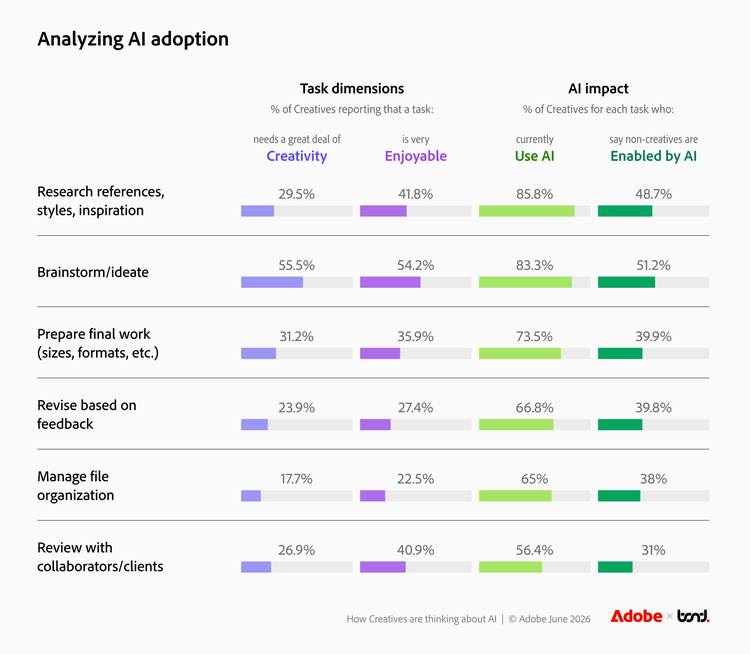
When we ranked creative tasks by AI adoption and compared against how those same tasks are rated on creativity and enjoyment, we found no such resistance. Tasks rated higher on creativity showed similar or higher AI adoption than lower rated tasks. A similar trend held for enjoyment, though the relationship was weaker.
Creatives are using AI most actively in areas where it already delivers clear practical value — especially during brainstorming, design, and research. However, tasks involving physical production, direct collaboration, or client interaction had lower AI adoption. Now, this doesn’t necessarily signal resistance. These tasks naturally present different practical constraints, and many creatives remain open to experimenting with AI more broadly as tools continue to evolve.
At the same time, the tasks with the highest AI adoption — brainstorming, research, ideation — also scored highest on AI-enabled skill democratization. These are the tasks where creatives most agree that AI allows people without professional training to produce comparable work.
Excitement about AI peaks among those with 6-9 years' experience
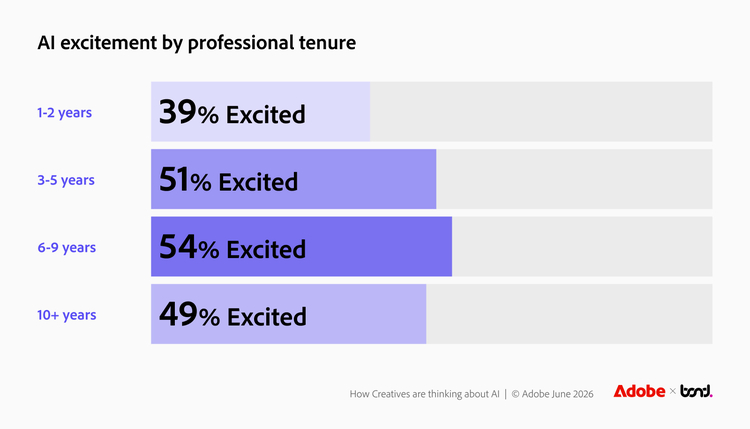
According to our data, enthusiasm about AI increases with professional tenure up until 10 years, where it begins to decrease. While the data does not explain why directly, it may point to an emerging pattern: creatives with greater professional stability and a more established workflow may feel more comfortable integrating AI into their process.
Enthusiasm is highest among creators who monetize their work and among professionals with 6 to 9 years of experience. In the US, 63% of monetizing creators say they are excited about AI. Among Creative Professionals with 6 to 9 years of experience, 54% say the same, and 47% say they use AI daily, the highest daily-use rate of any experience group. By contrast, among professionals with just 1 to 2 years of experience, only 39% are excited and only 18% use AI daily.
For a portion of Creatives with experience, market validation, or a clearer sense of their creative identity, AI may be viewed as less of a threat to originality and more as a tool for acceleration, exploration, and scale.
Creatives are concerned about IP and consent
Still, creative professionals are not evaluating AI on capability alone. Across the study, concerns around ownership, consent, and training data remained consistently high across audiences and creative disciplines.
Importantly, these concerns are not limited to people resisting AI. Even among more pragmatic or active AI users, a strong majority believe AI models should not be trained on artists’ work without consent.
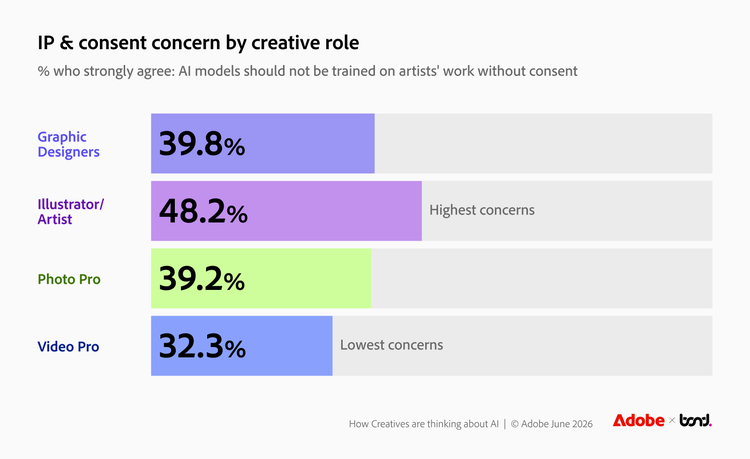
The findings suggest that creatives are not simply asking whether AI can improve the work — they are also asking how the technology is built, whose work it relies on, and whether creative labor is being respected in the process. If AI is going to play a lasting role in creative work, trust cannot be treated as an afterthought.
Taken together, the research points to a creative community that is thoughtful, engaged, and still actively shaping what AI’s role in creative work should become.
AI brings with it clear opportunity
Creatives are craving assistance that goes beyond helping people move faster. They want support in the parts of the process where ideas form, craft develops, and ownership still matters deeply, from tools that are designed with respect for how creativity works. The question remains not whether AI has arrived, but how creative people are choosing to work with it, question it, and shape it into something that serves the future of creative expression.
Who we asked
We collected survey responses from nearly 2,000 Creative Professionals (in roles like graphic design, illustration, photography, and video) and other Creatives in the US, the UK, and Japan.
About this research
This report was developed in partnership between Adobe and Bond Brand Loyalty, combining Adobe’s deep understanding of the creative ecosystem with Bond’s expertise in customer intelligence and engagement. Fieldwork was conducted by The Directions Group, using a survey designed by Bazile Lanneau and Nick Brown (Adobe Design Research & Strategy).
