What is the interleaving study method?
An effective study technique, interleaving involves mixing different topics or problem types in one session to improve retention, sharpen problem-solving, and strengthen knowledge transfer.

What is the interleaving study method?
The interleaving study method is a learning technique where you alternate between different topics, concepts, or problem types within a single study session rather than focusing on one subject until you've mastered it completely. The interleaving definition centers on this deliberate mixing of material to create what cognitive scientists call "desirable difficulty" — a productive challenge that strengthens memory and understanding.
So what is interleaving in practical terms? Imagine you're studying mathematics. Instead of completing twenty algebra problems, then twenty geometry problems, then twenty statistics problems, you would mix all three types throughout your study session. You might solve two algebra equations, then a geometry proof, then a statistics calculation, and continue rotating through the subjects.
This approach works because it forces your brain to continually retrieve different strategies and concepts from memory. Each time you switch topics, you must recall the relevant rules, formulas, and procedures for that subject. This repeated retrieval strengthens neural pathways and makes the information more accessible during exams and real-world applications.
Interleaving stands among proven study methods that cognitive psychology research has validated over decades of investigation. Studies consistently show that students who use interleaving outperform those who use traditional blocked practice on delayed tests, even though interleaved learning often feels more challenging in the moment.
The technique enhances discrimination — your ability to identify what type of problem you're facing and select the appropriate strategy. When you practice only one type of problem at a time, you don't develop this crucial skill because the solution method is obvious. Interleaving forces you to analyze each problem independently.
Interleaving proves particularly effective across several domains. In subjects like math, physics, and chemistry, mixing problem types helps you recognize which formulas and concepts apply to different situations. Language learners benefit from alternating between vocabulary, grammar, and conversation practice. Musicians improve faster by switching between different pieces or techniques rather than drilling one passage repeatedly. Athletes develop more adaptable skills by practicing varied movements in mixed sequences.
The ability to memorize information quickly improves significantly with interleaving because the technique engages deeper cognitive processing. Rather than relying on short-term memory to solve similar problems in sequence, you must genuinely understand and retrieve concepts each time you encounter them.
Benefits of the interleaving technique
The benefits of interleaving extend far beyond simple memorization. This technique fundamentally changes how your brain processes and stores information, leading to more durable and flexible learning outcomes. The purpose of interleaving is to create learning conditions that mirror real-world challenges, where you must identify problems and select appropriate solutions without knowing in advance what type of situation you'll encounter.
When you study using interleaving, your brain works harder to distinguish between concepts and retrieve the right information at the right time. This increased cognitive effort translates directly into stronger memory formation and better understanding. While the learning process may feel slower initially, the long-term payoff is substantial.

Key benefits of the interleaving technique include:
- Improved problem-solving skills. By constantly switching between different types of problems, you develop the ability to analyze situations and select appropriate strategies. This mirrors how challenges appear in exams and professional settings, where problems don't come pre-labeled with their solution methods.
- Enhanced long-term retention. Information learned through interleaving stays accessible longer because it's encoded more deeply in memory. The effort required to retrieve different concepts repeatedly strengthens the neural connections associated with that knowledge.
- Better transfer of knowledge to new situations. Interleaving helps you understand underlying principles rather than just surface procedures. This deeper understanding allows you to apply what you've learned to novel problems you've never encountered before.
- Stronger discrimination between concepts. When you study similar topics in mixed sequences, you become better at identifying the subtle differences between them. This skill is essential for avoiding confusion during high-pressure situations like exams.
- Reduced illusion of competence. Blocked practice can create a false sense of mastery because repetition makes problems feel easy. Interleaving provides more accurate feedback about your true understanding by testing your ability to identify and solve varied problems.
- More flexible thinking patterns. Regularly switching between different cognitive demands builds mental agility. You become more comfortable with uncertainty and better at adapting your approach based on the specific challenge you face.
Modern technology can amplify these benefits significantly. When you chat with your study materials using artificial intelligence (AI) tools, you can quickly generate varied practice problems across different topics, making it easier to implement interleaved study sessions. AI assistants can help you identify connections between subjects and create customized question sets that mix concepts in productive ways.
The research supporting interleaving is robust. Multiple studies have demonstrated that students who use interleaving score significantly higher on tests administered days or weeks after studying, even when they perform worse on immediate assessments. This pattern reflects the difference between performance during learning and actual long-term retention.
How to implement interleaving study method
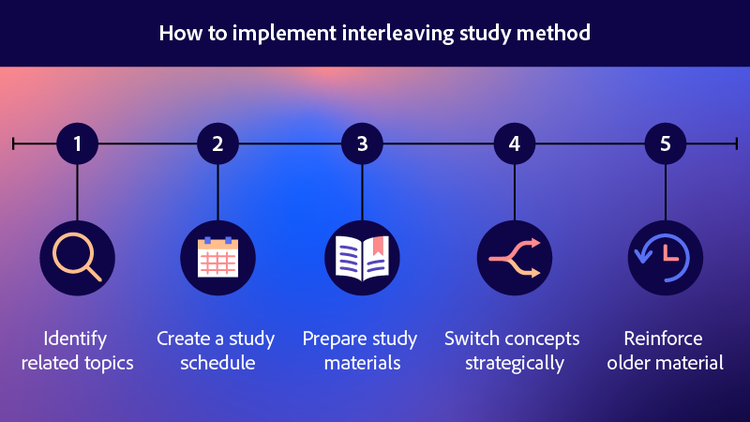
1. Identify related topics to mix
Start by selecting two to four subjects that share some conceptual overlap or that you need to learn simultaneously. Complete beginners may want to start with just two topics and gradually add more as they become comfortable with the switching process.
For mathematics, you might mix algebra, geometry, and statistics within the same study session. A language learner could alternate between vocabulary acquisition, grammar exercises, and reading comprehension. Science students might combine chemistry, physics, and biology concepts that relate to similar underlying principles.
The key is choosing subjects that are different enough to require distinct mental strategies but related enough that switching between them makes logical sense. Mixing completely unrelated topics like calculus and art history provides less benefit than combining subjects within the same general domain.
2. Create a study schedule
Structure your study sessions to include dedicated time for each topic you're interleaving. A typical two-hour session might include four thirty-minute blocks, with each block focusing on a different subject before rotating back to the first.
Alternatively, you can organize by problem count rather than time. Complete five problems from one topic, then five from another, continuing to rotate throughout your session. This approach works particularly well for subjects with clearly defined practice problems.
Balance your time across topics based on their difficulty and your current proficiency. You might spend slightly more time on challenging subjects while still maintaining the interleaved structure.
3. Prepare your study materials
Organization is crucial for effective interleaving. Before each session, gather all the resources you'll need for every topic you plan to study. Having materials ready eliminates transition time and keeps your momentum strong.
Consider ways to convert documents to PDF format so all your study materials are accessible in one place and easy to navigate. Digital organization makes switching between topics seamless and reduces the friction that might otherwise discourage interleaved practice.
You can turn your notes into flashcards organized by topic, then shuffle them together for interleaved review sessions. This approach is particularly effective for memorization-heavy subjects like vocabulary, terminology, or factual content.
4. Switch between concepts strategically
The timing of your switches matters. Switching too quickly — every minute or two — doesn't allow enough time for meaningful engagement with each topic. Switching too slowly — every hour or more — reduces the interleaving benefit and starts to resemble blocked practice.
Most research suggests that fifteen to thirty-minute blocks work well for most subjects and learners. However, you may need to adjust based on the complexity of your material and your personal learning style. Some students find that switching after completing a natural unit of work, like finishing a problem set or reading a chapter section, feels more organic than strict time-based switching.
When you switch topics, take a moment to mentally transition. Acknowledge that you're moving to a different subject and briefly recall what you know about it before diving in. This conscious transition strengthens the retrieval practice benefit of interleaving.
5. Review and reinforce older material
Effective interleaving incorporates spaced review of previously studied material. As you rotate through topics, periodically return to concepts you learned in earlier sessions or weeks. This combination of interleaving and spacing creates particularly powerful learning conditions.
Keep a log of what you've covered and when, so you can systematically revisit material at optimal intervals. Many students find that reviewing older content at the beginning of each study session, before moving to new material, helps maintain long-term retention.
Implementing the interleaving study method requires some initial planning, but the process becomes natural with practice. Many students find that the first few interleaved sessions feel awkward or frustrating — this is completely normal and actually indicates that the technique is working. The challenge you experience reflects the desirable difficulty that leads to stronger learning.
Here's how to do interleaving effectively, broken down into manageable steps.
Tips for successful interleaving:
- Don't switch too quickly between topics. Allow at least fifteen to thirty minutes with each subject to engage meaningfully before transitioning.
- Keep a study log to track what you've covered across sessions. This helps ensure balanced attention to all topics and identifies areas needing additional focus.
- Expect initial difficulty and embrace it. The struggle you experience during interleaved study is a sign of effective learning, not a problem to avoid.
- Use technology to streamline material organization. An AI-powered flashcard maker can help you create mixed practice sets quickly, while tools designed for students can keep all your resources organized and accessible.
Start gradually if interleaving feels overwhelming. Begin with two topics and add more as you become comfortable with the switching process.
Interleaving vs. blocked practice
Understanding the difference between interleaving and blocked practice helps you make informed decisions about when to use each approach. Blocked practice is the traditional study method most students default to — focusing intensively on one topic until it feels mastered, then moving to the next subject.
With blocked practice, you might spend Monday studying chapter one, Tuesday on chapter two, and Wednesday on chapter three. Or you might complete all the algebra problems in your homework before starting the geometry section. This approach feels intuitive and produces rapid improvement during the practice session itself.
The learning curves for these two approaches differ dramatically. Blocked practice produces faster initial performance gains. When you repeat the same type of problem over and over, you quickly become efficient at solving it. This creates a satisfying sense of progress and mastery.
Interleaving, by contrast, feels slower and more frustrating during practice. Because you're constantly switching between different problem types, you never develop the smooth, automatic performance that blocked practice provides. Many students mistakenly interpret this difficulty as evidence that interleaving isn't working.
However, long-term retention outcomes tell a different story. When tested days or weeks later, students who used interleaving consistently outperform those who used blocked practice. The extra effort required during interleaved study creates stronger, more durable memories that remain accessible over time.
Consider this example of interleaving learning. A tennis player using blocked practice might hit fifty forehands, then fifty backhands, then fifty volleys. A player using interleaving would mix these shots randomly throughout practice. The blocked practice player will look more polished during training, but the interleaved practice player will perform better in actual matches where shot selection is unpredictable.
Interleaving works best when combined with other evidence-based study techniques. Pairing interleaving with active recall — testing yourself rather than passively reviewing — amplifies the benefits of both approaches. The combination forces you to retrieve different types of information repeatedly, creating optimal conditions for long-term retention.
Similarly, time-blocking techniques can provide structure for interleaved sessions. Using timed intervals helps you switch between topics at appropriate intervals and maintains focus throughout longer study sessions.
There are situations where blocked practice remains appropriate. Complete beginners learning foundational concepts may benefit from focused practice before introducing interleaving. When you're first learning the basic rules of algebra, for instance, some concentrated practice helps establish the fundamental procedures. Once you have a basic grasp of multiple topics, transitioning to interleaved practice maximizes your learning.
The most effective learners often use a hybrid approach. They begin with brief blocked practice to establish foundational understanding of new concepts, then quickly transition to interleaving as they develop competence. This strategy captures the benefits of both approaches while minimizing their limitations.
Frequently asked questions
Is interleaving effective for all subjects?
How long should I study each topic before switching?
Why does interleaving feel harder than blocked practice?
Can I use interleaving for test preparation?
What if I'm completely new to a subject?
How do I track my progress with interleaving?
You may also like