How to use the Zettelkasten method of note-taking
The Zettelkasten method is a powerful knowledge management system for students and professionals who want to capture ideas, connect related insights, and build a durable, evolving network of understanding.

How to use the Zettelkasten method of note-taking
Originally developed by German sociologist Niklas Luhmann, the Zettelkasten approach to note-taking creates a personal knowledge network where individual ideas link together to form a growing web of interconnected insights. Whether you’re a student tackling complex subjects or a professional managing research projects, this approach helps you build lasting understanding by linking individual ideas into a growing network of knowledge.
- The Zettelkasten method is a note-taking system where each idea is written on its own individual note and stored in a single location while related ideas are connected through shared tags and direct links.
- This approach builds a personal knowledge network that grows more valuable over time as you add notes and discover new connections between concepts.
- Key principles include writing atomic notes (one idea per note), linking related concepts together, and allowing your knowledge base to develop organically through consistent use.
What is the Zettelkasten method
The Zettelkasten method originated in Germany, where the term translates to “slip box” or “card box.” German sociologist Niklas Luhmann popularized this system during the twentieth century, using it to produce an extraordinary body of work—over 70 books and 400 scholarly articles across diverse fields. His secret was a physical collection of roughly 90,000 index cards, each containing a single idea and linked to related notes through a unique numbering system.
At its core, the Zettelkasten system operates on three fundamental principles that distinguish it from traditional note-taking methods.
The first principle is atomic notes. Each note captures exactly one idea, concept, or insight. This constraint forces clarity and makes individual notes more versatile since they can connect to multiple contexts without becoming unwieldy.
The second principle involves linking ideas together. Rather than organizing notes into rigid folders or categories, the Zettelkasten method emphasizes connections between notes. When you create a new note, you identify existing notes that relate to it and establish explicit links between them.
The third principle focuses on building a knowledge network over time. Your Zettelkasten grows organically as you add notes and discover new connections. Unlike static notebooks that sit on shelves, this living system becomes increasingly valuable as it expands.
So, what is Zettelkasten used for? This method serves multiple purposes across academic and professional contexts. Researchers use it to synthesize sources and develop original arguments. Students employ it for long-term learning and exam preparation. Writers rely on it to generate and organize ideas for creative projects. Knowledge workers use it to manage information across complex projects and domains.
The method has experienced renewed popularity in the digital age for good reason. While Luhmann worked with physical cards, modern tools make linking, searching, and maintaining a Zettelkasten far more practical. Digital implementation removes many barriers that made the paper-based system challenging, opening this powerful approach to anyone willing to learn it. Students looking to enhance their study routines can explore study schedule templates to complement their Zettelkasten practice with structured time management.
Limitations of the Zettelkasten note-taking method
While the Zettelkasten method offers significant advantages for knowledge management, it presents real challenges that you should consider before committing to this approach.
The most commonly cited disadvantages of Zettelkasten include:
- Steep learning curve for beginners. Understanding atomic notes, linking conventions, and retrieval strategies takes time. Many people abandon the method before experiencing its benefits simply because the initial investment feels overwhelming.
- Significant time investment upfront. Creating well-crafted atomic notes requires more effort than quickly jotting down information. You must process, distill, and connect ideas rather than passively recording them.
- Requires consistent maintenance and review. A Zettelkasten only works if you regularly engage with it. Neglected systems quickly become cluttered graveyards of disconnected notes.
- Can become overwhelming without proper organization. As your collection grows into hundreds or thousands of notes, finding information depends entirely on your linking and tagging practices. Poor organization compounds over time.
- May feel fragmented compared to linear note-taking. Some learners prefer seeing information in sequential, hierarchical structures. The distributed nature of Zettelkasten can feel disorienting initially.
- Difficult to implement effectively with paper-only systems. While Luhmann managed with physical cards, most people find that searching, linking, and reorganizing paper notes becomes impractical at scale.
- Potential for over-engineering. Some practitioners spend more time perfecting their system than actually using it, falling into a trap of endless optimization rather than knowledge building.
Understanding these limitations helps you approach the method with realistic expectations. Digital tools and strategies to organize study notes effectively can help overcome many of these challenges, making the Zettelkasten more accessible than ever. Adobe Acrobat AI Assistant features like Summarize can help you quickly distill lengthy documents into manageable insights for your atomic notes.
How to create an effective Zettelkasten system
Building a sustainable Zettelkasten practice requires understanding not just the philosophy behind the method but also the practical steps for implementation. Following a structured approach helps you establish habits that make your knowledge network genuinely useful rather than another abandoned productivity experiment.
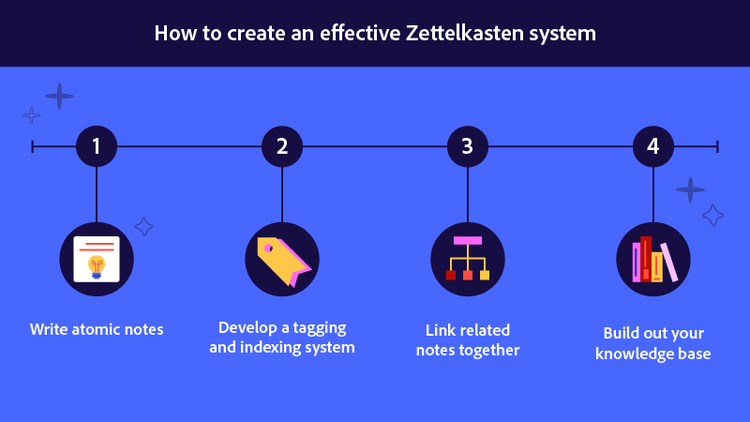
Step 1: Write atomic notes (one idea per note)
The atomic note principle forms the foundation of every effective Zettelkasten. Each note should contain exactly one idea, expressed clearly enough that you could understand it months or years later without additional context.
Limiting each note to a single concept improves retrieval dramatically. When ideas are bundled together, you can only find them by remembering which bundle contains what you need. Atomic notes surface individually through searches and links, making relevant information accessible from multiple pathways.
Writing atomic notes from longer sources requires active processing. Rather than copying paragraphs verbatim, you extract key insights and express them in your own words. This transformation deepens understanding and creates notes that integrate naturally with your existing knowledge. When working with lengthy documents, you can chat with PDFs to identify key concepts and ask questions about complex passages. Adobe Acrobat AI Assistant helps you summarize dense academic papers or research documents, extracting the core ideas that become your atomic notes.
Each atomic note should include a clear title that captures the essence of the idea, the main content written in your own words, and potential links to related concepts. This structure ensures consistency across your growing knowledge base.
Step 2: Develop a tagging and indexing system
Tags and indexes serve as entry points into your Zettelkasten. While links connect individual notes, tags group notes around themes, projects, or concepts that might not share direct relationships.
Creating meaningful tags requires balance. Too few tags make them useless for filtering. Too many create noise that obscures genuine patterns. Start with broad categories and refine them as your system grows and your needs become clearer.
Building an index—a dedicated note that serves as a table of contents for major topics—provides structure without imposing rigid hierarchy. Your index evolves alongside your knowledge base, reflecting the themes that matter most to your work. PDF AI tools can help identify recurring themes across your source materials, suggesting tags and categories you might otherwise miss.
Use consistent naming conventions from the start. Whether you prefer dates, sequential numbers, or descriptive titles, consistency makes your system predictable and searchable. Many practitioners use a combination approach—a unique identifier plus a descriptive title—that supports both systematic organization and intuitive browsing.
You can use a text paraphraser to help you restate complex ideas in different ways, which can clarify your understanding and reveal new angles for tagging and categorization.
Step 3: Link related notes together
Links transform a collection of notes into a genuine knowledge network. The connections between ideas often prove more valuable than the individual notes themselves, revealing patterns and relationships that linear note-taking obscures.
How is Zettelkasten different from mind mapping in this regard? While mind maps show relationships radiating from a central concept, Zettelkasten links create a web without a single center. Any note can connect to any other, allowing ideas to participate in multiple contexts simultaneously.
Identifying relationships between notes requires asking questions as you write. What existing notes does this new idea support, contradict, or extend? Where might this concept apply beyond its original context? Which notes would benefit from referencing this one?
Creating bidirectional links strengthens navigation. When Note A links to Note B, Note B should also reference Note A. This practice ensures you can traverse your knowledge network in any direction, discovering connections regardless of where you enter. Organizing related documents in AI-driven PDF Spaces can help you identify connections between source materials that inform your note linking strategy. This feature allows you to group related PDFs together and use AI to find common themes and relationships across documents.
Step 4: Build out your knowledge base over time
A Zettelkasten grows through consistent, incremental additions rather than intensive bursts of activity. Adding a few well-crafted notes daily produces better results than sporadic marathon sessions.
Reviewing and refining existing notes matters as much as creating new ones. As your understanding deepens, earlier notes may need updating, expanding, or connecting to ideas you had not yet encountered. This maintenance keeps your system alive and relevant.
Allow the system to grow organically rather than forcing predetermined structures. Your Zettelkasten should reflect your actual interests and needs, not an idealized vision of what you think you should know. Trust that meaningful patterns will emerge through sustained engagement.
Consider setting a regular rhythm for adding notes—perhaps reviewing one source document daily and extracting three to five atomic notes. This sustainable pace builds momentum without creating burnout.
Tips and advice for Zettelkasten success
Practical tips help you maximize the value of your Zettelkasten system and avoid common pitfalls that derail beginners.
- Add visuals and diagrams to enhance understanding. Complex relationships often become clearer through visual representation. A PDF editor allows you to annotate documents and incorporate visual elements into your notes.
- Browse your notes regularly to strengthen connections. Scheduled review sessions help you rediscover forgotten ideas and identify new linking opportunities. Set aside time weekly to wander through your Zettelkasten without a specific goal.
- Write notes in your own words, not direct quotes. Paraphrasing forces deeper processing and creates notes that integrate naturally with your thinking.
- Date your notes for context and tracking growth. Timestamps help you understand how your thinking has evolved and when specific insights emerged.
- Start small and expand gradually. Beginning with a manageable scope prevents overwhelm and builds sustainable habits. Focus on one project or topic area initially.
- Use digital tools to search and link efficiently. Modern software removes friction that made paper-based Zettelkasten challenging to maintain.
- Review and update older notes with new insights. Your Zettelkasten should evolve as your understanding deepens, not remain frozen at the moment of creation.
- Create fleeting notes before permanent notes. Capture quick ideas throughout the day, then process them into proper atomic notes during dedicated sessions.
- Trust the process during the early stages. The compound benefits of Zettelkasten take time to manifest. Consistency matters more than perfection.
Zettelkasten vs. other popular note-taking methods
Different note-taking methods serve different purposes and learning styles. Understanding how Zettelkasten compares to alternatives helps you choose the right approach—or combine methods strategically.
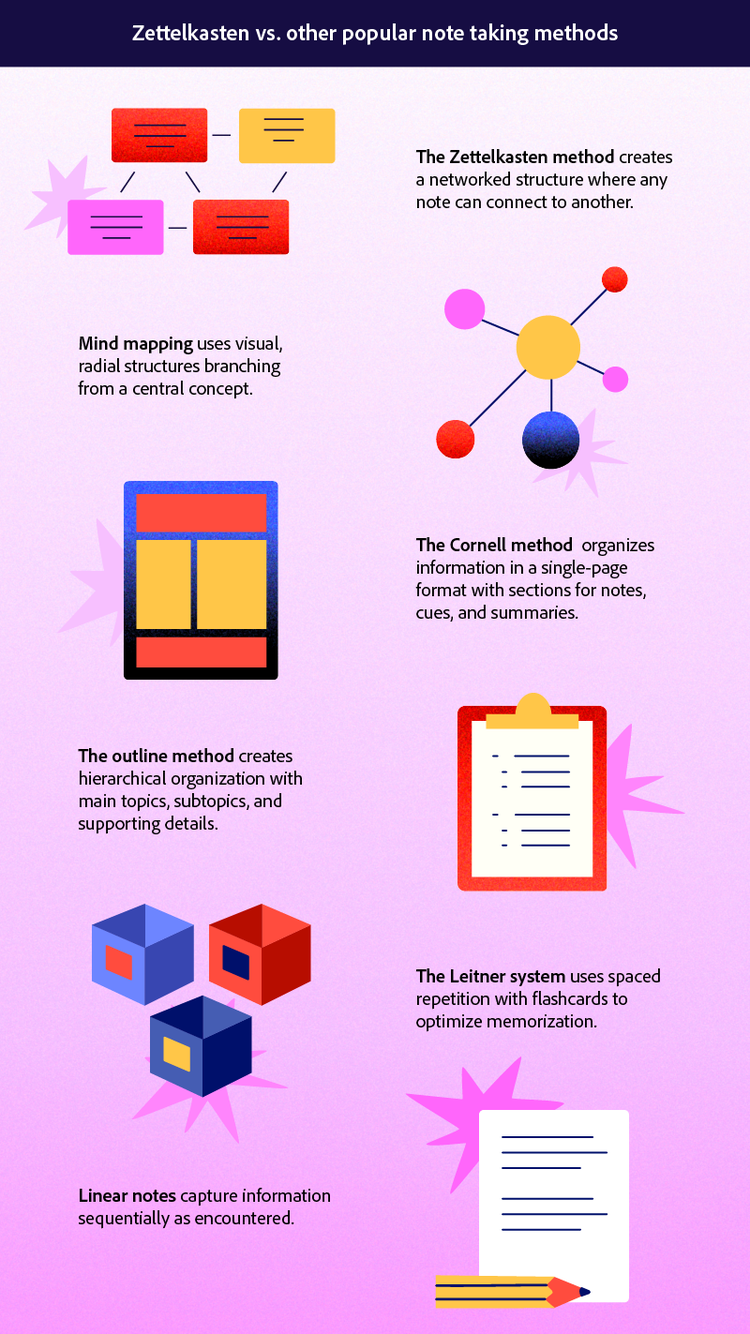
- Mind mapping vs. Zettelkasten: Mind maps use visual, radial structures radiating from a central concept. They excel at brainstorming and showing hierarchical relationships within a single topic. Zettelkasten creates a networked structure where any note can connect to any other, better suited for building knowledge across multiple domains over extended periods. Mind mapping works best for quick visualization of a single topic, while Zettelkasten builds deep understanding over time.
- Cornell method vs. Zettelkasten: The Cornell method organizes information within a structured single-page format with sections for notes, cues, and summaries. It works well for lecture capture and immediate review. Zettelkasten distributes ideas across many notes, sacrificing the contained structure for greater flexibility and long-term knowledge building. Students might use Cornell for initial lecture capture, then extract atomic notes into their Zettelkasten for long-term retention.
- Outline method vs. Zettelkasten: Outlining creates hierarchical organization with main topics, subtopics, and supporting details. This linear approach suits structured content and sequential learning. Zettelkasten’s non-linear connections allow ideas to participate in multiple contexts simultaneously, revealing relationships that hierarchies obscure. The outline method excels for capturing structured presentations, while Zettelkasten better supports creative synthesis.
- Leitner system vs. Zettelkasten: The Leitner system uses spaced repetition with flashcards to optimize memorization. It excels at committing facts to memory for exams or language learning. Zettelkasten focuses on understanding and knowledge building rather than pure recall, making it better suited for research and creative work. These methods can complement each other—use Zettelkasten for deep understanding and Leitner for memorizing specific facts.
- Linear notes vs. Zettelkasten: Traditional linear notes capture information sequentially as encountered. They require minimal setup and feel familiar. Zettelkasten’s atomic, linked approach requires more initial effort but produces a knowledge base that grows more useful over time rather than becoming harder to search.
Frequently asked questions
What is the best app for Zettelkasten?
What is Zettelkasten used for?
What are the disadvantages of Zettelkasten?
How is Zettelkasten different from mind mapping?
Can I use Zettelkasten for work projects?
How many notes should a Zettelkasten have?
Do I need special software to start a Zettelkasten?
How long does it take to see benefits from Zettelkasten?
You may also like