Adobe Acrobat
10 best study methods and how to use them
Studying is an essential part of learning, but the approach you take can make all the difference in your productivity, focus, and overall success.
Adobe Acrobat
Studying is an essential part of learning, but the approach you take can make all the difference in your productivity, focus, and overall success.

Study methods are structured techniques designed to optimize learning outcomes, catering to various learning styles such as visual, auditory, and kinesthetic. Finding the right strategy can transform the way you retain information and apply it effectively.
With so many study techniques available, students often face the challenge of selecting the one that works best for them. From mnemonic devices to retrieval practices, the sheer diversity can feel overwhelming.
For example, while one learner may thrive using mind maps, another may find success with active recall. Here’s a brief overview of study method types or categories:

The Feynman technique is a powerful strategy that involves simplifying complex concepts by teaching them to others. Named after physicist Richard Feynman, this method requires breaking down topics into simple language, identifying gaps in understanding, and refining your explanations.
This approach promotes deeper understanding and retention by forcing you to articulate ideas clearly. It’s particularly useful for mastering complex subjects, as it highlights areas where further study is needed.
The Leitner system is a flashcard-based method that employs spaced repetition to optimize learning. Flashcards are organized into boxes based on how well you know the material, with frequent reviews of cards in lower-confidence boxes. This study method is very commonly used for efficient memorization.
This system excels at improving long-term retention and is ideal for subjects requiring heavy memorization, such as vocabulary or historical dates. Learn how to turn notes into flashcards for even greater efficiency.
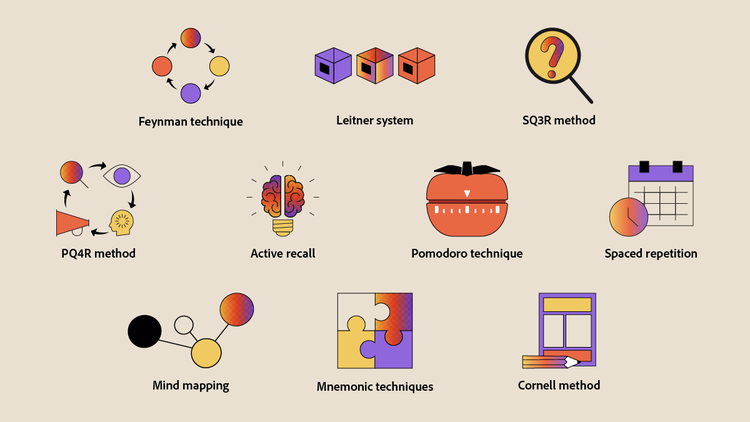
The SQ3R method—Survey, Question, Read, Recite, Review—is designed for comprehensive reading and understanding. It encourages active engagement with the material by breaking it down into manageable steps:
By dissecting complex topics into smaller parts, SQ3R improves comprehension and recall. It’s particularly helpful for studying dense texts. Find additional tips on how to study for a test using this method.
The PQ4R method—Preview, Question, Read, Reflect, Recite, Review—focuses on critical thinking and retention. This systematic approach ensures that learners engage deeply with material rather than passively skimming:
By encouraging reflection and active engagement, PQ4R fosters critical thinking skills and helps with long-term memory retention. This technique, similar to the SQ3R study method, is commonly used to effectively study for tests.
Active recall is a retrieval-based learning method that involves testing yourself on material rather than passively reviewing it. This technique strengthens memory pathways and enhances understanding. The main steps involved in active recall study method are:
By actively engaging your brain to retrieve information, this method boosts retention and helps build connections between concepts. It’s ideal for mastering complex networks of ideas.
The Pomodoro study method divides work into 25-minute intervals, separated by short breaks. This time management strategy is perfect for maintaining focus and productivity during study sessions.
It prevents burnout and helps manage study time effectively, ensuring consistent progress. This method works well for students juggling multiple tasks, because the technique supports focus and productivity in several ways:
Spaced repetition involves revisiting material at strategically timed intervals to maximize retention. This technique is backed by cognitive science and is particularly effective for memorizing large volumes of information.
By spacing out study sessions, this method prevents forgetting and strengthens memory over time. It’s ideal for subjects requiring cumulative knowledge.
Mind mapping is a visual technique that organizes information into diagrams, connecting ideas and concepts in a structured format. It helps connect concepts effectively and it’s based on 5 main steps:
Perfect for visual learners, mind mapping promotes creativity and helps clarify relationships between topics.
Mnemonic techniques use memory aids like acronyms, rhymes, and associations to simplify complex information. The basic steps involved in these techniques are:
This approach makes information more memorable and is particularly useful for languages, formulas, or lists.
The Cornell method involves dividing your notes into sections for key points, summaries, and questions. This structured approach enhances understanding and retention.
By summarizing content, you engage actively with the material, making it easier to recall later.
Selecting the right study methods depends on your individual learning style, goals, and the type of material you’re studying. Here are some tips to help you choose the method or methods that are most effective for you:
Understanding and applying the right study techniques can transform your learning experience, helping you achieve better results with less stress. Whether you choose Active recall, the Cornell method, or the Pomodoro technique, tailoring your approach to your needs is key.