A guide to global illumination.
In this guide, we’ll explain what global illumination is and share several GI techniques for you to try.
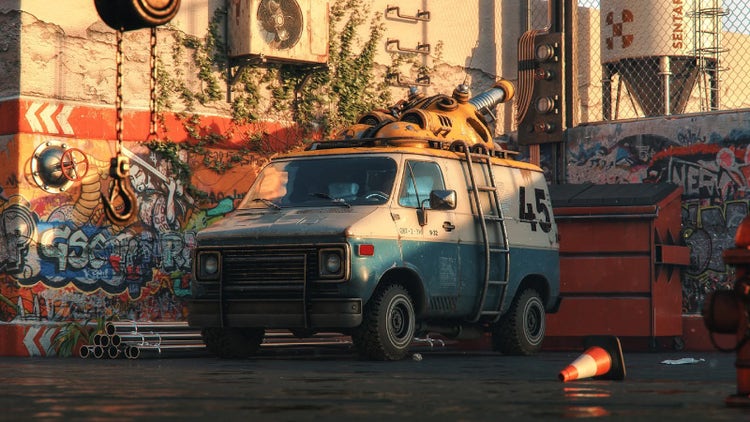
Understanding global illumination.
Global illumination is a feature that mimics how light interacts with surfaces in the real world in a virtual environment. Traditionally, game designers had to use direct lighting to illuminate objects from a direct source, which casts some shadows but doesn’t look very realistic.
With global illumination techniques, designers can use indirect lighting that scatters light when it hits a surface. This feature creates complex interactions that are far more intricate and realistic. It’s the reason why games using GI have more convincing environments that feel natural and immersive.
For example, global illumination can make a difference in the following scenarios:
- Bouncing light throughout a room from a window
- Dappling light through the tree leaves of a forest
- Reflecting light off the surface of a lake
Global illumination techniques.
There are many global illumination techniques you can use for rendering, such as:
- Radiosity. This technique divides surfaces into smaller areas. It diffuses light between these areas to create a softer gradient of light bouncing between objects in a scene.
- Photon mapping. This GI method shoots photons from a light source and stores them in a map as they move throughout the scene. It requires a lot of computing power but creates realistic reflections.
- Pre-computed GI. Pre-computed global illumination is calculated in advance and stored, usually as a lightmap. Designers lay it over a game’s texture during real-time rendering. It’s fast during gameplay but doesn’t handle moving objects well.
- Dynamic GI. Dynamic global illumination calculates light in real time, which makes it ideal for creating realistic environments with moving objects.
Global illumination vs. ray tracing.
Both global illumination and ray tracing help create realistic lighting. However, they’re not quite the same. They differ in terms of:
- Methodology. GI uses radiosity and photon mapping to diffuse light between surfaces. Alternatively, ray tracing shoots rays from a camera to see which light sources they hit.
- Performance. GI takes a lot of computing power, especially for real-time scenarios. That’s why most designers opt for precomputed GI. Ray tracing is also computationally expensive, so it’s more popular with CGI for film and TV.
Global illumination makes models more realistic by simulating indirect lighting. However, it isn’t always feasible for real-time games because it requires a lot of resources.
Ray tracing also makes realistic scenes by simulating reflections and soft shadows. Historically, it took a lot of resources to do ray tracing, although new innovations have made it possible to use it for real-time rendering.
These two techniques might sound similar, and that’s because they often overlap. Ray tracing typically is used to compute global illumination, so it’s likely that designers will see more tools combining GI and ray tracing in the future.
Global illumination in video game design.
Global illumination pushes the boundaries of what’s possible in video game design. It can be used to:
- Create realistic environments by adding direct and indirect light sources
- Make characters blend naturally into different environments by manipulating ambient lighting
- Generate dynamic light sources in real time
Modern games like The Witcher 3: Wild Hunt, Red Dead Redemption 2, and Uncharted 4 are great examples of using global illumination to create stunning virtual worlds. However, while global illumination can create lifelike video games, it requires a lot of computing resources, and not all hardware will support that.
Discover the power of light: simplifying global illumination with Adobe Substance 3D.
Global illumination brings virtual environments to life. It creates an ambiance that immediately immerses gamers in a story through clever indirect lighting.
While GI has its challenges, it’s a great tool for 3D and video game design. To see the difference firsthand, start using Adobe Substance 3D Stager to experiment with rendering global illumination in your own projects.
Frequently Asked Questions
IS RAY TRACING GLOBAL ILLUMINATION?
WHAT IS THE DIFFERENCE BETWEEN LOCAL ILLUMINATION AND GLOBAL ILLUMINATION?
WHAT ARE THE TYPES OF GLOBAL ILLUMINATION?
There are several ways to achieve global illumination, including:
● Radiosity
● Photon mapping
● Pre-computed
● Dynamics