Whether your goal is capturing live-action photography courtside or entering the editorial side of shooting sports, learning more about this field can help you take the next step on your career path.
Be passionate about a sport. You don’t have to be the best, but you have to understand it and love it.
Be passionate about photography. Practice shooting in all kinds of conditions and learn what camera settings work best in different situations.
Talk to people. Get to know team managers, coaches, and athletes. The more trust you build, the more access you get.
style
xl spacing, two up
layout
1 | 2
What is sports photography?
Sports photography is any type of photography that focuses on sports. As sports culture has grown in popularity, and now permeates fashion and pop culture, sports photography has expanded beyond live-action photojournalism to include product, editorial, and fashion photography for brands, athletes, and celebrities.
While there are more avenues for photographers seeking to build a career around sports, there are also more budding sports photographers looking to turn their passion into a career. Learn more about sports photography and ways to enter the field to help you get up to speed with the competition.
style
two up, center
Start with the basics to begin capturing great sports shots.
One thing that shooting sports and playing sports have in common is practice. “In the beginning, make things as simple as possible so you can learn the language of what it means to shoot whatever sport you choose,” photographer Pete Thompson says.
By getting out there — whether that’s a high school football game at night or a midday soccer match — you can begin to learn where to stand at sporting events to capture the best shots and how to best capture motion. You may find that your initial thoughts on positioning or shooting methods don’t apply to every situation or sport — important lessons to learn before on-the-job shooting of a live sports event.
Take your trial shots without the aid of additional equipment so you can understand the challenges of shooting a sport, and begin to solve them with your camera before adding equipment variables.
Lighting for sporting events, indoor sports, and the studio.
Being able to photograph sports outdoors at the right time of day may be ideal, but due to the requirements of fashion and editorial shoots, or the limitations of where and when live sporting events take place, choosing your preferred time and locale may be a rare luxury.
For live sports photography with a DSLR camera, checking each shot on the camera display (known as “chimping”) is helpful for making adjustments on the fly. This can help you compensate for harsh midday light or adjust for the low lighting of indoor sports, typically with a faster shutter speed and higher ISO value to allow more light into the camera. If possible — check with officials at the event — a mounted flash can be a useful tool for indoor sports, so long as it doesn’t distract or affect athletes.
style
two up, center, xl spacing
If you’re shooting in a windowless gym and a client’s directive calls for nostalgic early morning light, you have to get creative. Trial, error, and experience bring it all together. “You start seeing and understanding the light. Then you start understanding what the strobe flash might do. That comes from using it over and over,” photographer Brendan Coughlin explains. “Google other photographers’ lighting setups and see how they can apply to your work.”
Be mindful of unique challenges that may arise in sports photography. Reflective technology on sportswear is visible only when the angle of incidence for how the light reflects is direct, like a person behind the wheel and their headlights. To capture this effect in product photography, strobe lighting needed for studio shoots won’t work. “We use a ring flash on the camera body, so whichever angle you’re pointed at, your camera picks up the hyper-reflective,” Coughlin says. “The light is always there without affecting the rest of your environment too much.”
How to break into sports photography.
Whether your goal is shooting professional sports or capturing photos of your local pickup game, the desire to put sport on film is how you begin building your skills and making connections.
1. Focus on a sport you’re passionate about.
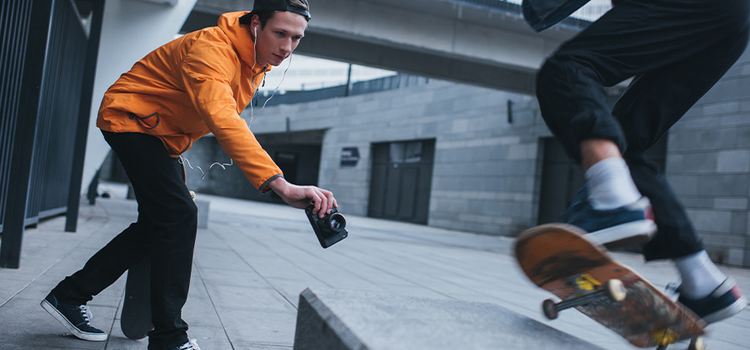
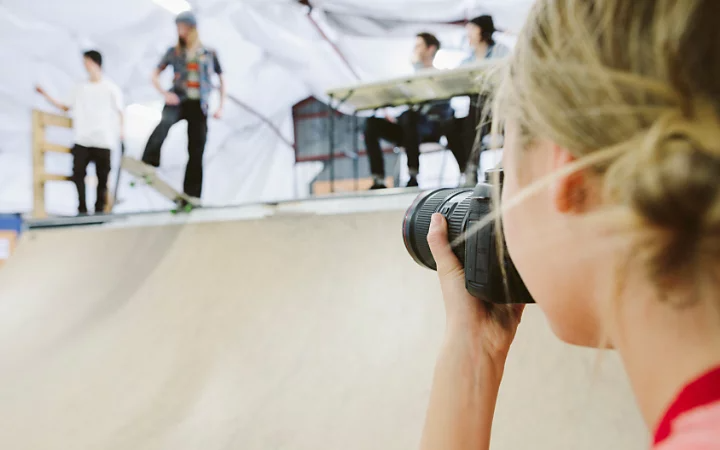
“Passion for the sport comes first — picking up a camera and working on that specific sport. You’ll begin to meet people who love that sport and have reach or influence within that community,” Thompson suggests. “I loved skateboarding, but I wasn’t the best skateboarder. But by the time I picked up a camera and started to express that, I knew a lot of really good skateboarders. That was my pathway into the skate magazines.”
Also, the more knowledge you have about a sport, the better off you’ll be. When you know the rules and strategies, you have a better sense of where to position yourself and where to look. You can anticipate certain plays or moments and be in the right place to catch them.
Study the work of other sports photographers for inspiration. Try to recreate shots you love and start building a portfolio of your best work. Don’t be afraid to do a little fashion photography with athletes. There’s more crossover than you might think — a fashion-style shoot is a great way to showcase an athlete’s gear and personality. If you’re having trouble finding athletes to photograph, keep in mind that most modeling agencies have athletic people in their client list that you can book time with.
2. Get involved in your local sports scene.
When you’re just starting out, you can’t expect to head right to the floor of Madison Square Garden. Start with sports in your local community. For youth sports, reach out to school directors or your state’s athletic association to obtain a media pass. That way, you can meet people and build credibility within the community while you also get access to games.
Another route is to seek out a photographer whose work and career you admire so you can learn from them on a shoot. “I was knocking on the specific door of the photographer that I wanted to work for, like, ‘Let me sweep your floors, let me make your coffee,’” Coughlin recalls. “And then, two months later, he was like, ‘We have this shoot. Come work for two days.’ Then he had four days of work for me. Then we worked 40 days in a row together and it led to me working with him for four years.”
Edit, organize, store, and share photos from anywhere.
Edit, organize, store, and share photos from anywhere.
3. Invest in the right equipment and gear.
For good sports photos, it helps to have a DSLR camera. You need an optical viewfinder so you can track the action, and you should be able to shoot at 6 to 7 frames per second (fps) or more. Focus speed is just as important, as your subjects are going to be in motion. For the same reason, you want as little shutter lag as possible. You want the shutter to open the instant you trigger it.
Battery life and continuous buffering are also important. You don’t want your camera to die in the final minutes of a game. Nor do you want the camera to start buffering in the middle of a play because you shot too many photos too early. Look for a camera that can continuously shoot for several shots before it has to buffer.
For the clearest shots, you can try using a monopod to help you keep the camera steady. With a monopod you can practice panning photography, capturing a moving object while leaving the surrounding scene blurred to convey motion.
4. Get to know your camera and its settings.
Shutter speed is an important camera setting when you’re trying to capture motion. A fast shutter speed is ideal for freezing motion, which is typical for capturing action shots.
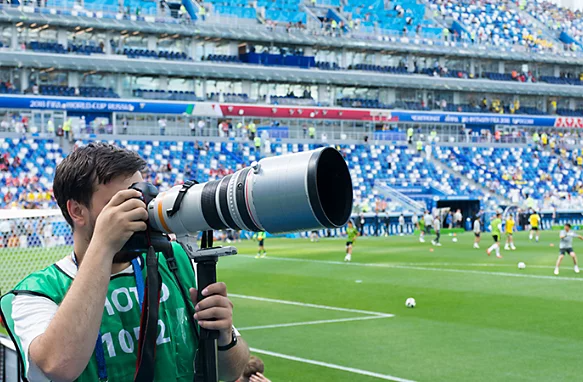
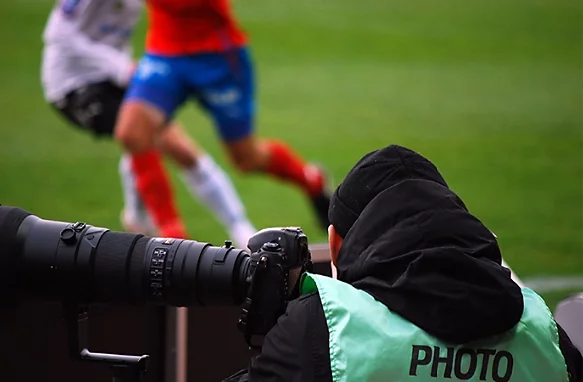
Equipping yourself with camera lenses of varying focal lengths is helpful for photographing live sports. You may need a zoom lens to get closer to the action.
Experiment with depth of field to capture different types of movement. To blur the background and pull a single subject into focus, try a small f-stop, which opens the aperture of your camera wide. Or you can go the opposite route to capture more of the scene around the athlete.
5. Consider branching out into shooting video.
Capture the motion with motion. With video, you can further expand your network and skillset.
Whether you shoot still photos or video, as you gain experience and the confidence that comes with it, you’ll expand your work portfolio and connections in sports. As you grow, you’ll find that all that experience can help you communicate better with clients, art directors, and agencies to supply them with photography that meets their goals or exceeds expectations. Stick with it, and that day-in and day-out practice and execution will pay off big-time on game day.
Whether your goal is capturing live-action photography courtside or entering the editorial side of shooting sports, learning more about this field can help you take the next step on your career path.
You can control how Adobe websites use cookies and similar technologies by making choices below. But note that if you disable cookies and similar technologies entirely, Adobe websites may not function properly.
Cookies are small text files stored by your web browser when you use websites. There are also other technologies that can be used for similar purposes like HTML5 Local Storage and local shared objects, web beacons, and embedded scripts. These technologies help us do things like remembering you and your preferences when you return to our sites, measure how you use the website, conduct market research, and gather information about the ads you see and interact with.
You can make choices in the menu below about what cookies and other technologies you want us to use on Adobe sites when you visit them from this browser. You can always change those choices later by clicking on the Cookie Preferences link at the bottom of the page.
If enabled:
We can improve your experience by tailoring the site and the content to things we think might be of interest
We can better keep track of your preferences — like what language you prefer to use
We will better understand your likely interests so we can provide you more relevant Adobe ads and content on non-Adobe websites and in non-Adobe apps
It will help us improve the performance of our website and those of our partners who use the Adobe Experience Cloud
If disabled:
We won’t be able to remember you from session to session so the experience may not be tailored to your interests
You’ll still have access to the content of the site but certain features that depend on cookies may not function
You’ll still see ads, they just may not be as relevant to you
General information
You can control how Adobe websites use cookies and similar technologies by making choices below. But note that if you disable cookies and similar technologies entirely, Adobe websites may not function properly.
Cookies are small text files stored by your web browser when you use websites. There are also other technologies that can be used for similar purposes like HTML5 Local Storage, web beacons, and embedded scripts. These technologies help us do things like remembering you and your preferences when you return to our sites, measure how you use the website, conduct market research, and gather information about the ads you see and interact with.
You can make choices in the menu below about what cookies and other technologies you want us to use on Adobe sites when you visit them from this browser. You can always change those choices later by clicking on the Cookie Preferences link at the bottom of the page.
If enabled:
We can improve your experience by tailoring the site and the content to things we think might be of interest
We can better keep track of your preferences — like what language you prefer to use
We will better understand your likely interests so we can provide you more relevant Adobe ads and content on non-Adobe websites and in non-Adobe apps
It will help us improve the performance of our website and those of our partners who use the Adobe Experience Cloud
If disabled:
We won’t be able to remember you from session to session so the experience may not be tailored to your interests
We’ll still count your use of our site and services
You’ll still have access to the content of the site but certain features that depend on cookies may not function
You’ll still see ads, they just may not be as relevant to you
Operate the site and core servicesOperate site and measure engagement
Always active
These cookies are required, and they are used to enable the site and related services core functionality. Without them the site could not operate, so they cannot be disabled.
These cookies enable the site and related services’ core functionality and collect statistics about user engagement, such as counting active use to help us understand trends. These cookies cannot be disabled.
Measure performance
These cookies are used to analyze site usage to measure and improve performance. Without them Adobe cannot know what content is most valued and how often unique visitors return to the site, making it hard to improve information we offer to you.
These cookies are used to analyze site usage to measure and improve performance. Without them Adobe cannot know what content is most valued, making it hard to improve information we offer to you.
Extend functionality
These cookies are used to enhance the functionality of Adobe sites such as remembering your settings and preferences to deliver a personalized experience; for example, your username, your repeated visits, preferred language, your country, or any other saved preference.
Personalize advertising
These cookies are used to enable Adobe and our partners to serve ads more relevant to your interests. Without them you will still see ads, but they might not be as relevant to you.