


TABLE OF CONTENTS
The key takeaways from the Adobe Creative Cities Index
The most creative cities in the UK, ranked
Brighton and Hove: The UK’s creative epicentre
Deep dive: The top 5 most creative cities in the UK
The UK cities loved most for their creativity and culture
Brighton and Hove has been named the UK’s most creative city for 2026, beating London by 35 places, in a new study from Adobe Firefly that analyses 50 of the UK’s largest cities.
The Adobe Creative Cities Index scores each city out of 100 across 22 indicators, from museums and libraries to creative agencies and concerts, to find out where the UK’s creative energy is really concentrated. The same study was applied across Europe, where Brighton and Hove placed 2nd overall, only behind Florence, Italy.
Population size is no reliable guide to creativity: some of the UK's smallest cities rank in the top 10, while several of its largest sit in the bottom half.
The UK’s leading locations for culture and creativity are those that are masterclasses in one or two of the metrics we analysed – that could be career opportunities, museum quality, the number of creative retailers, as well as many more.
How the ranking works
Before getting into the results, here’s a short explanation of how they were calculated (see the full methodology at the end of this report for more info!)
The Adobe Creative Cities Index scores the UK’s 50 largest cities out of 100, based on 22 indicators grouped around cultural infrastructure (libraries, museums), creative business (agencies, retailers), employment (creative jobs), entertainment (concerts and shows), tourism (cultural tours) and public art (street art). Data was drawn from sources including Google Maps, TripAdvisor, Glassdoor and Street Art Cities.
Where appropriate, indicators are adjusted for population or geographic area rather than relying on raw totals, allowing cities of different sizes to be compared more fairly - so a small city with a concentrated creative scene can outscore a much bigger one with more in absolute terms (as the report often demonstrates). The same methodology was then applied to a wider study of cities across Europe, so the UK’s results could also be compared internationally.
In the Adobe Creative Cities Index, a “creative city” is one that performs strongly across indicators covering creative employment and businesses, cultural infrastructure, arts and entertainment, tourism, visitor satisfaction and affordability.
The key takeaways from the Adobe Creative Cities Index
A quick snapshot of the research behind the Adobe Creative Cities Index:
- Brighton and Hove is the UK’s most creative city, with a score of 99.06 out of 100
- Florence, Italy, tops the wider European study with a perfect 100/100 score
- Lancaster is the UK’s most loved city for visitor experience, home to the UK’s highest-rated creative retailers and agencies
- London ranks a surprising 36th out of 50 UK cities, behind Cardiff, Edinburgh and Belfast
- City size doesn’t guarantee creativity: smaller cities feature prominently throughout the rankings
- None of the UK’s four capital cities crack the national top five; only Belfast makes the top 10
- The top 50 largest UK cities were analysed across 22 creative and cultural indicators
- Around 2,200 museums were analysed across the UK’s cities
- Nearly 40,000 creative businesses were analysed, including agencies and retailers
- More than 2,500 creative job listings were analysed
The most creative cities in the UK, ranked
Brighton and Hove tops the table by a clear margin, with a score of 99.06 out of 100. That’s high enough that no other city comes even close to matching it, as it dominates in several factors. Below that, the story is much tighter: Exeter and Cambridge take second and third respectively – with just 0.01 point between them – and several mid-sized cities crowd into the top 10 alongside far larger ones.
What stands out most is how little population size predicts a city’s ranking. Carlisle, home to just 110,000 people, sits in the top 10 alongside Glasgow, a city more than five times its size.
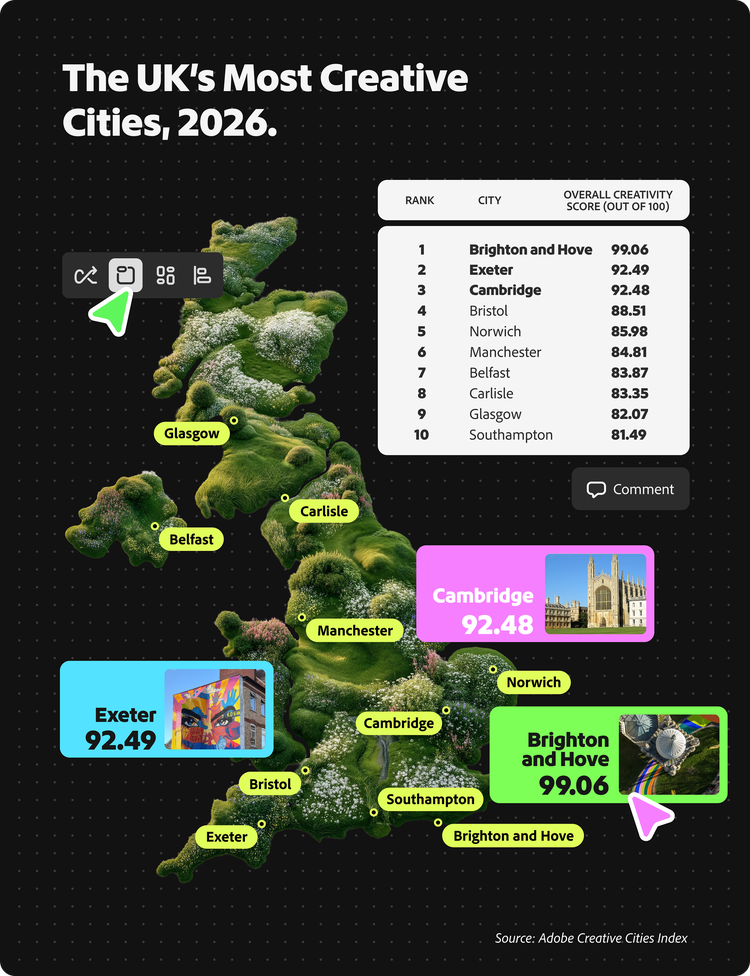
None of the UK’s four capital cities reach the top five – not even London, by far the country’s largest city. Belfast leads the pack among them in 7th place, some way ahead of Edinburgh (11th) and Cardiff (20th), while London trails right down at 36th, with a score of just 63.03.
Brighton and Hove: The UK’s creative epicentre
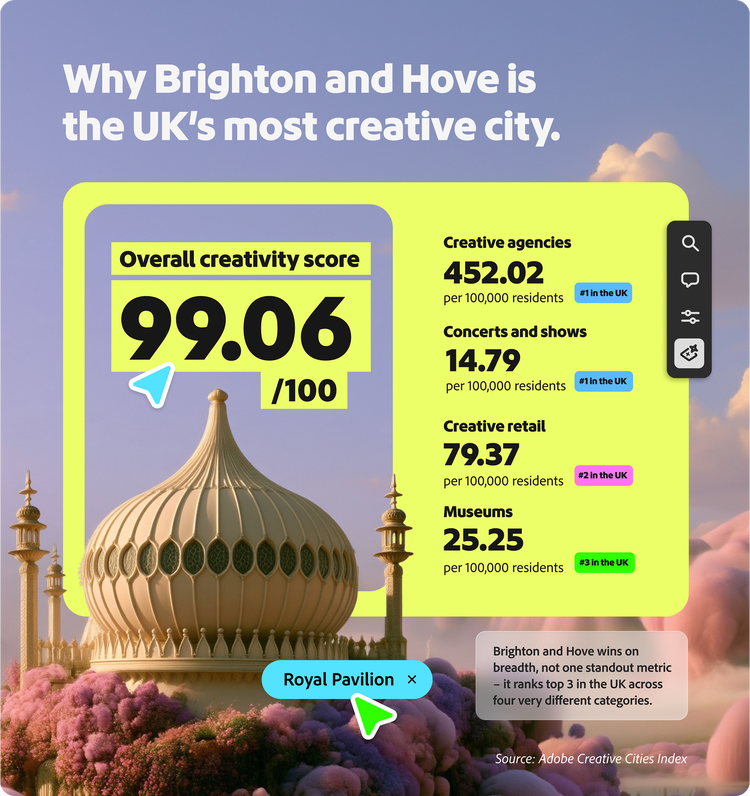
Adobe’s ranking names Brighton and Hove the most creative city in the UK, with a near-perfect score of 99.06 out of 100. Whereas most of the cities in the top 10 earn their position by excelling in one area, Brighton’s imagination and cultural enrichment shines across nearly every category measured.
The clearest signal is its creative agency scene: Brighton and Hove has more than double the concentration of any other UK city, likely fed by its reputation as a creative and tech hub within easy reach of London, and its long-standing pull for independent designers and studios. That same strength carries through entertainment, retail and museums, where it ranks in the top three nationally for each.
The city’s culture is born from deep roots. Brighton Festival has run every spring since 1967 – almost sixty years – making it one of England’s longest-established arts festivals. Additionally, the Brighton Fringe has since become England’s largest arts festival in its own right.
Brighton and Hove’s independent, do-it-yourself streak produced Fatboy Slim (Norman Cook), who returned to the city in the late 1980s to help build its dance music scene from the ground up. In 2002, he held Big Beach Boutique II, a free show on Brighton’s seafront which drew a quarter of a million people. Today’s agency and start-up boom feels like a natural continuation of that same grassroots creative energy.
Key strengths:
- Creative agencies: the highest concentration of any UK city, more than double the second-placed city
- Concerts and shows: also the highest in the UK
- Creative retail: second only to Norwich
- Museums: third highest in the UK, behind York and Edinburgh
Deep dive: The top 5 most creative cities in the UK
2. Exeter
Overall score: 92.49
Exeter’s presence in second place is a story about quality over quantity. With a population of just 131,000 – less than half of Brighton and Hove’s – it punches well above its weight on the strength of its libraries and independent retail scene, rather than sheer scale.
Its libraries are the third most concentrated in the UK, behind only the university cities of Cambridge and Oxford, and among the best-rated anywhere in the country – a sign of a well-served, engaged local reading and learning culture. Its creative retailers rank third nationally too, behind Norwich and Brighton and Hove, suggesting a genuinely thriving independent business scene for a city of its size.
That reading culture has centuries of history behind it. Exeter Cathedral Library has held the Exeter Book since 1072. The manuscript, which was compiled around 970 AD and is the largest surviving collection of Old English poetry anywhere in the world, was recognised by UNESCO in 2016 as a foundation volume of English literature – nearly a thousand years of unbroken custodianship that still shapes the city’s identity as one that takes the written word seriously.
Key strengths:
- Libraries: third highest concentration in the UK, behind only Cambridge and Oxford
- Library rating: second highest in the UK, behind only Carlisle
- Creative retail: third highest in the UK
3. Cambridge
Overall score: 92.48
Cambridge’s third-place finish continues one of British culture’s oldest rivalries: it comfortably out-libraries its old sparring partner Oxford, boasting the highest concentration of libraries of any UK city. That density of learning infrastructure lines up with the city’s deeper identity as a knowledge economy, reinforced by having the UK’s second-highest concentration of creative jobs, behind only Manchester.
Its cultural offering runs deeper still: Cambridge ranks in the UK’s top five for both museums and cultural tours, evidence that its creative strength isn’t confined to its universities but woven into the wider city.
That intellectual pedigree spills over into performance too. Cambridge Footlights, the university’s student comedy club, has staged revues since 1883, and its alumni list reads like a history of British comedy: Peter Cook and Jonathan Miller of Beyond the Fringe, most of Monty Python, and, more recently, Stephen Fry, Hugh Laurie, Emma Thompson, David Mitchell, John Oliver and Olivia Colman all earnt their stripes there.
Few cities can claim to have shaped both the UK’s academic culture and its comedic one so directly.
Key strengths:
- Libraries: the highest concentration of any UK city
- Creative jobs: second highest in the UK, behind only Manchester
- Museums and cultural tours: both rank in the UK’s top five
4. Bristol
Overall score: 88.51
Bristol’s fourth-place finish tells two stories at once: the first is one of live entertainment. It ranks third in the UK for concerts and shows, behind only Brighton and Hove and Oxford, signalling a genuinely active music and events scene, rather than a handful of big venues which mainly host the mainstream.
The other story is written on its walls. Following Banksy’s rise from local graffiti artist to global phenomenon, street art has become part of the city’s identity, and Bristol now ranks fifth in the UK for it – just behind Belfast, Southend-on-Sea, Nottingham and Portsmouth, all cities with their own strong street art traditions.
The artistic scene in Bristol can be found across time and mediums alike. Banksy is widely understood to have started out in Bristol’s underground graffiti scene of the 1980s and 1990s, giving the city’s current street art status genuine history rather than a recent trend. Bristol’s creative identity runs through animation just as strongly.
Aardman Animations, founded in the city in 1972, turned Plasticine into a global export – Wallace and Gromit, Chicken Run and Shaun the Sheep were all made in its Bristol studios – and the studio’s first Oscar, for Creature Comforts in 1990, established the city as a serious animation force years before its street art scene caught up.
Key strengths:
- Concerts and shows: third highest in the UK
- Creative agencies: fourth highest in the UK
- Street art: fifth highest in the UK
5. Norwich
Overall score: 85.98
Norwich rounds out the top five on the strength of a specialism obvious to any visitor to its city centre: it has the highest concentration of independent creative retailers anywhere in the UK, narrowly ahead of Brighton and Hove and Exeter.
This is reflected in its creative business economy more broadly, where Norwich ranks third nationally for the concentration of creative agencies, behind only Brighton and Hove and Winchester.
Norwich’s retail specialism sits alongside a genuinely deep literary heritage. In 2012, it became England’s first UNESCO City of Literature, built in large part on the reputation of the University of East Anglia, home to the UK’s first-ever Creative Writing MA.
Founded in 1970 by Malcolm Bradbury and Angus Wilson, with Ian McEwan as its first graduate, the course has gone on to produce Nobel laureate Kazuo Ishiguro and Booker Prize winner Anne Enright, among others. That literary lineage runs back much further too, to Julian of Norwich, whose 1395 work Revelations of Divine Love is considered the oldest surviving book written in English by a woman.
Key strengths:
- Creative retail: the highest concentration of any UK city
- Creative agencies: third highest in the UK
- Museums: fifth highest in the UK
The UK cities loved most for their creativity and culture
A city’s overall creativity score measures scale and concentration but says little about how much visitors actually enjoy what’s on offer. Looking specifically at average ratings and review volumes across museums, libraries, retailers, agencies, concerts and cultural tours tells a different story about which UK cities’ creative experiences visitors engage with, and rate, most highly.
This secondary “Most Loved” ranking is calculated separately from the main creativity score: it combines each city’s average visitor rating and review-volume intensity across six categories – museums, libraries, retail, creative agencies, concerts and cultural tours – which were then normalised and scaled out of 100 in the same way as the main index.
Because it measures visitor satisfaction rather than creative scale or concentration, a city’s Most Loved score is not directly comparable to its overall creativity score. While Lancaster’s 100/100 score reflects exceptionally strong visitor appreciation of its creative offering, Brighton and Hove’s 99.06/100 main-ranking score reflects its concentration of creative infrastructure and activity.
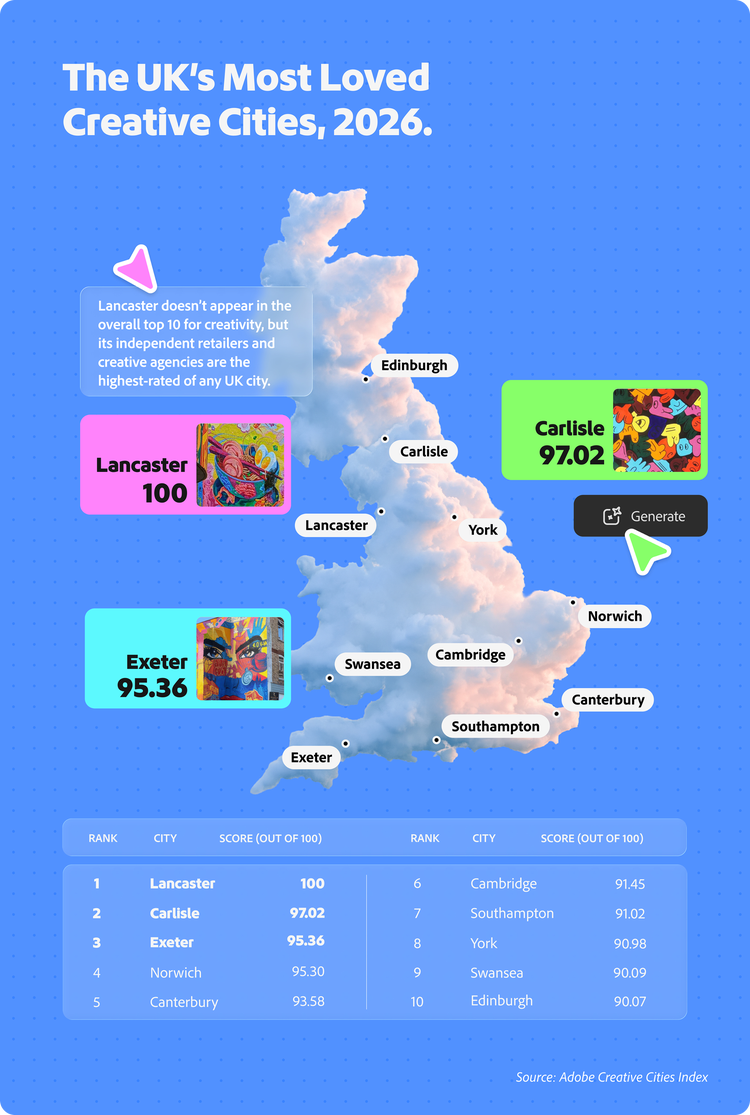
Lancaster tops the most-loved ranking despite not featuring in the UK’s overall top 20 for creativity. It has the highest-rated independent retailers and creative agencies of any UK city, suggesting a small but exceptionally well-run creative economy, even if it can’t match bigger cities on volume.
Carlisle, second on the list, backs up its top 10 creativity ranking with the UK’s highest-rated libraries, a rare case of a city that’s both large in scale and beloved in quality. Southampton and Exeter also stand out here: Southampton shares the UK’s highest average cultural tour rating with Plymouth, while Exeter’s libraries are the second-best rated in the country, behind only Carlisle.
Their appeal is nothing new. Lancaster’s compact centre – a Norman castle, a medieval priory and a Georgian quayside – sits on the doorstep of the Lake District, giving it an easy pull for the Romantic poetry crowd alongside its own visitors.
Carlisle’s border-city history, shaped by two thousand years as a Roman garrison town and its Reiver past, now anchors a growing contemporary arts scene built around The Tullie Museum and an expanding street art trail.
Southampton’s identity, meanwhile, is built on the water: as the departure port for the Titanic in 1912, and the hometown that shaped UK garage star Craig David, its maritime and musical stories both still draw visitors to its waterfront museums today.
Creative trends in the UK
Size doesn’t predict creativity
Across all 50 cities studied, population size makes almost no difference to a city's creativity score – whether a city is large or small has essentially no bearing on how it ranks. Cities of every size appear at every point in the ranking. Carlisle, with just 110,000 residents, outscores Glasgow’s 620,000; Winchester, home to just 127,500 people, has the second-highest concentration of creative agencies in the country. What separates the leaders isn’t how big they are, but how sharply they specialise.
The UK’s capitals underperform their status
None of the UK’s four capital cities crack the national top five, and only Belfast makes the top 10, in 7th. London is the most striking case: the country’s largest city by a huge margin, and home to more creative agencies in absolute terms than anywhere else in the UK, it ranks just 36th once that scale is measured per capita, last of all 50 cities for creative agency concentration, and 47th for creative retail.
Why does London rank only 36th?
London is home to more creative agencies in absolute terms than any other UK city – but once that scale is measured per capita, across a population of nearly nine million, it ranks last of all 50 cities for creative agency concentration, and 47th for creative retail. The gap between London’s raw scale and its per-capita ranking represents what the Adobe Creative Cities Index seeks to uncover: concentration of creativity across the UK. Brighton and Hove packs a similar density of agencies into a fraction of the population.
Britain’s big industrial cities lag their scale
It isn’t only the capital. Several of England’s largest cities outside London – Birmingham, Leeds, Bradford and Coventry among them – place in the bottom half of the ranking despite populations in the hundreds of thousands to over a million. Birmingham, the UK’s second city by population, ranks just 33rd. The pattern suggests that the economic and demographic scale doesn’t automatically translate into a concentrated creative scene.
The rise of creative entrepreneurship outside the biggest cities
Independent creative retailers, from craft shops to record stores, are mostly concentrated not in London or Birmingham, but in mid-sized cities like Norwich and Brighton and Hove. For independent creative businesses looking to accelerate early-stage concept development, tools such as Adobe Firefly can generate a video from a text prompt or generate a new image from an existing image.
Cultural infrastructure continues to drive the rankings
Every city in the UK’s top three has at least one standout piece of cultural infrastructure behind its ranking: Brighton and Hove on creative agencies and entertainment, Exeter on independent retail, and Cambridge on libraries. It’s a reminder that a high creativity ranking tends to be built on a genuine specialism, rather than broad, average performance across the board.
The most creative cities in Europe
How does the UK compare with Europe?
*Note - Adobe analysed the 20 most populated cities in countries from the European Union. Because of this, some cities appearing in the UK’s top were absent from analysis. As scores were determined by comparison to other cities, figures may be adjusted.
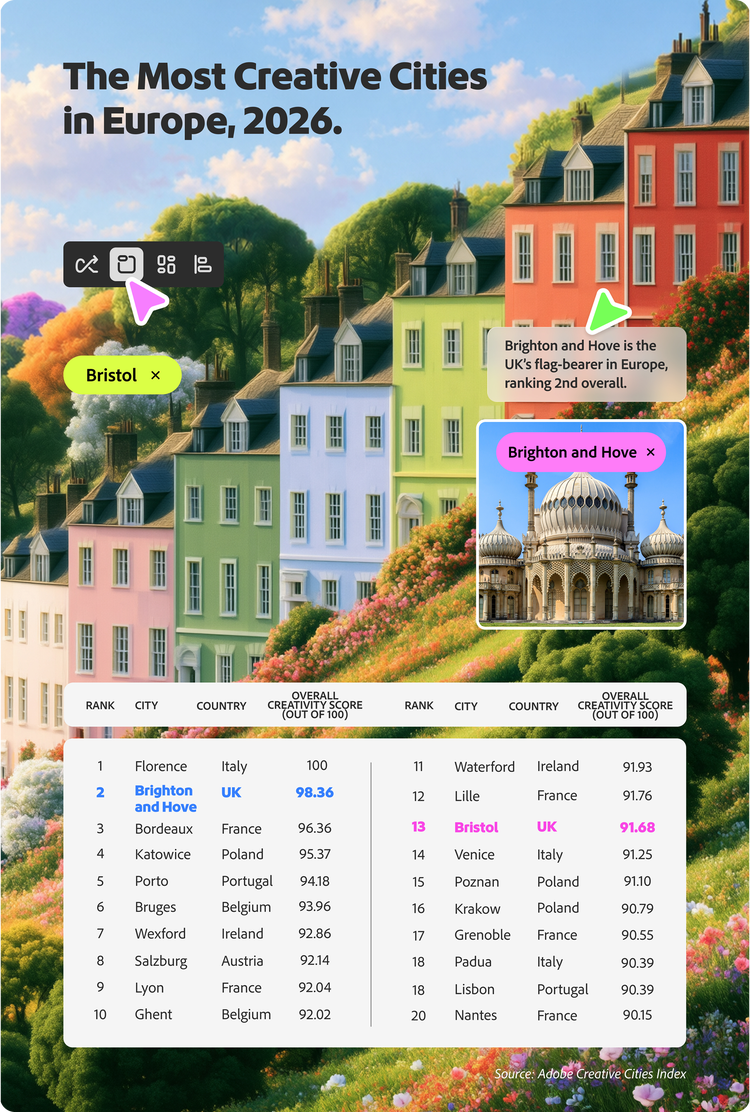
Two UK cities make the European top 20: Brighton and Hove (2nd) and Bristol (13th), with scores of 98.36 and 91.68 out of 100 respectively.
Because scores are calculated relative to the cities included in each ranking, a city’s UK score is not directly comparable to its score in the European comparison. For instance, Brighton and Hove’s 99.06/100 in the UK ranking and 98.36/100 in the European ranking both reflect the same underlying data, just measured against two different sets of competitor cities.
Florence, Italy, takes the number one spot in Europe – and, by extension, ranks among the most creative cities in the world – without leading any single metric outright. It performs consistently well across several instead, including the second-highest concentration of cultural tours in Europe, behind only Dubrovnik, Croatia.
Brighton and Hove’s European performance echoes its UK story: breadth over dominance. It ranks fourth in Europe for creative agency concentration, behind Bertrange (Luxembourg), Domzale (Slovenia) and Nicosia (Cyprus) – proof that its UK-topping agency scene holds up against a much larger field.
Conclusion
On the surface, this index is about numbers and rankings, but the cities that top the list have something else in common: a genuine, often long-standing creative identity that goes deeper than any single metric.
Brighton’s current do-it-yourself energy echoes the same spirit that built its festival scene and launched Fatboy Slim; Cambridge’s academic pedigree sits alongside a comedy lineage stretching back to 1883; Norwich’s independent shops trade in a city UNESCO once named England’s first City of Literature.
Ultimately, this index shows that creative concentration in the UK is not monopolised by its largest cities. Brighton, Exeter, Cambridge, Norwich and Carlisle all demonstrate how smaller and mid-sized cities can build highly concentrated creative ecosystems alongside – and, on the indicators measured here, sometimes outperform – much larger urban centres.
FAQ
What is the most creative city in the UK in 2026?
Brighton and Hove, with a score of 99.06 out of 100 in the Adobe Creative Cities Index.
What are the UK’s 10 most creative cities?
In order: Brighton and Hove (99.06), Exeter (92.49), Cambridge (92.48), Bristol (88.51), Norwich (85.98), Manchester (84.81), Belfast (83.87), Carlisle (83.35), Glasgow (82.07) and Southampton (81.49).
Why is Brighton and Hove the UK’s most creative city?
It has the highest concentration of creative agencies of any UK city – more than double the second-placed city – along with the highest concentration of concerts and shows, and top three rankings for creative retail and museums.
Where does London rank?
36th out of 50. London has more creative agencies in absolute terms than any other UK city but ranks last for agency concentration and 47th for creative retail once the population is taken into account.
What is the UK’s most creative capital city?
Belfast, in 7th place overall – the highest-ranked of the UK’s four capital cities.
Which UK city is best for creative jobs?
Manchester has the highest concentration of creative job listings in the UK, with Cambridge second.
Which city has the most creative agencies per capita?
Brighton and Hove, with more than double the concentration of the second-placed city.
Which city has the highest concentration of creative retailers?
Norwich, narrowly ahead of Brighton and Hove and Exeter.
How was the Adobe Creative Cities Index calculated?
Adobe scored the UK’s 50 largest cities out of 100 across 22 indicators covering cultural infrastructure, creative business, employment, entertainment, tourism and public art, with most indicators adjusted for population so cities of different sizes could be compared fairly.
When was the data collected?
All data was collected in July 2026.
Methodology
This study includes a localised ranking of the most creative cities in the UK, as well as a wider European ranking of the 20 most populated cities in each country included in the study. The same methodology and indicators were applied across both rankings to ensure the results could be compared consistently.
For the UK ranking, 50 cities were analysed using 22 indicators covering creative employment, creative businesses and shops, cultural infrastructure, arts and entertainment, visitor satisfaction and affordability.
The European ranking applies the same factors and scoring methodology to the 20 most populated cities in each participating country, allowing cities across different countries to be compared consistently.
Data was collected from Street Art Cities, Google Maps, Glassdoor and TripAdvisor, alongside population and geographic boundary data. Where relevant, OpenStreetMap boundaries were used to ensure a consistent geographic area was applied across different data sources.
The indicators measure factors including street art, libraries, creative shops, creative employment, museums, concerts and shows, and cultural tours. Depending on the indicator, data points include density, availability, ratings, review volumes, and affordability.
Indicator
Source
Measurement
Weight
Street art
Street Art Cities
Works per 10 sq km
9%
Libraries - density
Google Maps
Locations per 100k residents
5%
Libraries - rating
Google Maps
Average rating
9%
Libraries - reviews
Google Maps
Reviews per location per 100k residents
1%
Creative retail - density
Google Maps
Locations per 100k residents
9%
Creative retail - rating
Google Maps
Average rating
5%
Creative retail - reviews
Google Maps
Reviews per location per 100k residents
1%
Creative agencies - density
Google Maps
Locations per 100k residents
9%
Creative agencies - rating
Google Maps
Average rating
5%
Creative agencies - reviews
Google Maps
Reviews per location per 100k residents
1%
Creative jobs
Glassdoor
Listings per 100k residents
9%
Museums - density
TripAdvisor
Locations per 100k residents
2%
Museums - rating
TripAdvisor
Average rating
9%
Museums - reviews
TripAdvisor
Reviews per location per 100k residents
1%
Museums - affordability
TripAdvisor
% budget-friendly
0%
Concerts & shows - density
TripAdvisor
Events per 100k residents
2%
Concerts & shows - rating
TripAdvisor
Average rating
9%
Concerts & shows - reviews
TripAdvisor
Reviews per location per 100k residents
1%
Cultural tours - density
TripAdvisor
Tours per 100k residents
2%
Cultural tours - rating
TripAdvisor
Average rating
9%
Cultural tours - reviews
TripAdvisor
Reviews per location per 100k residents
1%
Cultural tours - price
TripAdvisor
Median price (USD per adult)
0%
*Figures were rounded to the nearest whole percent and may not sum up exactly to 100% as a result.
Population figures were used to calculate per-capita measures, while geographic boundaries were used for location-based indicators. This allows cities of different sizes to be compared more fairly.
The values were combined to produce an overall creativity score out of 100, with cities ranked from highest to lowest based on their final score.
As the study relies on data from multiple third-party platforms, coverage and categorisation may vary between cities. Some creative businesses, workers, venues, or activities may therefore not be captured. Ratings, reviews and affordability measures are also platform-specific and should be considered indicators rather than definitive measures.
Finally, scores are relative to the cities included in each ranking rather than based on an absolute benchmark. Rankings may therefore change as data, platform coverage, or indicator weightings evolve.
All the data was collected in July 2026 and is correct as of then.


