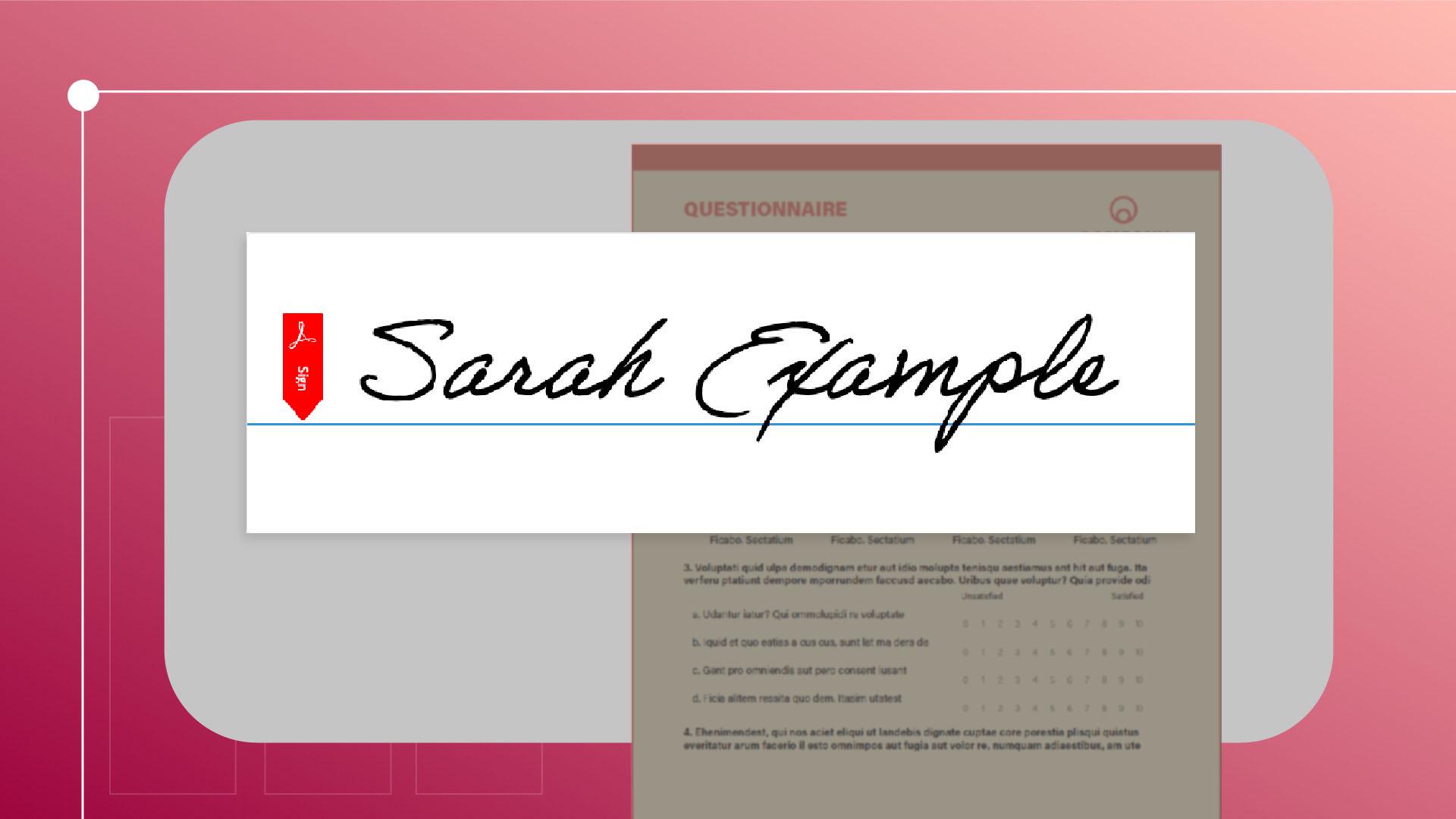
Complete and sign an unformatted document and request e-signatures from others.
Introduction
Adobe Acrobat offers an incredibly handy option to electronically sign PDF documents, as well as allowing you to ask for signatures when sending files to others.
I'm Sarah, and I'm going to show you how to use Acrobat's Fill & Sign Tool.
Add a signature or initials
With the document open, the E-Sign Tool can be found in the bar at the top.
It is also available in the All tools sidebar under Fill & Sign.
To sign a document, click on Add signature.
On this pop-up, we can type in our name and change the font style to one we like.
We also have the option to write our signature in ourselves using the mouse, or we can upload an image of it.
Once we are satisfied, we'll click Apply.
If we need to sign something using just our initials, we can go through the same process in Add initials.
Now we can click on the signature we just added and place it into the document.
If we need to adjust the size, we can do so by selecting the Font size buttons, or we can adjust it manually.
And to remove it, use the Trashcan icon.
Complete forms with additional marks
If we're filling out a form that needs more marks than just a signature, we have the option to add things like a cross mark, a check mark, a filled in dot, a mark to circle something, or a mark to cross something out.
And if we need to enter any text, we can use the Text Tool.
Once everything has been filled out, we can click this button to save a read-only copy of the document.
That will include Adobe Acrobat's Sign certification.
Request signatures from others
If we need to request a signature from someone else, we will use the Request e-signatures button.
On the pop-up, enter the email addresses of the recipients, then specify where you need them to sign.
Click anywhere in the document to place a form field.
Using the menu options, we can specify which type of field this needs to be.
Once we're finished, we'll click Send.
When the recipients open the document, they'll be able to use the same Fill & Sign tools to complete the request.
Using these tools makes electronic signing a breeze, getting important documents where they need to go quicker than ever.
I hope this helps.
Note: Stock assets provided are for practice purposes only. See terms.
What you’ll learn
Add a signature or initials
You can type your name, draw your signature, or upload an image of it. Once applied, you can place it anywhere on the page and resize or delete it as needed.
Complete forms with additional marks
You can add check marks, cross marks, circles, fill dots, and text to complete forms.
Request signatures from others
Use Request E-Signatures to send the PDF to other signers and specify where they need to sign. Recipients can finish the document using the same Fill & Sign tools.
You can control how Adobe websites use cookies and similar technologies by making choices below. But note that if you disable cookies and similar technologies entirely, Adobe websites may not function properly.
Cookies are small text files stored by your web browser when you use websites. There are also other technologies that can be used for similar purposes like HTML5 Local Storage and local shared objects, web beacons, and embedded scripts. These technologies help us do things like remembering you and your preferences when you return to our sites, measure how you use the website, conduct market research, and gather information about the ads you see and interact with.
You can make choices in the menu below about what cookies and other technologies you want us to use on Adobe sites when you visit them from this browser. You can always change those choices later by clicking on the Cookie Preferences link at the bottom of the page.
If enabled:
We can improve your experience by tailoring the site and the content to things we think might be of interest
We can better keep track of your preferences — like what language you prefer to use
We will better understand your likely interests so we can provide you more relevant Adobe ads and content on non-Adobe websites and in non-Adobe apps
It will help us improve the performance of our website and those of our partners who use the Adobe Experience Cloud
If disabled:
We won’t be able to remember you from session to session so the experience may not be tailored to your interests
You’ll still have access to the content of the site but certain features that depend on cookies may not function
You’ll still see ads, they just may not be as relevant to you
General information
You can control how Adobe websites use cookies and similar technologies by making choices below. But note that if you disable cookies and similar technologies entirely, Adobe websites may not function properly.
Cookies are small text files stored by your web browser when you use websites. There are also other technologies that can be used for similar purposes like HTML5 Local Storage, web beacons, and embedded scripts. These technologies help us do things like remembering you and your preferences when you return to our sites, measure how you use the website, conduct market research, and gather information about the ads you see and interact with.
You can make choices in the menu below about what cookies and other technologies you want us to use on Adobe sites when you visit them from this browser. You can always change those choices later by clicking on the Cookie Preferences link at the bottom of the page.
If enabled:
We can improve your experience by tailoring the site and the content to things we think might be of interest
We can better keep track of your preferences — like what language you prefer to use
We will better understand your likely interests so we can provide you more relevant Adobe ads and content on non-Adobe websites and in non-Adobe apps
It will help us improve the performance of our website and those of our partners who use the Adobe Experience Cloud
If disabled:
We won’t be able to remember you from session to session so the experience may not be tailored to your interests
We’ll still count your use of our site and services
You’ll still have access to the content of the site but certain features that depend on cookies may not function
You’ll still see ads, they just may not be as relevant to you
Operate the site and core servicesOperate site and measure engagement
Always active
These cookies are required, and they are used to enable the site and related services core functionality. Without them the site could not operate, so they cannot be disabled.
These cookies enable the site and related services’ core functionality and collect statistics about user engagement, such as counting active use to help us understand trends. These cookies cannot be disabled.
Measure performance
These cookies are used to analyze site usage to measure and improve performance. Without them Adobe cannot know what content is most valued and how often unique visitors return to the site, making it hard to improve information we offer to you.
These cookies are used to analyze site usage to measure and improve performance. Without them Adobe cannot know what content is most valued, making it hard to improve information we offer to you.
Extend functionality
These cookies are used to enhance the functionality of Adobe sites such as remembering your settings and preferences to deliver a personalized experience; for example, your username, your repeated visits, preferred language, your country, or any other saved preference.
Personalize advertising
These cookies are used to enable Adobe and our partners to serve ads more relevant to your interests. Without them you will still see ads, but they might not be as relevant to you.
Personalize advertising
These cookies are used to enable Adobe and our partners to serve ads more relevant to your interests. Without them you will still see ads, but they might not be as relevant to you.