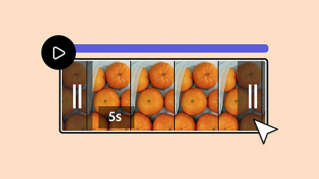
Audio can take your video to the next level. Make your voice heard. Give your video some life.
What you’ll need
Practice in the app
Introduction
How to add audio to a video.
Use an audio you already have by clicking Media,
Adding audio from uploaded files
select Audio and click Upload from device.
To record your own voiceover,
Recording voiceovers directly in the editor
click the Record voiceover button, activate your mic and click Start recording.
After the countdown, speak and then click Finish Recording.
You can also add an Adobe Stock audio file.
Using Adobe stock audio in your video
Search for the style of audio you need, preview the options and click the audio you want to add to your video.
Editing audio timing and adjusting volume
Now let's edit the audio to time it to your video.
Drag the edge of the audio Timeline to shorten or lengthen how long the audio plays.
Adjust the Volume with the sliding bar.
Adobe Express Keep creating.
Add audio to video
Adding audio to a video is a snap. Once you’ve loaded a video into the Editor, here are three simple ways you can make it happen.
Upload from device
To use audio you already have, click the Media icon on the left side of the screen, select the Audio tab, and click the “Upload from device” button.
Record a voiceover
If you want to create a verbal recording to add to your video, click the “Record voiceover” button, activate your mic, and go for it.
Use one of our tunes
You can always use an Adobe Stock audio file. Find something specific using the search bar, or click play on one of the options already visible to listen to a sample. Click the audio sample itself to automatically add it to the Editor.
Edit your audio file
Now that you’ve got video and audio in the Editor, sync them the way you want.
Click the audio timeline and drag the audio bar handles to adjust audio and video start and end times.
Use the sliding bar in the Volume menu to change the sound level of your audio.
You can control how Adobe websites use cookies and similar technologies by making choices below. But note that if you disable cookies and similar technologies entirely, Adobe websites may not function properly.
Cookies are small text files stored by your web browser when you use websites. There are also other technologies that can be used for similar purposes like HTML5 Local Storage and local shared objects, web beacons, and embedded scripts. These technologies help us do things like remembering you and your preferences when you return to our sites, measure how you use the website, conduct market research, and gather information about the ads you see and interact with.
You can make choices in the menu below about what cookies and other technologies you want us to use on Adobe sites when you visit them from this browser. You can always change those choices later by clicking on the Cookie Preferences link at the bottom of the page.
If enabled:
We can improve your experience by tailoring the site and the content to things we think might be of interest
We can better keep track of your preferences — like what language you prefer to use
We will better understand your likely interests so we can provide you more relevant Adobe ads and content on non-Adobe websites and in non-Adobe apps
It will help us improve the performance of our website and those of our partners who use the Adobe Experience Cloud
If disabled:
We won’t be able to remember you from session to session so the experience may not be tailored to your interests
You’ll still have access to the content of the site but certain features that depend on cookies may not function
You’ll still see ads, they just may not be as relevant to you
General information
You can control how Adobe websites use cookies and similar technologies by making choices below. But note that if you disable cookies and similar technologies entirely, Adobe websites may not function properly.
Cookies are small text files stored by your web browser when you use websites. There are also other technologies that can be used for similar purposes like HTML5 Local Storage, web beacons, and embedded scripts. These technologies help us do things like remembering you and your preferences when you return to our sites, measure how you use the website, conduct market research, and gather information about the ads you see and interact with.
You can make choices in the menu below about what cookies and other technologies you want us to use on Adobe sites when you visit them from this browser. You can always change those choices later by clicking on the Cookie Preferences link at the bottom of the page.
If enabled:
We can improve your experience by tailoring the site and the content to things we think might be of interest
We can better keep track of your preferences — like what language you prefer to use
We will better understand your likely interests so we can provide you more relevant Adobe ads and content on non-Adobe websites and in non-Adobe apps
It will help us improve the performance of our website and those of our partners who use the Adobe Experience Cloud
If disabled:
We won’t be able to remember you from session to session so the experience may not be tailored to your interests
We’ll still count your use of our site and services
You’ll still have access to the content of the site but certain features that depend on cookies may not function
You’ll still see ads, they just may not be as relevant to you
Operate the site and core servicesOperate site and measure engagement
Always active
These cookies are required, and they are used to enable the site and related services core functionality. Without them the site could not operate, so they cannot be disabled.
These cookies enable the site and related services’ core functionality and collect statistics about user engagement, such as counting active use to help us understand trends. These cookies cannot be disabled.
Measure performance
These cookies are used to analyze site usage to measure and improve performance. Without them Adobe cannot know what content is most valued and how often unique visitors return to the site, making it hard to improve information we offer to you.
These cookies are used to analyze site usage to measure and improve performance. Without them Adobe cannot know what content is most valued, making it hard to improve information we offer to you.
Extend functionality
These cookies are used to enhance the functionality of Adobe sites such as remembering your settings and preferences to deliver a personalized experience; for example, your username, your repeated visits, preferred language, your country, or any other saved preference.
Personalize advertising
These cookies are used to enable Adobe and our partners to serve ads more relevant to your interests. Without them you will still see ads, but they might not be as relevant to you.
Personalize advertising
These cookies are used to enable Adobe and our partners to serve ads more relevant to your interests. Without them you will still see ads, but they might not be as relevant to you.