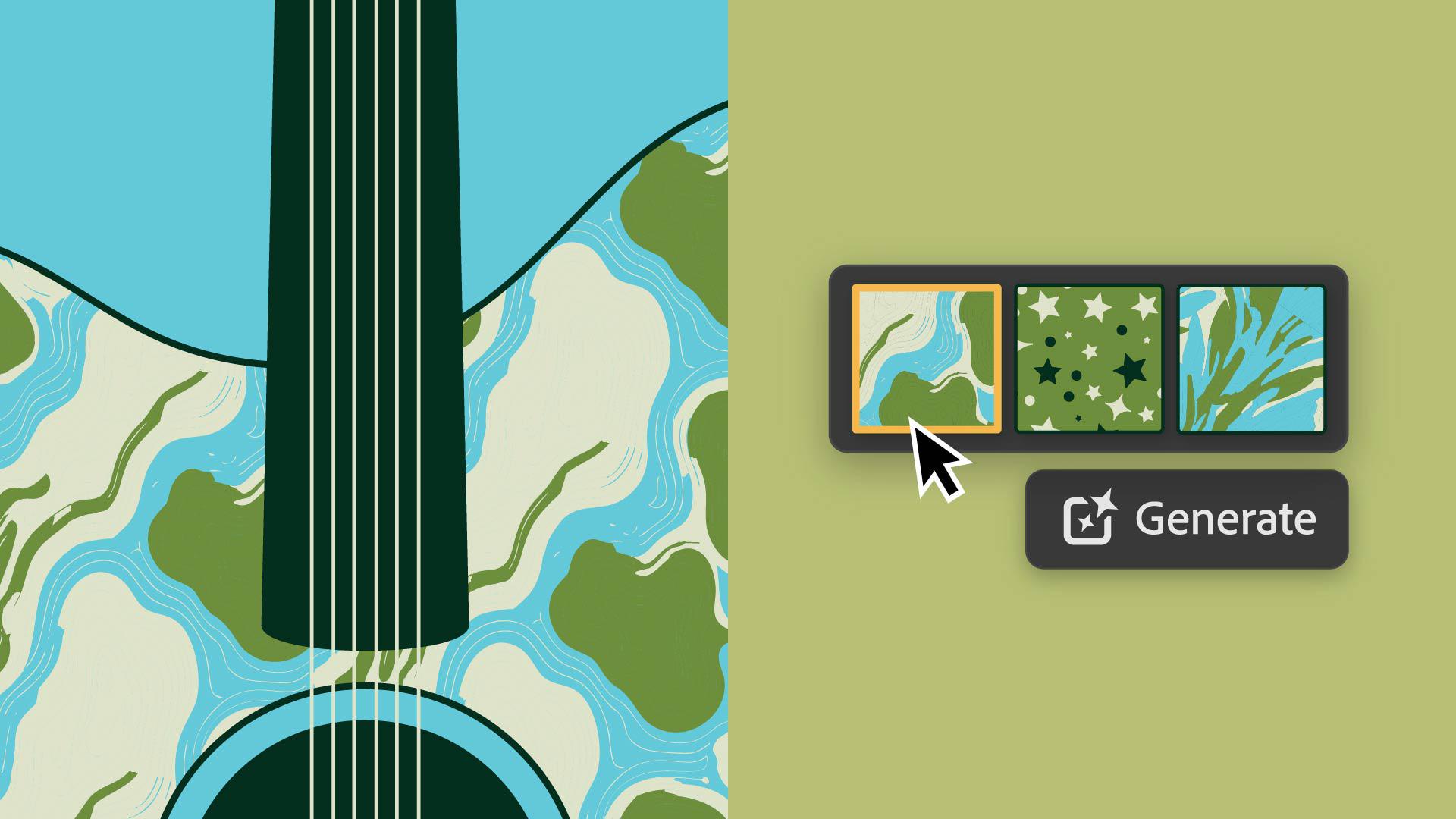
What happens when you have a design or illustration and feel like it needs a little something extra?
With Adobe Illustrator and Generate Patterns, you'll be able to add extra character and texture to your artwork.
Hi, my name is Carra Sykes, I'm an Illustrator, Designer, and Creative Director.
In this video, I'm going to show you how I add a little extra personality to a band poster using Generate Patterns in Adobe Illustrator.
Generating patterned texture for poster artwork
I work here on a poster design for my friend's band, but I feel like there's something missing from the overall look and feel.
Let's select the guitar and go to Object, Pattern, Generate Patterns.
I'm going to pick a style effect.
We're going to do Flat Design.
And then I'll put in my prompt, dark and large starry sky.
Generate and see what we get.
Exploring and selecting pattern variations
I'm going to click through the options that were generated and see if there's anything that we think we want to use.
Looking through these I want to explore a little further.
So I'm going to click Generate again.
Let's check these out.
I think I'm going to go back to this one.
I really like this one.
Now, this pattern isn't in the palette of the poster,
Customizing patterns to match style and color palette
so I'm going to double-click on the swatch, so I can edit it.
I'm going to go in and edit some of the elements in my own style, like the star.
I'm going to make it like a star, I like to draw.
And then I'm going to edit the color, so it fits the palette of the poster.
I'm going to add a few more elements and there we go.
Now I'm going to rescale the pattern by going to Object, Transform, Scale...
But don't transform the objects, only the patterns.
We are making about 120%, make it a little bit bigger.
I'm happy with how this looks, but I'm ready to explore further.
So let's do a different prompt and see what happens.
Creating alternative pattern concepts
Let's do, topographic map.
My friend really likes to hike.
I'll go in and I'll make it about 3 colors.
Yes.
And then pick one of my palette colors, and then I'll go into Effects and do the Geometric style, and also let's do a Flat Design style.
Let's generate.
Wow, these are a bit more complex.
Look at the colors on these.
Let's generate a few more.
Oh let's see this one right here.
Oh that's really cool.
I like the texture of this one.
I'm going to update the colors to be the palette of the poster and then I'm going to change the Scale of the pattern and also the Rotation with Transform.
That's so cool.
I really like this one.
Now that I know I can move quickly to ideate and customize these patterns, I'll generate and refine a few more patterns to share with my friend.
Iterating and refining patterns for final designs
I might even play with a few color palettes and use Generative Recolor.
I like to use some of the prompts that already exist, because sometimes I have trouble figuring out what prompt I would use.
Have some fun with Adobe's Generate Patterns to add some extra personality and texture to your work.
Again, my name is Carra Sykes, and I cannot wait to see what you create.
What you'll learn
Create multiple pattern options
Add texture and visual interest to your illustration. Use Generate Patterns to explore pattern options with prompts and styles.
Refine patterns to fit your illustration
Adjust pattern elements and colors to match your illustration’s style. This makes the pattern uniquely yours.
Create multiple color versions of your poster
Use Generative Recolor to experiment with different color palettes. It's a great way to provide extra options for your client.
You can control how Adobe websites use cookies and similar technologies by making choices below. But note that if you disable cookies and similar technologies entirely, Adobe websites may not function properly.
Cookies are small text files stored by your web browser when you use websites. There are also other technologies that can be used for similar purposes like HTML5 Local Storage and local shared objects, web beacons, and embedded scripts. These technologies help us do things like remembering you and your preferences when you return to our sites, measure how you use the website, conduct market research, and gather information about the ads you see and interact with.
You can make choices in the menu below about what cookies and other technologies you want us to use on Adobe sites when you visit them from this browser. You can always change those choices later by clicking on the Cookie Preferences link at the bottom of the page.
If enabled:
We can improve your experience by tailoring the site and the content to things we think might be of interest
We can better keep track of your preferences — like what language you prefer to use
We will better understand your likely interests so we can provide you more relevant Adobe ads and content on non-Adobe websites and in non-Adobe apps
It will help us improve the performance of our website and those of our partners who use the Adobe Experience Cloud
If disabled:
We won’t be able to remember you from session to session so the experience may not be tailored to your interests
You’ll still have access to the content of the site but certain features that depend on cookies may not function
You’ll still see ads, they just may not be as relevant to you
General information
You can control how Adobe websites use cookies and similar technologies by making choices below. But note that if you disable cookies and similar technologies entirely, Adobe websites may not function properly.
Cookies are small text files stored by your web browser when you use websites. There are also other technologies that can be used for similar purposes like HTML5 Local Storage, web beacons, and embedded scripts. These technologies help us do things like remembering you and your preferences when you return to our sites, measure how you use the website, conduct market research, and gather information about the ads you see and interact with.
You can make choices in the menu below about what cookies and other technologies you want us to use on Adobe sites when you visit them from this browser. You can always change those choices later by clicking on the Cookie Preferences link at the bottom of the page.
If enabled:
We can improve your experience by tailoring the site and the content to things we think might be of interest
We can better keep track of your preferences — like what language you prefer to use
We will better understand your likely interests so we can provide you more relevant Adobe ads and content on non-Adobe websites and in non-Adobe apps
It will help us improve the performance of our website and those of our partners who use the Adobe Experience Cloud
If disabled:
We won’t be able to remember you from session to session so the experience may not be tailored to your interests
We’ll still count your use of our site and services
You’ll still have access to the content of the site but certain features that depend on cookies may not function
You’ll still see ads, they just may not be as relevant to you
Operate the site and core servicesOperate site and measure engagement
Always active
These cookies are required, and they are used to enable the site and related services core functionality. Without them the site could not operate, so they cannot be disabled.
These cookies enable the site and related services’ core functionality and collect statistics about user engagement, such as counting active use to help us understand trends. These cookies cannot be disabled.
Measure performance
These cookies are used to analyze site usage to measure and improve performance. Without them Adobe cannot know what content is most valued and how often unique visitors return to the site, making it hard to improve information we offer to you.
These cookies are used to analyze site usage to measure and improve performance. Without them Adobe cannot know what content is most valued, making it hard to improve information we offer to you.
Extend functionality
These cookies are used to enhance the functionality of Adobe sites such as remembering your settings and preferences to deliver a personalized experience; for example, your username, your repeated visits, preferred language, your country, or any other saved preference.
Personalize advertising
These cookies are used to enable Adobe and our partners to serve ads more relevant to your interests. Without them you will still see ads, but they might not be as relevant to you.
Personalize advertising
These cookies are used to enable Adobe and our partners to serve ads more relevant to your interests. Without them you will still see ads, but they might not be as relevant to you.