See how to create realistic paint effects in Adobe Photoshop that catch light — and a lot of attention. Try DJ’s tutorial.
Introduction
My name is DJ Javier and I'm an artist and graphic designer.
Adding depth with Bevel and Emboss effects
I completed artwork in Fresco to be able to bring it into Photoshop.
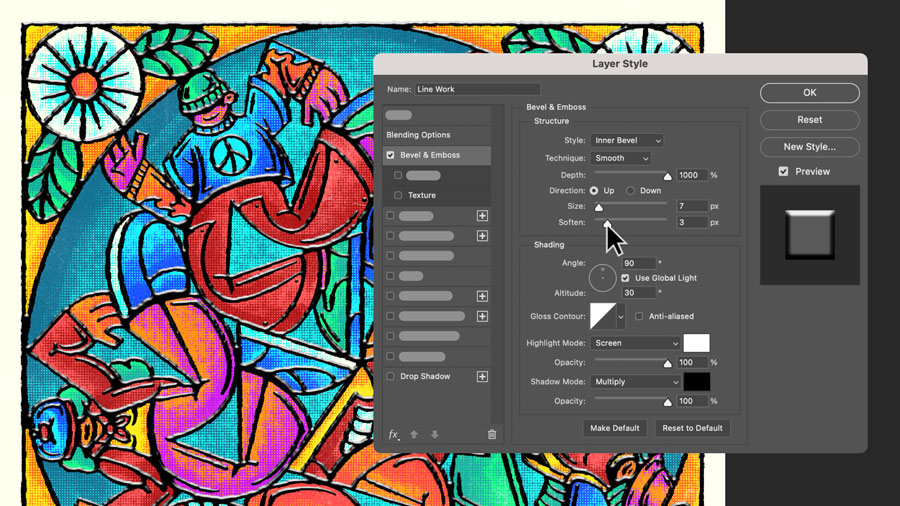
I took the line work and I used the Bevel and Emboss tool to then create a bit of like a 3D effect, as if it was actually handmade or hand carved.
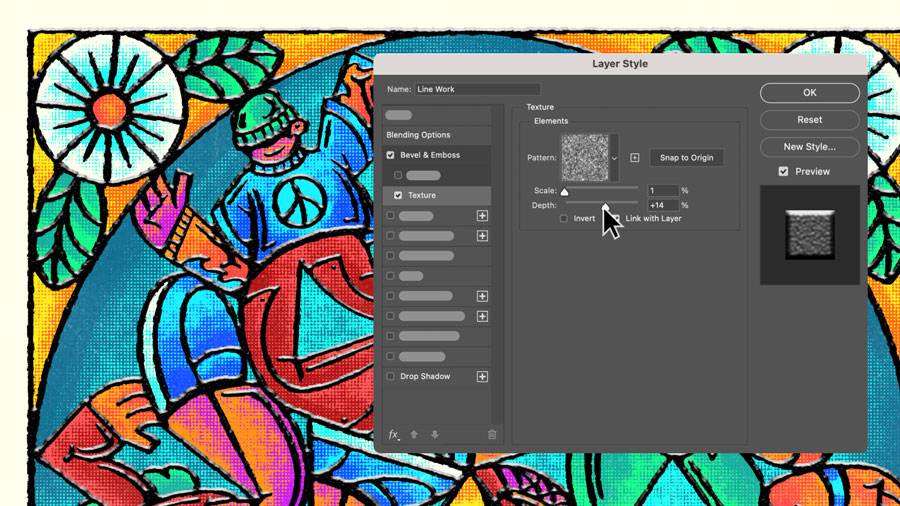
Added a bit of texture on top of that.
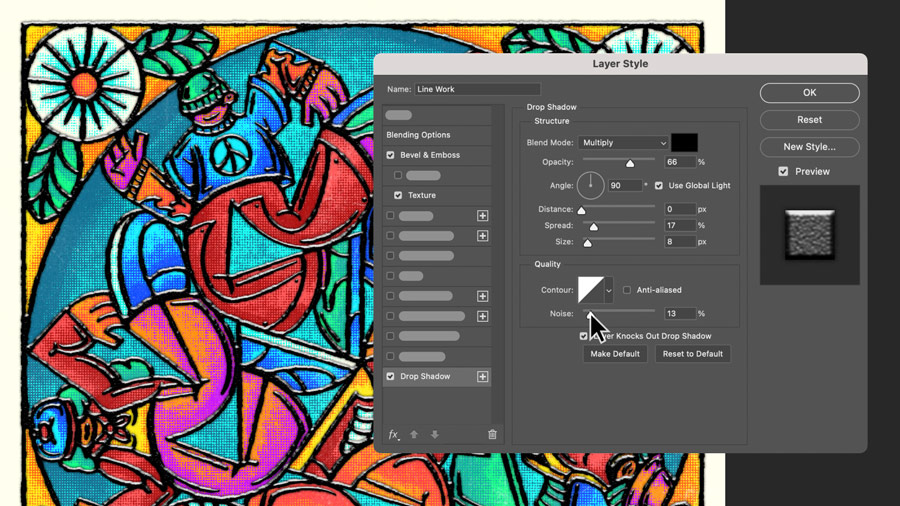
And then I added a drop shadow as well
Enhancing artwork with texture, shadows, and blend modes
onto the line work with a bit of noise.
The use of the Bevel and Emboss tool really reminds me of how I like to paint.
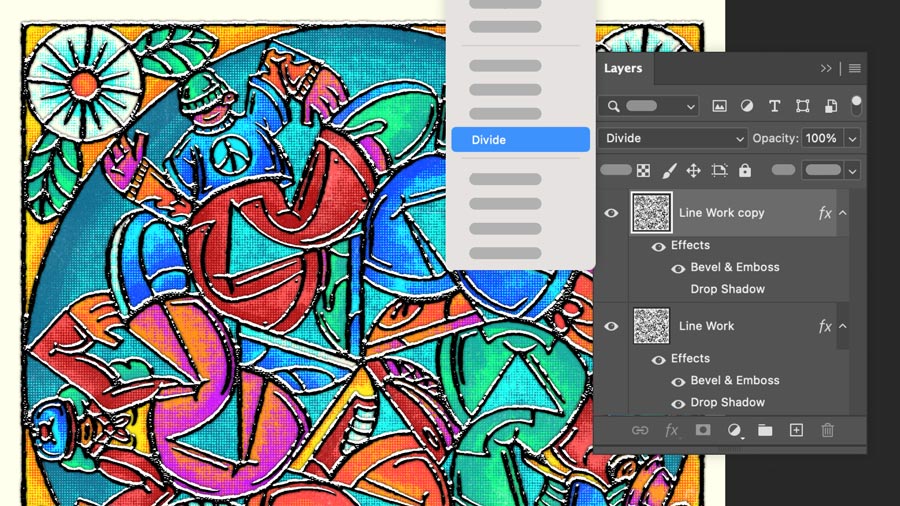
I took the top layer, duplicated it, and I set the blend mode to divide.
From there, I was able to then give the work like a bit more life and a bit more character.
Finding new creative possibilities in familiar tools
Being able to discover new things within your old tools, it really puts the power back in your hands creatively.
1 Raise the bar.
You can bevel and emboss anything in Adobe Photoshop, even outlines. Head to the Layers panel (Window > Layers), select the Line Work layer and select the fx icon. Choose Bevel and Emboss to create a raised effect.
2 Time to shine.
Make simple black lines appear more liquid by adjusting the Blending Options. Choose Bevel and Emboss then select Texture. DJ chose Water–Pool Pattern to give his lines a wet-look shine.
3 Drop in a Drop Shadow.
For a real 3D effect, you need a shadow. In Blending Options, select Drop Shadow. Adjust the opacity, angle, and distance to create line work you can almost reach out and touch.
4 Add a real highlight.
Create more defined highlights by duplicating your Line Work layer. In the Layers panel, drag it to the + sign, then change the Blending Mode of the duplicate to Divide, and toggle off the Drop Shadow. Keep playing with colors, textures, and gradients to make it your own.
You can control how Adobe websites use cookies and similar technologies by making choices below. But note that if you disable cookies and similar technologies entirely, Adobe websites may not function properly.
Cookies are small text files stored by your web browser when you use websites. There are also other technologies that can be used for similar purposes like HTML5 Local Storage and local shared objects, web beacons, and embedded scripts. These technologies help us do things like remembering you and your preferences when you return to our sites, measure how you use the website, conduct market research, and gather information about the ads you see and interact with.
You can make choices in the menu below about what cookies and other technologies you want us to use on Adobe sites when you visit them from this browser. You can always change those choices later by clicking on the Cookie Preferences link at the bottom of the page.
If enabled:
We can improve your experience by tailoring the site and the content to things we think might be of interest
We can better keep track of your preferences — like what language you prefer to use
We will better understand your likely interests so we can provide you more relevant Adobe ads and content on non-Adobe websites and in non-Adobe apps
It will help us improve the performance of our website and those of our partners who use the Adobe Experience Cloud
If disabled:
We won’t be able to remember you from session to session so the experience may not be tailored to your interests
You’ll still have access to the content of the site but certain features that depend on cookies may not function
You’ll still see ads, they just may not be as relevant to you
General information
You can control how Adobe websites use cookies and similar technologies by making choices below. But note that if you disable cookies and similar technologies entirely, Adobe websites may not function properly.
Cookies are small text files stored by your web browser when you use websites. There are also other technologies that can be used for similar purposes like HTML5 Local Storage, web beacons, and embedded scripts. These technologies help us do things like remembering you and your preferences when you return to our sites, measure how you use the website, conduct market research, and gather information about the ads you see and interact with.
You can make choices in the menu below about what cookies and other technologies you want us to use on Adobe sites when you visit them from this browser. You can always change those choices later by clicking on the Cookie Preferences link at the bottom of the page.
If enabled:
We can improve your experience by tailoring the site and the content to things we think might be of interest
We can better keep track of your preferences — like what language you prefer to use
We will better understand your likely interests so we can provide you more relevant Adobe ads and content on non-Adobe websites and in non-Adobe apps
It will help us improve the performance of our website and those of our partners who use the Adobe Experience Cloud
If disabled:
We won’t be able to remember you from session to session so the experience may not be tailored to your interests
We’ll still count your use of our site and services
You’ll still have access to the content of the site but certain features that depend on cookies may not function
You’ll still see ads, they just may not be as relevant to you
Operate the site and core servicesOperate site and measure engagement
Always active
These cookies are required, and they are used to enable the site and related services core functionality. Without them the site could not operate, so they cannot be disabled.
These cookies enable the site and related services’ core functionality and collect statistics about user engagement, such as counting active use to help us understand trends. These cookies cannot be disabled.
Measure performance
These cookies are used to analyze site usage to measure and improve performance. Without them Adobe cannot know what content is most valued and how often unique visitors return to the site, making it hard to improve information we offer to you.
These cookies are used to analyze site usage to measure and improve performance. Without them Adobe cannot know what content is most valued, making it hard to improve information we offer to you.
Extend functionality
These cookies are used to enhance the functionality of Adobe sites such as remembering your settings and preferences to deliver a personalized experience; for example, your username, your repeated visits, preferred language, your country, or any other saved preference.
Personalize advertising
These cookies are used to enable Adobe and our partners to serve ads more relevant to your interests. Without them you will still see ads, but they might not be as relevant to you.
Personalize advertising
These cookies are used to enable Adobe and our partners to serve ads more relevant to your interests. Without them you will still see ads, but they might not be as relevant to you.